

Introduction to AI Agents: The Evolution of Autonomy
Think of an AI agent as a shift from software that waits to software that acts. Unlike a standard ChatGPT session where you supply a prompt and get text back, an agent uses a Large Language Model (LLM) as a central reasoning engine—a "brain" capable of navigating ambiguity.
Instead of just predicting the next word, an agent employs the Cognitive Trinity:
Planning: Breaking complex goals into manageable steps.
Memory: Retaining context over time.
Tool Use: interacting with APIs, databases, or the web.
The Architectural Shift
We are moving away from rigid, single-prompt interactions toward long-running, autonomous workflows.
Scripted Software: Deterministic. It follows a strict "If X, then Y" logic. The user is responsible for managing the process.
Agentic Architectures: Non-deterministic. You define the outcome, and the agent figures out the process, orchestrating its own actions to solve the problem.
Market Context: This leap in capability is driving massive industry growth, projected to surge from $6.8 billion in 2024 to nearly $200 billion by 2034.
The Anatomy of an AI Agent: Core Components
When you strip away the hype, an autonomous agent isn't a single magical entity—it's a system of four distinct modules working in concert. Think of this architecture as the "body" that supports the AI's "brain."
Here is how the anatomy breaks down:
Agent Core (LLM): This is the central reasoning engine. It interprets the user's intent and orchestrates the other components. It’s the decision-maker that decides what needs to be done next.
Memory: Just like us, agents need context. We divide this into Short-term memory (in-context learning for immediate tasks) and Long-term memory (using vector databases like Pinecone or FAISS to store and retrieve persistent data).
Planning: Intelligence requires strategy. In this module, the agent uses techniques like Chain of Thought (CoT) to decompose complex, abstract goals into a step-by-step checklist.
Tools: These are the agent's "hands." This layer enables the model to transcend its training data by actively calling APIs, executing code, or searching the web to perform real-world actions.
Reasoning Patterns: ReAct and Plan-and-Execute
The ReAct Loop
At its core, agentic reasoning often relies on the ReAct (Reason + Act) framework. Think of this as the agent's internal monologue: it generates a "reasoning trace," performs a specific action, observes the output, and repeats. This interleaving prevents the model from blindly guessing.
Here is the conceptual logic:
while task_is_incomplete:
    thought = agent.think("To answer X, I first need data from Y.")
    action = agent.select_tool("database_query", query="Y")
    observation = tools.execute(action)
    # The agent analyzes the observation to refine the next thought
Moving Beyond Single Loops
While React is intuitive, it struggles with context crowding. As tool definitions and history pile up, the model's performance degrades.
To solve this, we use Plan-and-Execute patterns. By strictly separating the planning module from the execution module, you reduce the immediate cognitive load on the LLM. Research indicates that switching to this separated architecture can boost accuracy on complex tasks from ~85% to 92%.
Pro Tip: Always implement Self-Reflection. Enabling the agent to "critique" its previous steps allows it to catch errors and correct course before the user ever sees a wrong answer.
Memory Management: Short-Term vs. Long-Term Storage
Think of the LLM as the CPU: it handles the reasoning, but it’s stateless by default. To create a cohesive agent, you need memory to persist context. We typically architect this in layers, similar to how human cognition works.
The Core Divide: Context vs. Storage
Short-term memory is essentially "in-context learning." It lives entirely within the model's context window (the prompt). It's immediate and high-fidelity, but it's expensive and ephemeral.
Long-term memory decouples storage from the model. We use vector databases (like Pinecone or FAISS) to store semantic embeddings, retrieving only the relevant facts via RAG (Retrieval-Augmented Generation) when needed.
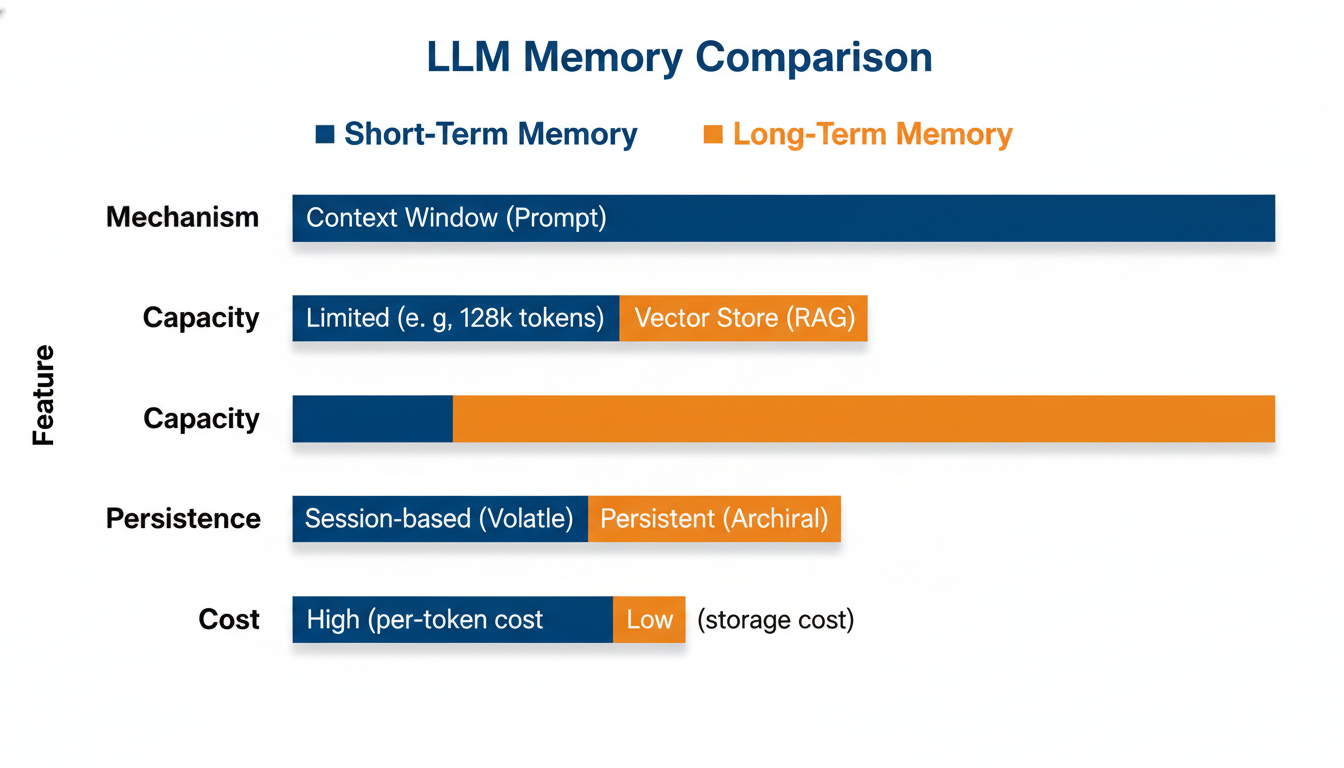
FeatureShort-Term Memory Long-Term Memory Mechanism Context Window (Prompt)Vector Store (RAG)Capacity Limited (e.g., 128k tokens)Virtually Infinite Persistence Session-based (Volatile)Persistent (Archival)Cost High (per-token cost)Low (storage cost)
Advanced Memory Structures
As we move toward complex orchestration, two other memory types become critical:
Archival Memory: This acts as the agent's library—vast stores of static documents and manuals that provide deep domain expertise without clogging the context window.
Shared Memory: In multi-agent systems (like CrewAI or AutoGen), agents need a "shared whiteboard." This allows a researcher agent to pass findings to a writer agent without redundant API calls or hallucinations.
The Agent Framework Landscape: LangChain, CrewAI, and AutoGen
Choosing Your Stack
If you're stuck deciding on a stack, you aren't alone. The ecosystem is crowded, but for most production-grade applications, the choice usually comes down to the specific level of abstraction you need.
Here is how the heavyweights compare:
LangChain & LangGraph: This is for builders who need total control. It provides the most granular building blocks for creating stateful, cyclic workflows, allowing you to define complex logic loops that linear chains just can't handle.
CrewAI: Think of this as "management-as-a-service." It is a process-driven framework designed to orchestrate role-based collaborative 'crews'. It handles the delegation logic between personas so you don't have to write it from scratch.
Microsoft AutoGen: Historically the go-to for conversational multi-agent systems that handle automated code execution.
Pro Tip: Be aware that Microsoft moved AutoGen into maintenance mode in late 2025. New enterprise development is consolidating around the unified Microsoft Agent Framework.
Building Your Agent: A Seven-Step Development Lifecycle
The Roadmap: From Concept to Deployment
Building an autonomous agent isn't magic; it's an engineering discipline. You can't just throw a prompt at an LLM and expect reliable results. To move from a cool demo to a production-ready tool, we follow a structured, seven-step lifecycle.
Define Purpose: Pin down the specific intent. Is this a researcher, a coder, or a support bot?
Select Tools: Identify the "hands"—APIs and functions—the agent needs to execute tasks.
Gather Internal Data: Curate the knowledge base. Remember, garbage in, garbage out applies doubly here.
Design Architecture: Map out the cognitive flow (e.g., ReAct or Plan-and-Execute) and memory strategy.
Core Development: Build the logic, integrating the cognitive trinity: planning, memory, and tools.
Test and Iterate: Verify performance against benchmarks. For complex workflows, aim for a latency target of P50 < 3s to ensure a smooth user experience.
Monitor and Optimize: Keep a close watch on recursive LLM calls. Without limits, these can lead to runaway costs and infinite loops.
Pro Tip: Start with simple prompt chaining before moving to fully autonomous loops. Incremental complexity saves you from debugging "black box" behavior later.
Multi-Agent Systems (MAS): The Enterprise Standard
The era of the solitary chatbot is effectively over. We're seeing a massive pivot toward Multi-Agent Systems (MAS), which now account for over 66% of enterprise implementations.
Why accept the extra complexity? It comes down to reliability. A lead orchestrator managing specialized sub-agents can deliver performance gains of nearly 90% over standalone models. By assigning distinct personas, we stop asking one LLM to be a generalist and start building a team of specialists.
Key Orchestration Patterns
To make this work, we rely on specific architectural flows:
Consensus: Multiple agents generate outputs and "vote" on the best result. This is critical for high-stakes error reduction where hallucinations aren't an option.
Producer-Reviewer: One agent generates the work, while a second agent—prompted specifically for critique—reviews it. The loop continues until quality standards are met.
Efficiency Note: Beyond accuracy, these architectures are actually cheaper at scale. Using stateful transfers during handoffs can reduce redundant LLM calls by 40–50%.
Security, Ethics, and Legal Challenges
Navigating the Risk Landscape
Here’s the paradox: while 79% of organizations report adopting AI agents, nearly 95% struggle to demonstrate clear ROI. We call this the GenAI Divide. It’s often not a failure of technology, but a hesitation born of risk.
Opening your infrastructure to autonomous agents creates new attack vectors. We are seeing a rise in data poisoning—where corrupted training data skews decision-making—and jailbreaking, where users manipulate an agent's logic to bypass safety guardrails.
However, the most immediate danger isn't technical; it's legal.
⚠️ The Air Canada Precedent In a landmark 2024 ruling, a tribunal held Air Canada liable for misinformation provided by its chatbot regarding bereavement fares.
The airline attempted to argue that the agent was a "separate legal entity" responsible for its own actions. The tribunal flatly rejected this defense. The lesson is clear: Companies are fully accountable for their agents' hallucinations.
Regulators are catching up, too. The EU AI Act now explicitly targets systems capable of deception or manipulation. As you design your agents, remember that compliance and guardrails aren't just "nice-to-haves"—they are now your primary defense against liability.
The Future of Agents: 2025 and Beyond
As we look toward 2025, the honeymoon phase for AI agents is officially over. We are moving from experimental sandboxes to the messy, demanding reality of enterprise scale. The industry focus is shifting entirely from "what can it do?" to "can it do it reliably, every single time?"
Here is the trajectory we are seeing for the agentic market:
The Rise of ACIs: We are moving toward 'Agent-Computer Interfaces' (ACI). Just as humans need good UX, agents need well-documented, standardized tools to ensure reliability and stop hallucinating capability.
The Cost Reality Check: CIOs are facing a harsh truth—many have underestimated deployment costs by up to 1,000%. The hidden price tag isn't the LLM; it is the massive data preparation and continuous maintenance required to keep agents smart.
Ubiquity by 2028: Projections indicate that 33% of enterprise software will feature built-in agentic capabilities within four years, up from less than 1% today.
Production over Pilots: The era of the "cool demo" is dead. Success is now exclusively defined by crossing the chasm from fragile pilot phases to scaled, production-ready autonomous systems.