
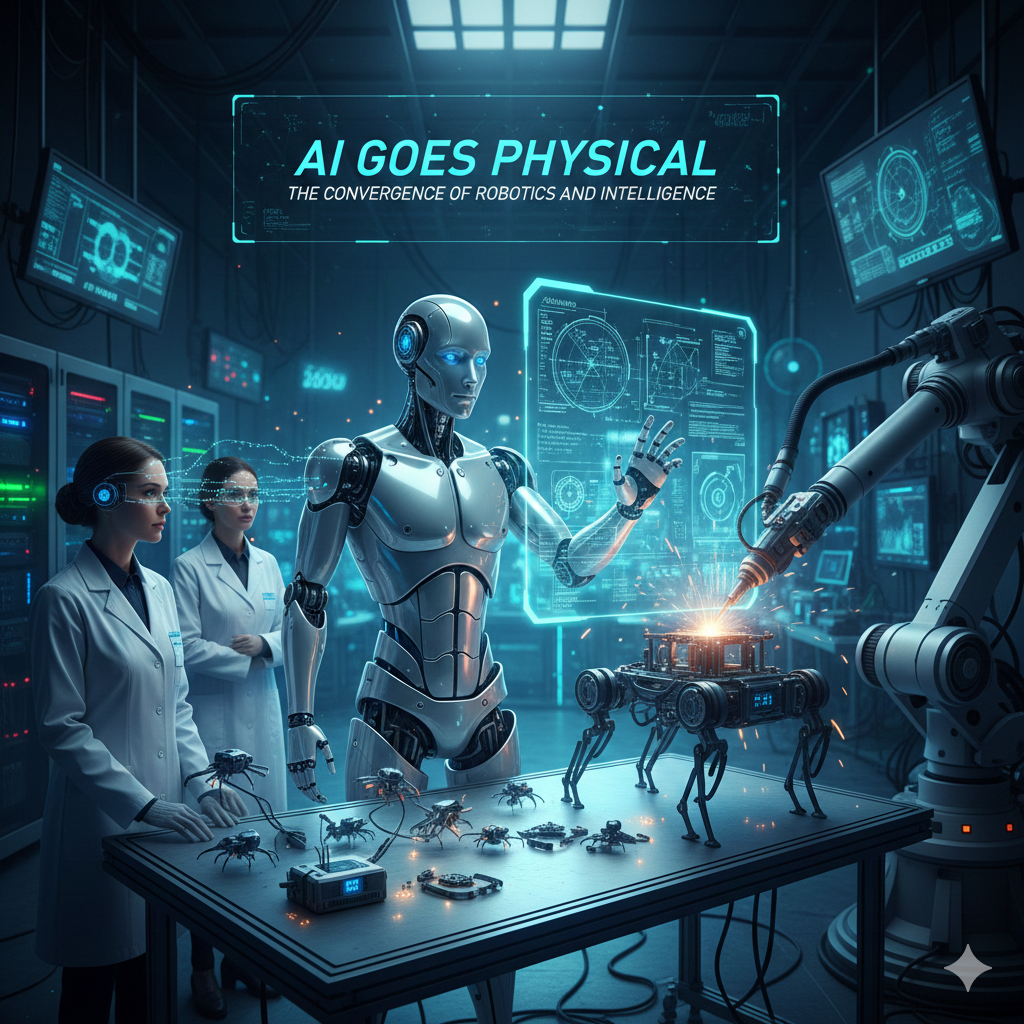
For the last three years, the world has been mesmerized by a "ghost in the machine" that can write poetry and code with human-level fluency. But we are now entering a second act where that ghost is finally finding its body, moving from the ethereal realm of pixels and text into the gritty reality of the three-dimensional world.
This is the dawn of Physical AI, a paradigm shift where intelligence is no longer just a digital consultant but a physical actor that can perceive, reason, and act within unstructured environments. Unlike the generative AI revolution of the early 2020s, which focused on manipulating information, this new era is grounded in the laws of physics and the requirement for real-time responsiveness.
The Ghost Gets a Body: What is Physical AI?
To understand Physical AI, we have to look past the traditional definition of a "robot." For decades, industrial robots were essentially high-precision statues—powerful machines that performed the same movement in a cage, oblivious to anything that wasn't part of their pre-programmed script.
Physical AI, or embodied intelligence, refers to a system where the "brain" and the "body" are deeply integrated. These systems acquire data through advanced sensors, process it through reasoning models, and execute actions via actuators in a continuous feedback loop.
This transition is an inflection point for industrial markets. According to recent reports from Citi Research, we are seeing an era of abundant capital and maturing technology that is finally allowing AI-enabled edge devices to grow at double-digit percentages.
The Conceptual Shift from Digital to Embodied
In the digital world, an error is a hallucination in a text box; in the physical world, an error is a broken arm or a damaged assembly line. This means Physical AI must be "grounded" in spatial relationships and real-time physics.
We are moving away from siloed views of computing. Leading institutions like Carnegie Mellon University are now teaching engineers to approach problems from a broad perspective that integrates mechatronics with neural networks.
The VLA Revolution: Teaching Robots to Think and Do
The most significant software breakthrough in this convergence is the rise of Vision-Language-Action (VLA) models. If Large Language Models (LLMs) taught machines to talk, VLA models are teaching them to understand instructions and execute physical movements simultaneously.
A Vision-Language-Action model acts as a unified "policy" for the robot. Instead of having separate code for "seeing a cup" and "moving the hand," a VLA model allows the robot to take a prompt like "pick up the blue mug" and translate it directly into motor commands.
Why Multimodal Models Matter
Research into models like RoboMamba shows that robots can now achieve impressive reasoning and manipulation skills with minimal fine-tuning. These models leverage "visual common sense," allowing a machine to understand that a glass bottle is fragile or that a heavy box requires a firmer grip.
By 2025, the development of efficient VLA models has enabled robots to perform mobile manipulation—tasks where the robot must move through a room while simultaneously interacting with objects. This is a massive leap from the fixed-base robots of the past.
The Humanoid Form Factor: Why Now?
While robots can take many shapes, the humanoid form is currently attracting the most attention and investment. The logic is simple: we built the world for ourselves. Our stairs, door handles, and tools are designed for a two-legged, two-armed creature with a specific height and reach.
Companies like Tesla, Figure AI, and 1X are racing to commercialize general-purpose humanoids. We are seeing a transition from pilot programs in controlled labs to large-scale production expected to hit full stride by 2026.
Leading Players in the Race
Tesla’s Optimus Gen 2 is perhaps the most famous example, aiming for a price point around $30,000 to assist in manufacturing and eventually home automation. Meanwhile, startup 1X is already delivering its NEO robot to homes, focusing on safe, human-centric design.
These machines aren't just cool gadgets; they are economic necessity. As productivity gains plateau and labor shortages persist in manufacturing and caregiving, Physical AI offers a "labor augmentation" strategy that could reshape global GDP.
The "Digital Twin" and the Simulation-First Approach
You cannot train a robot the same way you train a chatbot. You can't let a million-dollar robot "guess" how to walk ten billion times in the real world—it would destroy itself in minutes. This is where high-fidelity physics simulation comes in.
NVIDIA has become a cornerstone of this industry through platforms like Isaac Sim and Omniverse. These "digital twins" allow developers to train robots in a virtual world that perfectly mimics gravity, friction, and light.
Training at Warp Speed
In a simulation, a robot can "live" ten thousand lifetimes in a single afternoon. Once the robot masters a task in the virtual world, the "policy" is transferred to the physical machine—a process known as Sim-to-Real.
This approach solves the problem of data scarcity in Physical AI. While the internet provides endless text for LLMs, high-quality physical data is rare, making synthetic data from simulations the fuel for the next generation of robots.
The Hardware Breakthroughs: Feeling the World
Intelligence is useless if the "body" is clumsy. Two critical hardware components are currently undergoing a revolution: tactile sensing and advanced actuators.
The Sense of Touch
Humans rely heavily on touch to manipulate objects without looking at them. To give robots this same capability, Meta FAIR and GelSight recently released the Digit 360 sensor.
This artificial fingertip can perceive the world with human-level sensitivity, capturing micron-level details and omnidirectional deformations. When a robot can "feel" the slip of a glass or the texture of a fabric, its ability to perform delicate tasks—like surgery or electronics assembly—increases exponentially.
Agile Movement with QDD Actuators
Movement requires a balance of power and agility. Most modern agile robots, like the MIT Mini Cheetah, utilize Quasi-Direct Drive (QDD) actuators.
These actuators provide high torque-to-weight ratios and "back drivability," meaning the robot can absorb impacts and react to external forces without snapping its gears. This technology is growing at an 18.9% CAGR, proving that the mechanical "muscles" of robots are finally catching up to their digital "brains."
Powering the Machine: The Battery Challenge
If a humanoid robot is to work an eight-hour shift, it needs a massive amount of energy stored in a small, lightweight package. Most current robots use standard Lithium-ion batteries, but the industry is looking toward solid-state batteries as the ultimate solution.
Solid-state technology offers higher energy density and improved safety, which is crucial for machines operating in close proximity to humans. Reports suggest that humanoid robots could drive a 1500x growth in demand for these next-generation batteries by 2035.
Safety, Regulation, and the Human Element
As AI moves into our physical spaces, safety becomes the paramount concern. We are seeing a major overhaul in international safety standards, with the ISO 10218-1:2025 update providing strict guidelines for industrial robots.
Furthermore, the EU AI Act is introducing a risk-based framework that classifies many autonomous robots as "high-risk." This ensures that as we deploy these systems, they remain trustworthy, human-centric, and accountable.
The "Red Flag" Law Metaphor
History often repeats itself. In 1861, the UK passed a law requiring a person to walk in front of every car with a red flag because the technology was so new and frightening.
We are currently in the "red flag" phase of robotics regulation. While some rules might seem conservative today, they provide the predictable legal foundation necessary for companies to invest billions in the real-world implementation of Physical AI.
Conclusion: The Next Great Platform
The convergence of AI and robotics is not just another tech trend; it is the realization of the computer as an active participant in human life. We are moving from a world where we go to computers to a world where computers come to us.
The challenges are significant—from solving the "sim-to-real" gap to perfecting the energy density of solid-state cells. However, the trajectory is clear. As the "ghost" of AI finds its home in the hardware of tomorrow, the boundary between the digital and physical will continue to blur.
By 2026, the arrival of general-purpose humanoids in our factories and homes will likely be remembered as the "App Store moment" for the physical world. The question is no longer whether robots will be present in our lives, but how we will build a future that harmoniously integrates their intelligence with our own.