
Is MCP Failing? The Hidden Crisis in AI Context Management
The Model Context Protocol (MCP) arrived with the promise of being the "USB-C for AI"—a universal standard to plug any Large Language Model (LLM) into any data source. The vision was elegant: connect your favorite model to your database, your Slack, and your file system, and watch it become an omniscient agent.
But after months of integrating MCP servers and building agentic workflows, a crack has appeared in the foundation. It isn’t a bug in the code or a flaw in the protocol itself. The problem is Context Management, and it is silently killing the performance of "smart" agents.
If you have ever felt that your AI agent gets dumber the more tools you give it, you aren't alone. Here is why the current approach to MCP is hitting a wall—and what we need to do to fix it.
The "More is Less" Paradox
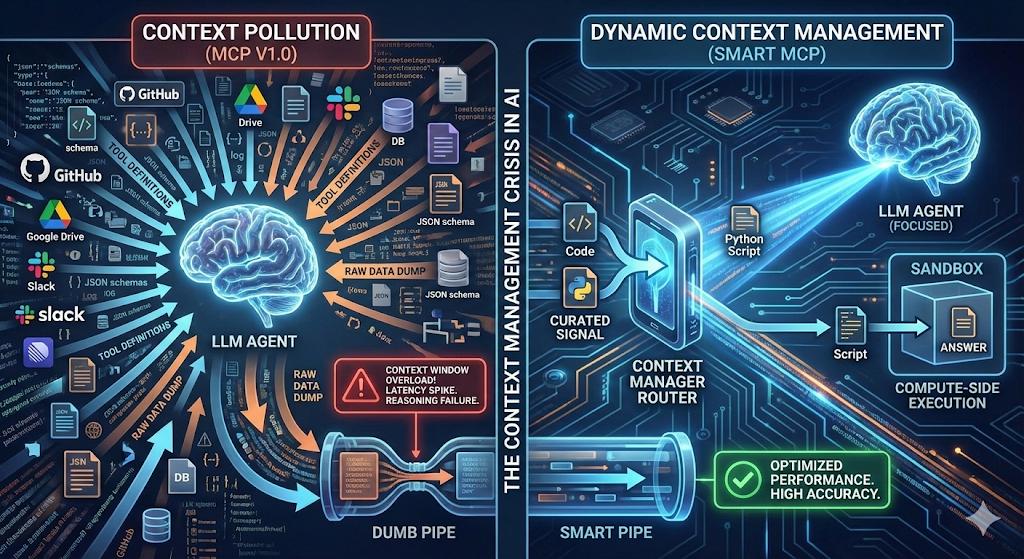
The default implementation of MCP encourages a "kitchen sink" approach. You spin up an MCP server for GitHub, another for Google Drive, and another for Linear. Each server broadcasts a list of available tools to the LLM.
Theoretically, this makes the AI powerful. In practice, it suffocates it.
Every single tool definition—its name, description, and schema—must be loaded into the LLM's context window (its short-term memory). When you attach five MCP servers, you might be feeding the model hundreds of lines of JSON schema before you even ask a question.
I learned this the hard way: Context Pollution is real.
Latency Spikes: The model has to process massive system prompts containing every possible tool definition on every turn.
Reasoning Degradation: When an LLM is presented with 50 diverse tools, its ability to select the right one diminishes. It starts hallucinating tool parameters or simply refuses to use them because the "noise" of the tool definitions overpowers the "signal" of your prompt.
The Inefficiency of the "Chat Loop"
The second failure point isn't just about tool definitions; it's about data flow.
In a standard MCP workflow, if you ask an agent to "analyze the last 100 log files," the agent often tries to read the logs, pass the text through its context window, and then analyze it. This is catastrophically inefficient.
The "Dumb Pipe" Problem:
The Agent calls
read_file.The MCP server returns the file content.
Crucially: This raw content is dumped into the LLM’s context.
The Agent reads it and decides what to do next.
If those log files are large, you burn through tokens and money instantly. Worse, you push valid instructions out of the context window. We are using a supercomputer (the LLM) to act as a mere data conveyor belt.
What I Learned: The Shift to "Smart Context"
MCP isn't failing because the standard is bad; it is failing because our context architecture is naive. We cannot simply treat LLMs as infinite buckets for data.
To make MCP viable for production, I had to completely change my mental model from "Static Tool Loading" to "Dynamic Context Management."
1. Dynamic Tool Routing
Instead of dumping all 50 available tools into the system prompt at start-up, we need an intermediary layer. A lightweight "router" model should analyze the user's intent first (e.g., "The user is asking about code") and then dynamically inject only the GitHub and VS Code MCP tools into the main context.
Result: The main model sees 5 tools, not 50. Accuracy soars; latency drops.
2. Compute-Side Execution
We must stop moving data to the model. Instead, we should move the model's intent to the data. The most successful MCP implementations I’ve built don't pull data back to the LLM. They use a "Code Interpreter" or "Sandbox" MCP.
Old Way: Agent pulls CSV data -> Agent analyzes data in chat -> Agent outputs answer.
New Way: Agent writes a Python script -> Sends script to MCP server -> MCP server runs script on the CSV -> MCP server returns only the answer.
The Verdict
Is MCP failing? No. But the "Version 1.0" mindset—where we blindly plug everything into the context window—is absolutely failing.
The protocol provides the pipes, but it doesn't manage the flow. The future of AI engineering isn't just about building more MCP servers; it's about building Context Managers that curate, filter, and optimize what the model sees.
If you are building with MCP today, stop asking "How many tools can I connect?" and start asking "How do I protect my model's attention?" That is the only way to move from a toy demo to a production-grade agent.