
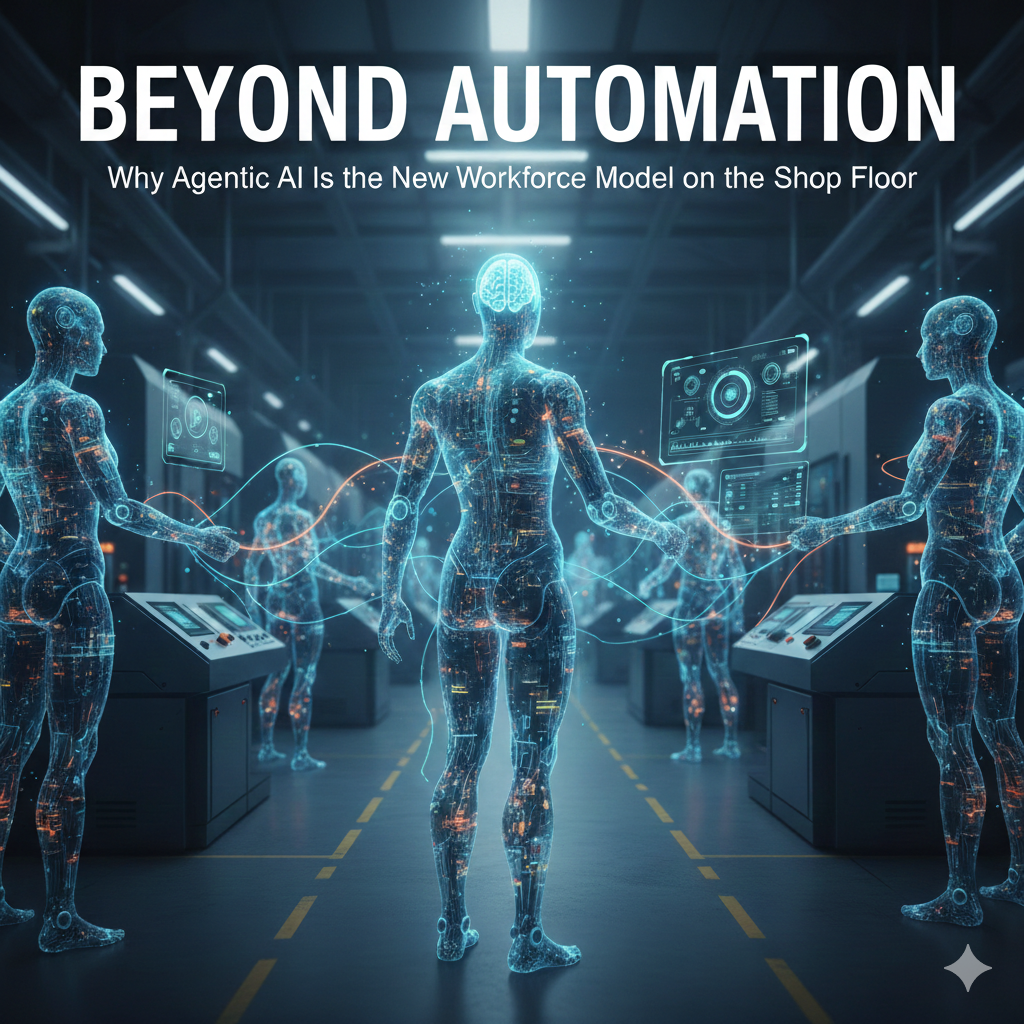
The era of the "dumb" robot is ending. For decades, the primary goal of industrial engineering was to eliminate variance through rigid, rule-based systems that executed the same motion with surgical precision, provided nothing in the environment changed. But the moment a sensor drifted or a raw material batch fluctuated, the machine would throw an error and wait for a human to fix it.
We are now witnessing a fundamental structural transition in manufacturing. According to recent analysis by McKinsey, agentic artificial intelligence is evolving from a digital tool into an active partner. It is a new class of digital workforce capable of goal-driven reasoning, multi-step planning, and autonomous execution across complex, interconnected systems.
This isn't just "better" automation. It is a shift from executing tasks to orchestrating outcomes, marking the birth of a workforce model where the software doesn't just suggest a schedule—it negotiates the solution.
From Predictive Dashboards to Autonomous Agency
Traditional industrial AI has largely focused on prediction. We built dashboards that told us a bearing might fail in three days, but it still required a maintenance manager to read that data, order the part, and schedule the technician. The "human in the loop" was actually the bottleneck.
Agentic AI changes the equation by closing the loop. In a modern "self-healing" factory, an AI agent identifies the vibration pattern of a failing motor, checks the inventory in the ERP system, and autonomously orders the replacement part. It then reshuffles the production line to compensate for the upcoming downtime without a single manual entry.
The World Economic Forum notes that planners are becoming orchestrators. Instead of "firefighting" daily disruptions, they are now supervising a fleet of agents that handle the micro-variances that used to derail a shift.
The Multi-Agent Symphony
The shop floor isn't managed by one giant brain, but by a "Multi-Agent System" (MAS). Think of it as a professional sports team where each player has a specialty—quality control, logistics, or energy optimization—but they all communicate in real-time to win the game.
When a vision system agent detects a recurring defect in a weld, it doesn't just stop the line. It communicates with the upstream welding agent to recalibrate the voltage and alerts the logistics agent to quarantine the last ten minutes of production. This level of cross-functional communication happens in milliseconds, far faster than any human supervisor could coordinate across siloed departments.
The Sovereign AI Mandate: Intelligence as Infrastructure
As factories become more autonomous, the question of where this "intelligence" lives has become a matter of national and corporate security. Organizations are increasingly moving away from generic, public-cloud AI toward what is known as Sovereign Industrial AI.
The goal is to keep sensitive production data and the reasoning logic that runs the factory on-site or within highly regulated local infrastructure. For a manufacturer, its process data is its "secret sauce." If an AI agent learns how to optimize a proprietary chemical reaction, that intelligence must remain under the company's exclusive control.
Major players like Siemens and AWS are already building frameworks that allow manufacturers to deploy these autonomous agents within secure, private environments. This ensures that while the factory gets smarter, it doesn't get more vulnerable to external disruptions or intellectual property theft.
The Human-Centric Evolution of the Workforce
One of the loudest objections to agentic AI is the fear of job displacement. While it is true that agents will handle the "three Ds"—tasks that are Dull, Dirty, or Dangerous—the reality on the ground looks more like an upgrade than a replacement.
According to research from EY, the real challenge isn't losing jobs, but capturing the "tacit knowledge" of experienced workers before they retire. Agentic AI acts as a vessel for this expertise. By codifying the intuition of a thirty-year veteran machinist into an agent's reasoning loop, the company preserves its most valuable asset.
Redefining the Factory Manager
The role of the middle manager is undergoing its own transformation. Instead of spending 80% of their time on data entry and troubleshooting, managers are evolving into "Agent Educators." They set the guardrails, define the high-level goals, and step in only when an agent encounters an ethical or high-stakes edge case.
This transition requires a cultural shift. We are moving from a world where we "manage people" to one where we "manage systems of agents." Success in this era belongs to those who can bridge the gap between mechanical engineering and digital orchestration.
Navigating the Risks of Autonomous Action
Granting autonomy to a digital system is not without peril. If an AI agent has the permission to change machine settings or order expensive materials, a "hallucination" or a logic error could have physical consequences.
The security industry is already sounding the alarm on "identity sprawl." In an agentic workforce, every digital agent needs its own set of permissions, just like a human employee. Organizations must implement robust AI Risk Management Frameworks like those proposed by NIST to ensure that every action taken by an agent is traceable, reversible, and governed by strict policy.
Reliable operations require more than just smart code; they require "Explainable AI." When an agent decides to slow down a production line, the human supervisor must be able to ask "Why?" and get a transparent, data-backed answer immediately.
The Bottom Line for 2026 and Beyond
We are at the precipice of a $10 trillion autonomous economy. By 2035, MarketsandMarkets predicts that nearly a billion autonomous units will be operating globally across various sectors.
The winners of this decade won't be the companies that simply buy the most robots. They will be the organizations that successfully redesign their workforce models around the concept of agency. This means building a foundation of unified data, investing in sovereign infrastructure, and empowering their human workers to become the conductors of an increasingly intelligent symphony.
Agentic AI isn't coming to replace the shop floor; it’s coming to make it think. The question for leaders is no longer if they will adopt these agents, but how much of their factory's intelligence they are prepared to own.