
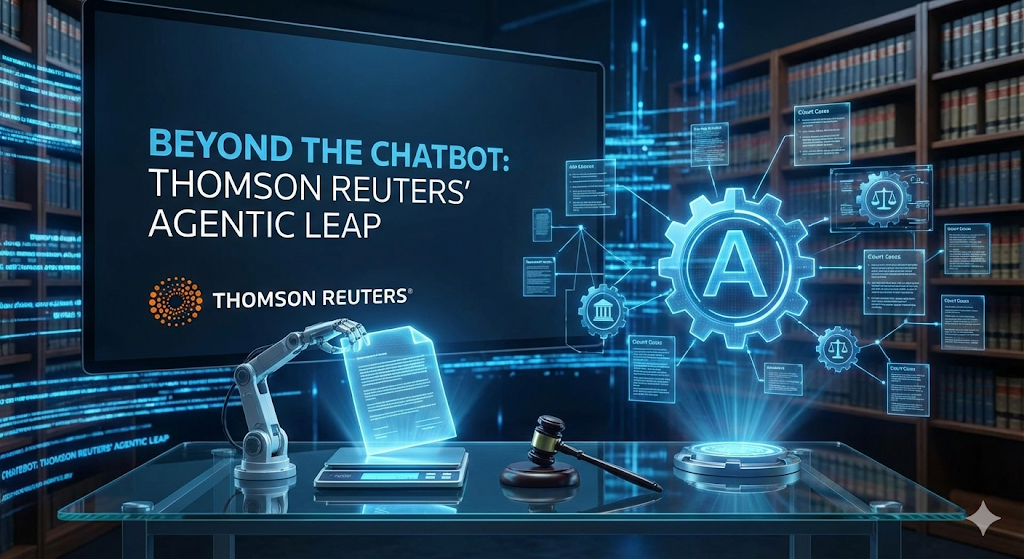
For the last two years, the legal profession has been stuck in the "Chatbot Era." We’ve marveled at LLMs that can draft a clause in seconds, but we’ve also rolled our eyes at their tendency to hallucinate cases or require endless hand-holding. We treated AI like a very fast, slightly drunk junior associate: useful, but you wouldn’t let them file a motion without checking every word.
That era effectively ended this month.
With the launch of Agentic AI capabilities within CoCounsel and the strategic acquisition of Safe Sign Technologies, Thomson Reuters (TR) isn't just upgrading a software feature; they are signaling a fundamental shift in how legal work gets done. We are moving from AI that talks to AI that acts.
Here is why the shift to "Agentic" systems is the turning point legal tech has been waiting for—and why the "human-in-the-loop" just got a powerful new partner.
The "Agentic" Difference: Think Partner, Not Intern
To understand why this launch matters, you have to understand the limitation of standard Generative AI (GenAI).
Standard GenAI is probabilistic. It predicts the next word in a sentence. It’s a writer. Agentic AI, by contrast, is a thinker and a doer. It possesses the ability to reason, plan, and execute multi-step workflows autonomously.
Imagine you need to research a complex regulatory issue spanning three jurisdictions.
GenAI waits for you to prompt it: "Search for X." Then you read the result and prompt: "Now check Y." It’s a linear, manual tennis match.
Agentic AI acts like a senior associate. You give it a goal. It breaks that goal down into tasks, queries the database, reads the results, realizes it needs more information, adjusts its own search strategy, and then presents you with a synthesized answer.
As TR’s recent white paper notes, Agentic AI moves us from "statistical patterns to strategic partners." It doesn't just retrieve information; it understands the assignment.
The Power of "Deep Research"
The flagship feature of this rollout is Deep Research, now available in the UK and expanding globally.
Deep Research isn't just a search bar on steroids. It utilizes an agentic framework to navigate TR’s massive proprietary databases (Westlaw and Practical Law). When you ask a complex question, the agent:
Analyzes the legal concepts involved.
Formulates a research plan.
Executes searches across thousands of documents.
Evaluates the relevance of the findings (and discards the noise).
Iterates if the initial results aren't sufficient.
This is critical because it solves the "blank page" paralysis. Instead of spending hours crafting the perfect Boolean search string, lawyers can now offhand a research project to CoCounsel and receive a citation-backed memo that shows how the AI reached its conclusion.
"The future of work isn't just about having AI capabilities — it's about having the right AI capabilities to enhance human expertise."
Buying Brainpower: The Safe Sign Acquisition
Thomson Reuters didn't just build this in a vacuum; they bought the brainpower to accelerate it. The acquisition of Safe Sign Technologies is a major piece of this puzzle.
Safe Sign specializes in building LLMs specifically for legal reasoning. By bringing this team in-house, TR is acknowledging that general-purpose models (like standard GPT-4) are great generalists, but legal work requires specialists.
This acquisition suggests TR is betting on "Vertical AI"—models fine-tuned not just on language, but on the logic of law. It’s the difference between a model that knows what a contract looks like and a model that understands why an indemnity clause is risky in a specific context.
The Trust Gap: Why "Black Box" Won't Fly
The biggest hurdle for AI in law isn't capability; it's trust. A lawyer cannot cite a case that doesn't exist.
Recognizing this, TR has simultaneously launched the Trust in AI Alliance with heavy hitters like Google, OpenAI, and Anthropic. This isn't just a PR move; it’s a survival mechanism for the industry.
Agentic systems are autonomous, which makes them scarier. If an AI is making decisions on its own, how do we know it's right? The Alliance aims to set standards for:
Transparency: Showing the "chain of thought" the agent used.
Groundedness: Ensuring every claim is linked to a verifiable source (e.g., a real Westlaw case ID).
Guardrails: preventing the AI from going "rogue" in its reasoning.
For law firms, this "linked-to-source" architecture is non-negotiable. An agent that provides an answer without a citation is a liability. An agent that provides an answer linked to a primary source is a tool.
The "Adopt or Die" Reality
The 2026 Legal Market Report paints a stark picture: the AI bubble isn't bursting; it's hardening into infrastructure.
We are seeing a divergence in the market. On one side, firms that use AI to suppress costs and increase speed (value-based billing). On the other, firms clinging to the billable hour for tasks that an agent can do in minutes.
The launch of Agentic AI accelerates the death of the "efficiency drag." If a machine can do 10 hours of research in 10 minutes with higher accuracy, charging a client for those 10 hours borders on malpractice.
Conclusion: The New Colleague
The launch of Agentic AI by Thomson Reuters is a "crossing the Rubicon" moment. We are no longer just generating text; we are delegating work.
For lawyers, this requires a mindset shift. The skill of the future isn't just "prompt engineering" (knowing what to ask); it’s "agent orchestration" (knowing how to manage and verify autonomous workflows).
The AI is no longer just a tool in your pocket. It’s sitting in the chair next to you. The question now is: do you trust it enough to let it drive?