
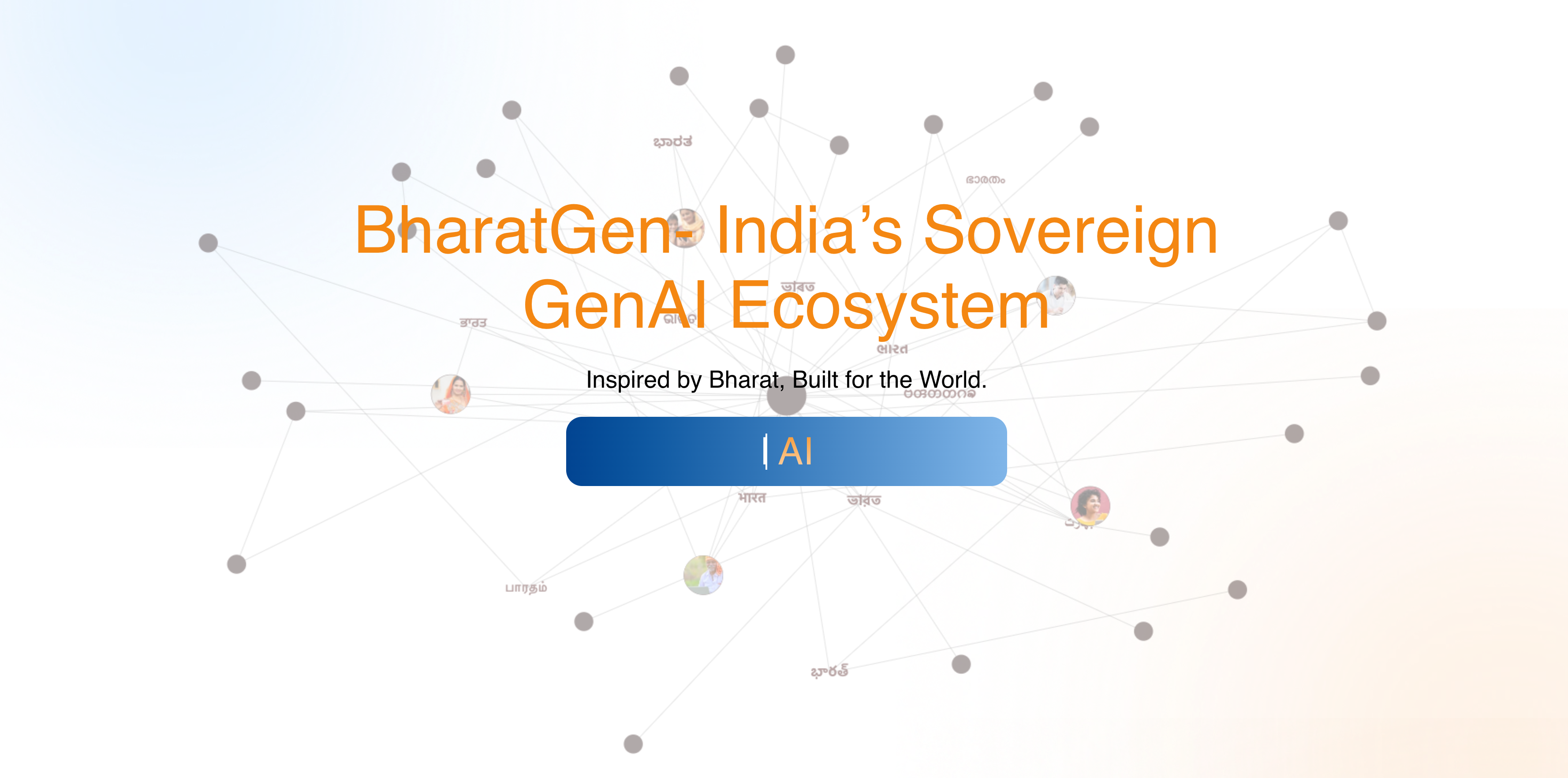
The IIT Bombay Initiative Redefining What "Made in India" Means for Artificial Intelligence
While commercial startups like Sarvam AI race to capture enterprise revenue, a quieter but equally consequential AI initiative has been taking shape inside India's premier academic institutions. BharatGen is not a startup — it has no venture capital, no Series A announcement, no Silicon Valley investors. It is a government-backed, IIT Bombay-led consortium that describes itself as India's first sovereign multilingual and multimodal AI initiative. Its mandate is not to build the next unicorn, but to build the AI infrastructure that a democratic nation of 1.4 billion people, speaking 22+ languages, will need for the next 50 years.
This is the story of BharatGen: what it is, what it has built, what it's attempting, and why it matters.
The Institutional DNA: Who Built BharatGen?
BharatGen was born out of India's National Mission on Interdisciplinary Cyber-Physical Systems (NM-ICPS), a government initiative administered by the Department of Science and Technology (DST). The mission funnels research and development resources through Technology Innovation Hubs (TIHs) at India's elite technical institutions, and the AI hub — TIH-IIT Bombay — became BharatGen's operational home.
The initiative is led by Prof. Ganesh Ramakrishnan, Professor-in-Charge, with Rishi Bal serving as CEO of the BharatGen Technology Foundation. Crucially, BharatGen has formalized itself as a Section 8 (not-for-profit) company — the BharatGen Technology Foundation — allowing it to operate as a national-scale institution rather than merely a research lab. This structural choice is deliberate: BharatGen does not want to become a commercial company, but it does want to be something more than a journal paper factory.
The founding consortium brings together eight of India's most respected technical institutions: IIT Bombay, IIT Madras, IIT Kanpur, IIT Hyderabad, IIIT Hyderabad, IIT Mandi, IIT Kharagpur, IIIT Delhi, and IIM Indore. Each brings domain expertise — NLP, speech, computer vision, economics, policy — that collectively covers the breadth needed to build a truly full-stack AI system.
The project is supported by ₹235 crore from the DST through the IIT Bombay TIH — and has more recently received a further ₹1,058 crore from MeitY under the India AI Mission, transforming it from a focused research initiative into a nationwide AI infrastructure project.
Industry partnerships include IBM, Zoho, NASSCOM, the Ministry of Water and Sanitation, and multiple state governments including Maharashtra, bringing domain data, sector-specific challenges, and deployment networks into the fold.
The Governing Philosophy
BharatGen's thesis starts with a simple, uncomfortable observation: the world's AI is being built primarily on English data, by English-speaking researchers, for English-speaking users. The technical consequence is that models like GPT-4 or Gemini are structurally biased toward English fluency. Even their multilingual capabilities are often translation-based — English thinking clothed in other languages — rather than genuine comprehension of how those languages encode meaning, culture, and lived experience.
For India, this matters profoundly. The country's 1.4 billion citizens communicate overwhelmingly in Hindi, Tamil, Telugu, Bengali, Marathi, Kannada, and dozens of other languages. Its accumulated knowledge — in legal records, agricultural practices, medical texts, government schemes, and classical literature — is encoded in those languages, not in English. AI that cannot access that knowledge cannot serve those citizens.
BharatGen's response is to build from the ground up: native training data in Indian languages, natively Indian models, deployed on Indian compute, governed by Indian institutions. It is, in the fullest sense, sovereign AI.
The Product Stack: What BharatGen Has Built
BharatGen's product portfolio is organized across three modalities — text, speech, and document vision — with application layers built on top. Each product has a name drawn from Sanskrit or Hindi, reflecting the initiative's commitment to Indian identity at every layer.
Param: The Foundational Text Model
Param-1 was BharatGen's first major model release — a 2.9-billion-parameter foundational language model trained on a staggering 7.5 trillion tokens, with over one-third of the training data representing Indian content. This Indian content ratio is substantially higher than virtually any comparable open-source model and is the core technical differentiator. The model handles code-mixing natively — understanding sentences that blend Hindi, English, and regional vocabulary in the fluid, unselfconscious way that real Indians actually write — and is designed to comprehend Indian cultural references, idioms, and contextual nuance.
Param-2 represents a significant generational leap. Launched publicly with PM-level attention at a high-profile event, Param-2 is a 17-billion-parameter model with coverage across all 22 scheduled Indian languages — an increase from Param-1's Hindi-English bilingual focus to a genuinely pan-Indian polyglot architecture. The scale-up reflects both the growth in BharatGen's computational resources and the broader IndiaAI Mission backing.
Building on Param's foundations, BharatGen has also released domain-specific fine-tuned variants:
Ayur Param is fine-tuned on Ayurvedic texts and traditional medicine knowledge — an extraordinary application for a country where Ayurveda is a practiced, living medical system with an enormous knowledge corpus in Sanskrit, Hindi, and regional languages that no global model has meaningfully indexed.
Agri Param is fine-tuned on agricultural knowledge, designed to power precision farming tools and government advisory services for India's 150 million farming households.
Legal Param targets India's judiciary and legal ecosystem, trained on Indian case law, statutes, and administrative documentation — a domain where language specificity and contextual accuracy are particularly critical.
Patram: India's First Vision-Language Document Foundation Model
If Param is BharatGen's cognitive core, Patram is its eyes for the paper world.
India is a document civilization. Land records, court judgments, ration cards, school certificates, bank passbooks, agricultural receipts, government scheme notices — the infrastructure of Indian life is encoded in paper and scanned images, written in dozens of scripts, often handwritten, frequently low-quality. No global OCR or document-understanding model has been trained to handle this universe with meaningful accuracy.
Patram-7B-Instruct is a 7-billion-parameter vision-language model trained on 2.5 billion tokens of specifically Indian administrative documents — government forms, IDs, certificates, court records, and academic texts — across multiple scripts and layouts. It is not merely an OCR engine; it is a comprehension model that can respond to natural language prompts: summarize this notice, extract the beneficiary name from this form, find the date of judgment in this court document, answer questions about this government scheme based on the scanned circular.
The transformative use cases are immediately visible. A farmer in Bihar can photograph a government scheme notice and ask Patram (via the DocBodh application layer) what benefits they qualify for. A bank officer can verify KYC documents in Malayalam automatically. A lawyer can search judgments in Kannada with citation accuracy. An archivist can digitize and index a library of Hindi manuscripts.
Patram is available on Hugging Face (bharatgenai/patram-7b-instruct) and on AI Kosh (India's national AI model repository), making it freely accessible to developers and researchers.
DocBodh: The Application Interface for Document Intelligence
DocBodh is the consumer and enterprise-facing application suite built on top of Patram. Where Patram is the engine, DocBodh is the interface — the product that a government department, a bank, a university, or an individual user would actually interact with.
DocBodh offers three core interaction modes. First, Chat with the Doc: users can upload any document and ask questions via text or voice, in Indian languages or English — receiving answers drawn directly from the document with cited references. Second, Smart Highlights: the system generates instant summaries with citations, providing verifiable, trustworthy digests of complex documents rather than hallucinated paraphrases. Third, DocHub: a connected intelligence layer that allows organizations to build centralized, multilingual document repositories — digitizing, tagging, and making searchable entire archives of Indic-language documents.
Voice input support is particularly significant. It means that even users who are not comfortable typing can interact with complex official documents in their own spoken language. This is not a marginal feature — it is the difference between this technology being accessible to educated urban professionals only, or to the vast majority of Indians who interact with government paperwork every year.
Shrutam: Automatic Speech Recognition for Real India
The name means "that which is heard" in Sanskrit — and Shrutam is BharatGen's automatic speech recognition system, designed to hear India as it actually sounds.
The challenge of Hindi ASR is harder than it might appear. Spoken Hindi in real India is not the clean, slow, standard dialect of broadcast television. It is accented by region — Bihar Hindi, UP Hindi, Rajasthani Hindi, Mumbai Hindi each carry their own phonological signatures. It mixes in English words freely. It is often spoken against the ambient noise of crowded streets, call centers, agricultural fields, and busy markets.
Shrutam is a 30-million-parameter ASR model (with a more complex 120M-parameter variant also released) trained on over 2,000 hours of diverse, real-world Hindi audio — specifically including challenging conditions like call center recordings and noisy street environments. It uses the e-Branchformer architecture and has achieved state-of-the-art performance on the Vistaar benchmark for Hindi ASR. The newer release of Shrutam extends coverage to 12 Indian languages, significantly broadening its utility beyond the Hindi-English axis.
Sooktam: Text-to-Speech for India's Many Voices
Sanskrit for "well-spoken," Sooktam is BharatGen's text-to-speech model — and it is among the most technically ambitious components of the platform.
Built on a 150-million-parameter Voicebox architecture, Sooktam is designed to produce speech that is not merely intelligible but genuinely expressive: capturing the rhythm, intonation, prosody, and emotional register of Indian languages. It supports 19 different speech synthesis voices across languages including Marathi, Hindi, Tamil, Telugu, Kannada, Punjabi, Gujarati, Malayalam, and Bengali — with the latest version extending to 12 languages.
Its advanced features include voice cloning, which allows organizations to create branded voice identities or recreate specific speakers; style transfer, which controls emotional tone and delivery; and fine-grained voice editing, enabling precise control over how a sentence is spoken. For a country building voice-first government services, ed-tech platforms, and agricultural advisories, these capabilities directly translate into millions of users who can receive information in their own language, in a voice that sounds natural rather than robotic.
Bharat Data Sagar: The National Data Infrastructure
Underlying every model BharatGen has built is a data problem: there is simply not enough high-quality Indian language text available in publicly accessible corpora. Less than 0.01% of the world's crawled web data represents Indian languages. Academic research, government documents, literature, agricultural knowledge, legal precedent — the overwhelming majority of India's information heritage is not digitized, not indexed, and certainly not in LLM-ready form.
Bharat Data Sagar (BDS) — "India's Ocean of Data" — is BharatGen's answer to this foundational challenge. It is a national initiative to collect, curate, and build openly shareable datasets that capture India's linguistic, cultural, and regional diversity across text, speech, images, and other media. Its scope covers all 22+ scheduled Indian languages, with an intentional emphasis on regional dialects and under-resourced languages that are typically invisible in global datasets.
BDS is conceived as collaborative infrastructure: it invites individuals, institutions, government departments, and enterprises to contribute data under a framework that ensures India retains sovereignty over its own knowledge resources. The resulting datasets power BharatGen's models but are also intended to be accessible to the broader Indian AI research community — a public good, not a proprietary moat.
Krishi Sathi: AI Companion for Indian Farmers
Agriculture employs roughly half of India's workforce and accounts for roughly 18% of GDP. It is also the sector where information asymmetry, language barriers, and digital exclusion create the most avoidable human harm — in crop losses, debt cycles, and preventable pest outbreaks.
Krishi Sathi ("Farming Companion") is BharatGen's direct intervention in this space. Currently focused on onions and grapes — two major commercial crops with well-defined pest and yield management challenges — Krishi Sathi is an AI platform that provides farmers with personalized, real-time advice on pest management, crop yield prediction, irrigation guidance, and weather risk alerts.
The platform supports Hindi and English with voice-based interaction, recognizing that literacy barriers cannot be an obstacle to adoption in its target user base. Farmers can speak naturally to the app, receive advice in their own dialect, and act on it without needing to read or type. Integration with government scheme databases means Krishi Sathi can also proactively inform farmers about subsidies, insurance programs, and financial support they may qualify for.
The agricultural AI space is crowded with aspirational startups that have failed to penetrate rural India at scale. What distinguishes Krishi Sathi's potential is BharatGen's government linkages — direct partnerships with the Ministry of Agriculture and state-level agriculture departments provide both distribution channels and ground-truth data that commercial players struggle to access.
e-vikrAI: Visual Commerce Automation for Indian Sellers
India's e-commerce market is booming — but a striking statistic hangs over it: online retail represents only about 8% of India's total retail market. The barriers to expanding that percentage are not primarily on the buyer side. Millions of micro-entrepreneurs, rural artisans, self-help groups, and small manufacturers would benefit enormously from access to online marketplaces — but the product listing process is a significant practical obstacle. Filling in detailed category forms, writing product descriptions, optimizing for SEO, all in English, is simply not accessible to a Hindi-speaking potter from Khurja or a sari weaver from Varanasi.
e-vikrAI (a play on "vikraya," the Sanskrit word for sale) is a vision-language model–powered auto-cataloging tool. The seller's workflow is reduced to a single step: take a photo of the product. e-vikrAI does the rest — automatically generating India-aware, SEO-optimized titles, product category classification, feature descriptions, and pricing suggestions. The generated content can be translated into multiple Indian languages, and can be read back to the seller via audio output, closing the loop for users who cannot read the generated text.
The government alignment is noteworthy: e-vikrAI explicitly supports the ODOP (One District One Product) and GeM (Government e-Marketplace) initiatives, providing a direct bridge between rural craft producers and national government procurement platforms.
Comparison: BharatGen vs. Sarvam AI
BharatGen and Sarvam AI are frequently discussed in the same breath — India's two most prominent indigenous AI initiatives. But they are fundamentally different in structure, purpose, and market positioning.
Sarvam AI is a venture-backed startup with a commercial mandate: build a full-stack sovereign AI platform, win enterprise customers, generate revenue, and ultimately create value for shareholders. Its $41M Series A, its enterprise clients like Tata Capital, and its API pricing model all reflect this commercial logic.
BharatGen is a government-funded academic institution structured as a not-for-profit. Its primary accountability is to the Indian public and to the scientific community, not to investors. Its outputs — models on Hugging Face, open datasets through Bharat Data Sagar — are public goods, not proprietary products.
Their technical choices reflect these mandates. Sarvam has made faster commercial progress: its Bulbul TTS model supports 30+ voices, its Samvaad platform powers live enterprise deployments, and its Vision model has posted competitive benchmarks against global competitors. BharatGen's Param-2, Shrutam, and Sooktam represent equally serious technical work, but their open-source orientation means the commercial packaging is less polished.
Where BharatGen has a clear advantage is in the breadth of its language coverage (22 languages vs. Sarvam's 10-11 in most products), the depth of its agricultural and legal vertical applications, and the legitimacy that comes from being a multi-institutional national effort rather than a startup making claims.
Where Sarvam has an advantage is in enterprise-readiness, speed of iteration, and the full-stack deployment infrastructure that enterprises actually need. Sarvam's SOC 2 Type II certification, its private cloud deployment options, and its forward-deployed engineering model give it a credibility with regulated industries that BharatGen's academic model cannot easily replicate.
The honest framing is that they are solving different layers of the same problem — and India benefits from both existing simultaneously.
Shortcomings and Honest Critiques
For all its ambition and genuine technical achievement, BharatGen faces real limitations that deserve honest acknowledgment.
The not-for-profit constraint cuts both ways. Academic institutions move at academic speed. The product iteration cycle of a DST-funded consortium governed by faculty committees is simply slower than a well-capitalized startup. BharatGen's products show signs of this — the website is sometimes sparse on concrete specifications, some pages appear in early stages, and there is no unified developer portal comparable to Sarvam's API marketplace.
Hindi-centric foundations. Despite claiming coverage of 22 languages, BharatGen's current models skew heavily toward Hindi. Shrutam was explicitly Hindi-focused in its initial release. Param-1 was bilingual Hindi-English. The 22-language Param-2 is newer and less well-tested on lower-resource languages. For Tamil, Telugu, or Bengali speakers, the practical quality gap between Hindi support and their language's support may be substantial.
Crop coverage of Krishi Sathi remains narrow. Covering only onions and grapes at this stage, Krishi Sathi's agricultural intelligence is a proof of concept rather than a deployable tool for most of India's 600+ million people who depend on agriculture. The roadmap to scaling across paddy, wheat, cotton, and the hundreds of other crops farmed across India's diverse agro-climatic zones is long.
No enterprise deployment infrastructure. BharatGen has no equivalent of Sarvam's private cloud or on-premises deployment options. For government agencies, banks, and healthcare providers that need their AI running on local infrastructure under strict data governance rules, BharatGen currently cannot offer an end-to-end managed deployment solution.
Measurement gaps. BharatGen publishes technical details like parameter counts and training data volumes, but published benchmarks comparing its models to global or domestic alternatives are sparse on the website. Unlike Sarvam, which has posted head-to-head OCR benchmarks against Gemini and ChatGPT, BharatGen's comparative performance claims are harder for developers to independently evaluate.
Discoverability and developer ecosystem. The developer ecosystem around BharatGen models — documentation, SDKs, tutorials, community forums — remains thin. Models are available on Hugging Face, but the path from "download the model" to "build a production application" requires significantly more self-direction than comparable Western frameworks.
The IndiaAI Mission and the Path Forward
The most significant development in BharatGen's recent history is the receipt of ₹1,058 crore from MeitY under the India AI Mission — an order-of-magnitude expansion in resources that transforms the initiative from a university research project into national infrastructure. This funding level, combined with the Section 8 company structure and the multi-institutional consortium, gives BharatGen the resources to move much faster on model scale, language coverage, and application development.
The most recent model releases — Param-2 with 17 billion parameters across all 22 scheduled languages, Shrutam and Sooktam extended to 12 languages, and the DocBodh framework for document intelligence — were launched at a PM-level event, signaling the political seriousness of the investment.
The domain-specific fine-tuned models (Ayur Param, Agri Param, Legal Param) point toward a future where BharatGen becomes the backbone AI layer for sector-specific government digital initiatives — a kind of India Stack for AI, sitting below the application layer in the same way NPCI's UPI infrastructure sits below fintech apps.
Why BharatGen Matters Beyond Technology
It is tempting to evaluate BharatGen purely on technical benchmarks — parameter counts, WER scores, OCR accuracy. These matter, but they miss something important about what BharatGen represents.
India is one of only a handful of countries in the world attempting to build sovereign AI at the foundational model layer. Most nations — including rich ones — will be AI consumers rather than AI producers, relying on models built in the US or China that reflect those nations' values, priorities, and languages. India is choosing a different path: investing public capital to build AI that encodes Indian languages, Indian cultural context, Indian legal traditions, Indian agricultural practices.
This is not merely about technical independence. It is about the right of a civilization to represent itself in the AI systems that will increasingly mediate access to information, government services, healthcare, and economic opportunity. A farmer in Kerala who can describe their crop disease in Malayalam and receive accurate, actionable advice in the same language — without that knowledge being processed through English, without that data being stored on American servers, without that interaction being subject to pricing decisions made in San Francisco — is experiencing something qualitatively different from what global AI platforms can offer.
BharatGen, for all its roughness and academic pace, is building toward that future. Its products are not yet ready to displace the convenience and polish of commercial tools. But they are laying the data infrastructure, the open models, the institutional frameworks, and the domain-specific applications that will make India genuinely capable of governing its own AI future.
That is a project worth watching — and supporting.
Article based on publicly available information as of February 2026, including official government press releases, BharatGen's product pages, IIT Bombay communications, and news reports.