
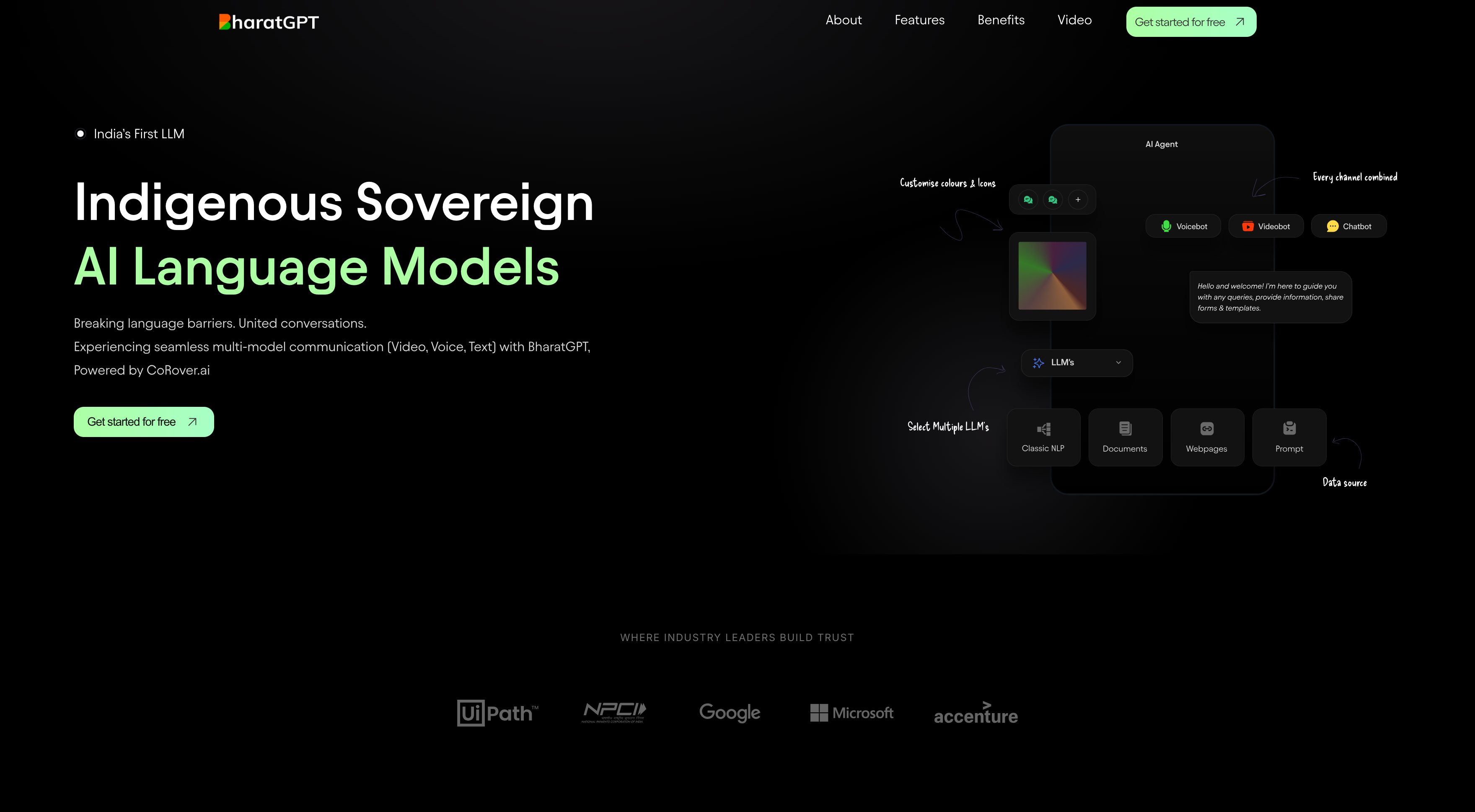
CoRover's Quiet Eight-Year Journey from IRCTC Chatbot to Sovereign LLM
There is a version of India's AI story that begins in 2023, with well-funded startups and government missions and billion-dollar ambitions. Then there is CoRover's version, which began in 2016 in Bengaluru — long before most of the world had heard of ChatGPT — when a small team of engineers decided that the most natural way for humans to interact with machines was to simply talk to them.
BharatGPT, the large language model that emerged from that eight-year journey, is not the flashiest name in India's AI ecosystem. It has neither the academic prestige of BharatGen nor the venture-scale ambition of Sarvam AI. What it has is something more pragmatic and arguably more rare: real users, real deployments, and a billion-scale user base that encountered AI long before most Indians knew what an LLM was.
This is the story of BharatGPT — what it is, how it got here, what it can do, and where it falls short.
The Company: CoRover.ai
BharatGPT is not an independent platform; it is the foundational intelligence layer of CoRover.ai, a Bengaluru-based conversational AI company founded in 2016 by Ankush Sabharwal (CEO & CTO), Kunal Bhakhri, Manav Gandotra, and Rahul Ranjan.
CoRover's founding thesis was deceptively simple but technically demanding: every system — software or hardware — should communicate the way humans do. Not through forms or clicks or commands, but through natural language — voice, text, and video — in whatever language the user happens to speak. The company's tagline, "the world's first human-centric conversational AI platform," reflects this belief. The human is the constant; the technology must adapt.
For the first several years, CoRover operated largely under the radar, building chatbots, voicebots, and videobots for Indian enterprises and government agencies. It was not a household name, and it was not trying to be. It was accumulating something more valuable: domain expertise, real-world deployment experience, and a relationship with some of India's highest-volume citizen-facing services. That institutional footprint would later become the foundation on which BharatGPT was built.
The Founder: Ankush Sabharwal
Ankush Sabharwal is the driving intellectual and operational force behind CoRover and BharatGPT. A technologist-entrepreneur who combines deep NLP expertise with a visceral conviction that technology must serve the common Indian citizen, Sabharwal made a significant strategic call early in CoRover's history: he shut down the company's US and UK operations to focus entirely on India.
This was a deliberate inversion of the typical Indian tech startup trajectory, which often uses India as a launch pad before pivoting attention to higher-margin Western markets. Sabharwal's bet was that India itself — with its scale, its linguistic complexity, and its unserved hundreds of millions — was the most interesting and ultimately most valuable market to build for. The BharatGPT ambition is the fullest expression of that bet.
The Breakthrough Deployment: AskDISHA and the IRCTC Story
CoRover's reputation was built on a single deployment that became, in a very real sense, a national institution.
AskDISHA is the AI virtual assistant embedded in IRCTC.in — the Indian Railway Catering and Tourism Corporation website, which processes millions of train ticket bookings daily. CoRover built and deployed AskDISHA, which became the single most-used AI chatbot in India by sheer volume of interactions. The deployment was so significant, so widely used, and so publicly visible that it earned something almost unheard of in the technology world: a 200-word question in the Indian Civil Services examination — the country's most competitive entrance exam — reflecting its recognition as a landmark in Indian digital public infrastructure.
AskDISHA was not a generative AI system in its initial form. It was a carefully engineered conversational system that handled millions of queries about train schedules, ticket availability, cancellations, PNR status, and refund processes. Its success established CoRover's credibility with government clients and demonstrated that conversational AI, done well, could operate reliably at the scale of India's railway network.
The next evolution of AskDISHA came at the Global Fintech Fest 2024, when CoRover, NPCI (the National Payments Corporation of India), and IRCTC jointly launched Conversational Voice Payments powered by UPI and BharatGPT — the world's first conversational voice payment system for merchants using UPI. Users could now tell AskDISHA to book a ticket in their own language — Hindi, Gujarati, and others — and complete the payment by voice, with the system retrieving their UPI ID automatically and initiating the transaction. NPCI's CTO Vishal Anand Kanvaty called it a milestone; IRCTC's CMD Sanjay Kumar Jain summarized it as: "You have to speak; you have to raise your voice to get your payment deducted and get the tickets."
The Government Client Portfolio
AskDISHA is CoRover's most famous deployment, but it is far from the only one. The company has built AI assistants for some of India's most consequential institutional clients:
Ask PAi — deployed at NPCI/BHIM-UPI, helping users navigate India's flagship digital payments infrastructure.
AskMitra — deployed at LIC (Life Insurance Corporation of India), handling policyholder queries for one of the world's largest insurance companies by customer count.
Chetna — the AI assistant for DMRC (Delhi Metro Rail Corporation), serving daily commuters.
SEVA — deployed at SEBI (Securities and Exchange Board of India), the financial markets regulator.
eSevak — CoRover's conversational citizen grievances management system, designed to make it easier for ordinary Indians to file and track government complaints.
IGL (Indraprastha Gas Limited), Indian Navy (GRSE), Max Life Insurance, and the Government of India itself (via various ministries) round out a client roster that touches virtually every dimension of Indian civic and economic life.
Across these deployments, CoRover claims a user base of over 1 billion users — a figure that reflects cumulative interactions through its clients' platforms rather than direct users. It is a meaningful number nonetheless, because it means BharatGPT's underlying models have been tested on the conversations of real Indians conducting real transactions, not just benchmark datasets.
BharatGPT: The Model Family
With this operational foundation established, CoRover turned to the harder problem of building its own foundational LLM. The result is a family of models under the BharatGPT brand, each targeting a different point on the capability-efficiency spectrum.
BharatGPT (Core Platform)
The core BharatGPT platform is CoRover's proprietary Generative AI system, the engine powering its conversational AI agents across all deployments. It is integrated for voice modality in 14+ Indian languages and text modality in 22+ languages, developed in partnership with BHASHINI — the National Language Translation Mission under MeitY. This government partnership is significant: it gives BharatGPT access to the translation and language infrastructure that the Indian state is building, and aligns CoRover with the "Make AI in India" policy agenda.
What distinguishes BharatGPT from generic LLMs in enterprise deployment contexts is its multi-layered architecture — a design philosophy that deliberately avoids using heavy generative inference for every query. The system operates in layers: frequently asked, deterministic queries are handled by lighter models (supervised learning, AIML-based rule layers, context-based auto-suggestion), while novel or complex queries escalate to the deep learning generative layer. This means GPU load is substantially reduced compared to architectures that run every query through a large generative model, making BharatGPT significantly more economical to operate at scale. For India's cost-sensitive enterprise market, where customers are paying per interaction across millions of users, this efficiency advantage is commercially important.
BharatGPT-3B-Indic
Released on Hugging Face and gaining over 2,000 downloads within days, BharatGPT-3B-Indic is a 3-billion-parameter transformer-based model fine-tuned specifically for Indic languages. Its technical highlights include:
Secure RAG (Retrieval-Augmented Generation): The model integrates a secure retrieval mechanism that allows it to answer questions grounded in enterprise-specific private knowledge bases, without the knowledge leaving the organization's security perimeter. This is critical for regulated sectors like banking, insurance, and government, where sensitive data cannot be processed through external APIs.
GGUF Quantization for Edge Devices: The model supports a quantized format (GGUF) that allows it to run on mobile phones and IoT devices with significantly reduced computational requirements. This is not just a technical optimization — it is a prerequisite for the offline use cases that matter most in rural India.
Sovereign by Design: The model is explicitly designed for private deployment within national or enterprise-specific infrastructure, enabling compliance with India's data localization requirements.
BharatGPT Mini
Launched in June 2025 at VivaTech Paris by Union Minister of State Jitin Prasada — a ceremony that signaled strong government backing — BharatGPT Mini is CoRover's most strategically significant release: India's first offline-capable multilingual Small Language Model (SLM).
At 534 million parameters, BharatGPT Mini is not trying to win benchmarks against GPT-4. It is trying to answer a specific and profoundly practical question: can AI be made useful for a schoolteacher in Nagaland or a health worker in Chhattisgarh, where internet connectivity is intermittent and smartphones are mid-range at best?
BharatGPT Mini runs entirely on-device, without internet connectivity, processing and encrypting data locally. It supports 14 Indian languages, handles text, voice, and video inputs, and is deployable via CoRover Builder — the company's no-code/low-code platform — across websites, telephony systems, mobile apps, and IoT interfaces. CoRover claims that integrating BharatGPT Mini can make project pipelines 60-70% more efficient and projects a fivefold increase in SLM adoption by small and medium businesses by FY26.
The CoRover Builder Platform: Gen AI as a Service
One of BharatGPT's most practically important features is the CoRover Builder platform, which enables developers and non-technical users alike to build production-ready multilingual AI agents in "just 2 minutes" — by uploading their own content, documents, or knowledge base. The generated agent can handle voice, text, and video modalities, and can be deployed across any channel: website, WhatsApp, telephony, IoT, or mobile app.
This "Gen AI as a Service" (GaaS) model is the engine of CoRover's commercial strategy. Rather than selling model weights or API credits, CoRover sells outcomes: working, deployed, multilingual AI agents that handle real enterprise use cases. The business model is modular, with revenue coming from subscriptions, transactions, and enterprise licensing.
The GPT Ecosystem: Vertical-Specific Agents
Perhaps the most striking expression of CoRover's commercial ambition is the sheer breadth of domain-specific GPT agents the company has either built or outlined under the BharatGPT umbrella. Already deployed or actively developed:
IncomeTaxGPT, GSTGPT — tax information and compliance assistance for citizens and businesses.
RailGPT, AirGPT, BusGPT, ShipGPT — multi-modal transport information, booking, and payment across India's vast transportation networks.
HealthGPT — healthcare information and guidance, particularly critical for rural populations with limited access to doctors.
LegalGPT, JusticeGPT — access to legal information in plain language and regional languages, for a population where most people cannot afford legal counsel.
KarnatakaGPT, GujaratGPT, J&KGPT — state-level government service agents, bringing the entire service portfolio of a state government into a conversational interface.
GeMGPT — supporting the Government e-Marketplace, helping small sellers access government procurement.
KisanGPT — agricultural guidance for farmers.
SpaceGPT, EnergyGPT, ExternalAffairsGPT, DARPGGPT — sector-specific agents for ISRO, energy ministries, the Ministry of External Affairs, and the civil services training ecosystem.
The consumer layer includes planned agents like BankGPT, InsureGPT, InvestGPT, PayGPT, EatGPT, LearnGPT, TravelGPT, and EntertainGPT — a vision that essentially reimagines every digital consumer vertical as a conversational AI experience.
Whether all of these are production deployments or aspirational product roadmap items is not always clear from public documentation. But the breadth of coverage is genuinely impressive — and reflects the practical advantage of having built relationships with institutional India over eight years.
Key Technical Capabilities
Multimodal and Omnichannel: BharatGPT handles text, voice, and video natively across 120+ languages (globally) and 22 Indian languages specifically. The video capability — including video cloning and interactive digital twin experiences — is genuinely distinctive; no other Indian AI platform at this scale offers it.
Inbuilt Payment Gateway: The integration of UPI-based transactional capability directly into the conversation flow — exemplified by the IRCTC voice payment launch — makes BharatGPT one of the only AI systems in the world where a user can have a conversation and complete a financial transaction within the same interface, without switching apps or entering card details.
Aadhaar-Based KYC: Integration with India's biometric identity system enables BharatGPT-powered agents to conduct identity verification natively — a capability that is essential for financial services, insurance, and government service onboarding.
Sentiment Analysis and Real-Time Analytics: Enterprise deployments include real-time dashboards tracking user sentiment, conversation success rates, escalation patterns, and channel performance.
ERP/CRM Integration: Standard API-based integration with enterprise systems ensures that BharatGPT agents can both retrieve and update records in existing systems — making them genuinely transactional rather than merely informational.
Secure RAG: Enterprise-grade private knowledge base querying that keeps sensitive data within the organization's perimeter.
Responsible AI Framework: CoRover emphasizes a "governance and safety net" layered into BharatGPT's architecture, with explicit attention to accuracy, context-awareness, and avoidance of hallucination in high-stakes use cases like government services and financial transactions.
Infrastructure and Partnerships
BharatGPT runs on Google Cloud Platform (GCP), with data sovereignty ensured by hosting within India. The GCP partnership also gives CoRover access to Vertex AI for model serving and scaling, and provides the infrastructure reliability that large enterprise and government clients require. Partnerships with Microsoft and Accenture further extend CoRover's enterprise distribution and credibility.
Funding and Business Profile
CoRover has raised approximately $4.96 million in total funding, with a $4 million Series A led by Venture Catalysts in September 2024, with participation from CanBank Venture Capital Fund, IIM Calcutta Innovation Park, IIIT Delhi's iHub Anubhuti, Cogniphy LLC, Karekeba Ventures, and Lead Angels.
This is a strikingly modest capitalization for a company claiming a billion-user reach — especially compared to Sarvam AI's $41 million Series A. The company's current valuation is ₹151 crore (approximately $18 million), and its last reported annual revenue was ₹6.92 crore ($830,000) for FY2024. It has a team of approximately 37-61 employees depending on the reporting period.
Notably, Sabharwal has stated that CoRover has been profitable for the last three years, maintaining consistent margin at a smaller revenue scale. Only 25% of revenue comes from government (B2G) business — the remainder from private sector clients — a more balanced commercial profile than the institutional deployment story alone might suggest.
BharatGPT vs. Sarvam AI vs. BharatGen: Where Each Fits
The three major players in India's indigenous AI ecosystem are addressing meaningfully different market needs.
BharatGPT / CoRover is the deployment-layer specialist — its entire architecture is oriented around making AI work in production, at scale, across channels, with enterprise integrations, payment transactions, and real users. Its competitive advantage is eight years of real deployment experience and institutional relationships that no newcomer can quickly replicate. Its models are not the largest or the most technically impressive on raw benchmarks, but they work reliably in the messy, transaction-heavy, multilingual reality of Indian enterprise.
Sarvam AI is the enterprise platform play — a commercially aggressive, well-funded startup building a full-stack from model layer to API to agent deployment, with strong voice and TTS capabilities and growing enterprise revenue. Sarvam is more polished in its developer-facing offerings, has more impressive individual model benchmarks, and is expanding faster in the enterprise segment. But it lacks the eight-year deployment track record and the institutional relationships that CoRover has accumulated.
BharatGen is the national infrastructure play — a government-academic consortium focused on open-source models, data sovereignty, and public-good AI that can serve all 22 scheduled languages. It is the least commercially oriented of the three but the most impactful on the long-term data and model infrastructure that everyone else depends on.
The three are not direct competitors. India needs all three layers: open infrastructure (BharatGen), enterprise platforms (Sarvam), and deployment specialists with institutional access (BharatGPT/CoRover). A future where they interoperate — BharatGen models powering CoRover's deployment stack or Sarvam's enterprise platform — would be more powerful than any of them operating in isolation.
Shortcomings and Honest Critiques
BharatGPT's strengths are real, but so are its limitations.
Modest technical scale. At 534 million parameters (Mini) and 3 billion parameters (3B-Indic), BharatGPT's models are small compared to Sarvam-M (24B) or BharatGen's Param-2 (17B), to say nothing of global frontier models. For complex reasoning tasks, multi-turn conversations, code generation, or nuanced content creation, the performance gap against larger models may be significant.
Revenue and team size raise questions about depth. A team of 37 employees and annual revenues of ₹6.92 crore supporting a "billion-user platform" suggests the platform is very asset-light in terms of human support — which could be a strength (efficiency) or a weakness (inability to iterate rapidly on complex client requirements). The revenue figure, while profitable, is small for a company claiming this scale of deployment impact.
Low capitalization limits model development. Building competitive frontier LLMs requires compute that $4.96 million in total funding cannot realistically sustain. CoRover has compensated with its multi-layer efficiency architecture and the GCP/Vertex AI partnership, but the ability to train genuinely large, competitive models remains constrained.
Opacity on benchmark comparisons. Unlike Sarvam, which has published head-to-head benchmark comparisons against Gemini and ChatGPT on specific tasks, CoRover's public documentation is thin on rigorous independent benchmarks for BharatGPT's language quality. The company's performance claims rest heavily on deployment metrics (users served, tickets booked) rather than model capability benchmarks.
The GaaS model may limit developer adoption. CoRover's primary offering is a managed platform (CoRover Builder) rather than open-weight models or clean APIs. Developers who want to experiment, fine-tune, or build custom architectures on top of BharatGPT models will find the ecosystem less accommodating than Hugging Face–hosted alternatives from BharatGen or Sarvam.
Marketing ambition vs. product reality. The list of planned GPT verticals — SpaceGPT, AstroGPT, NatureGPT, and dozens more — reads aspirationally in places. It is not always clear which of these are live production deployments versus roadmap items, which can make it harder for enterprise buyers to evaluate what CoRover actually delivers today versus what it is planning to deliver.
The Road Ahead
CoRover's Series A capital is directed at three areas: technology development (particularly for BharatGPT Mini and the edge-device offline stack), team expansion, and go-to-market acceleration. The company is explicitly targeting a fivefold increase in SLM adoption among SMEs by FY26 — a market that remains largely underserved by enterprise AI vendors who focus on large institutional clients.
The upcoming release of the Milkyway educational tablet — powered by BharatGPT's voice and video capabilities — points toward a hardware play in ed-tech, extending the conversational AI thesis into physical devices for students in underserved schools.
The government relationship will remain central. CoRover's institutional deployments are both its main reference architecture and its most reliable revenue source. As India's government accelerates AI-first public services — tax filing, healthcare, welfare schemes, judicial access — CoRover is positioned to be a foundational delivery layer.
Conclusion: The Tortoise in India's AI Race
BharatGPT represents something undervalued in India's AI narrative: the slow compounding of practical deployment experience over eight years. While newer, flashier competitors attract larger funding rounds and generate more media coverage, CoRover has been running the largest conversational AI deployments in the country, learning what works and what breaks at national scale, building the institutional relationships that enable access to data, distribution, and trust that money alone cannot buy.
Its models may not be the largest or the most technically impressive. Its funding may be a fraction of its competitors'. Its public visibility may be lower than its actual impact warrants. But when a billion people have touched your technology — booking a train ticket, filing a complaint, paying a bill — through the infrastructure you built, you have earned a kind of credibility that no benchmark can replicate.
BharatGPT is not trying to be India's OpenAI. It is trying to be India's conversational infrastructure — the layer that every citizen interacts with when they engage with the state and the economy, in their own language, through their own voice. That is a less glamorous ambition than building a frontier model, but it may, in the end, be a more durably valuable one.
Article based on publicly available information as of February 2026. Figures sourced from company announcements, press releases, Tracxn data, and media reports.