
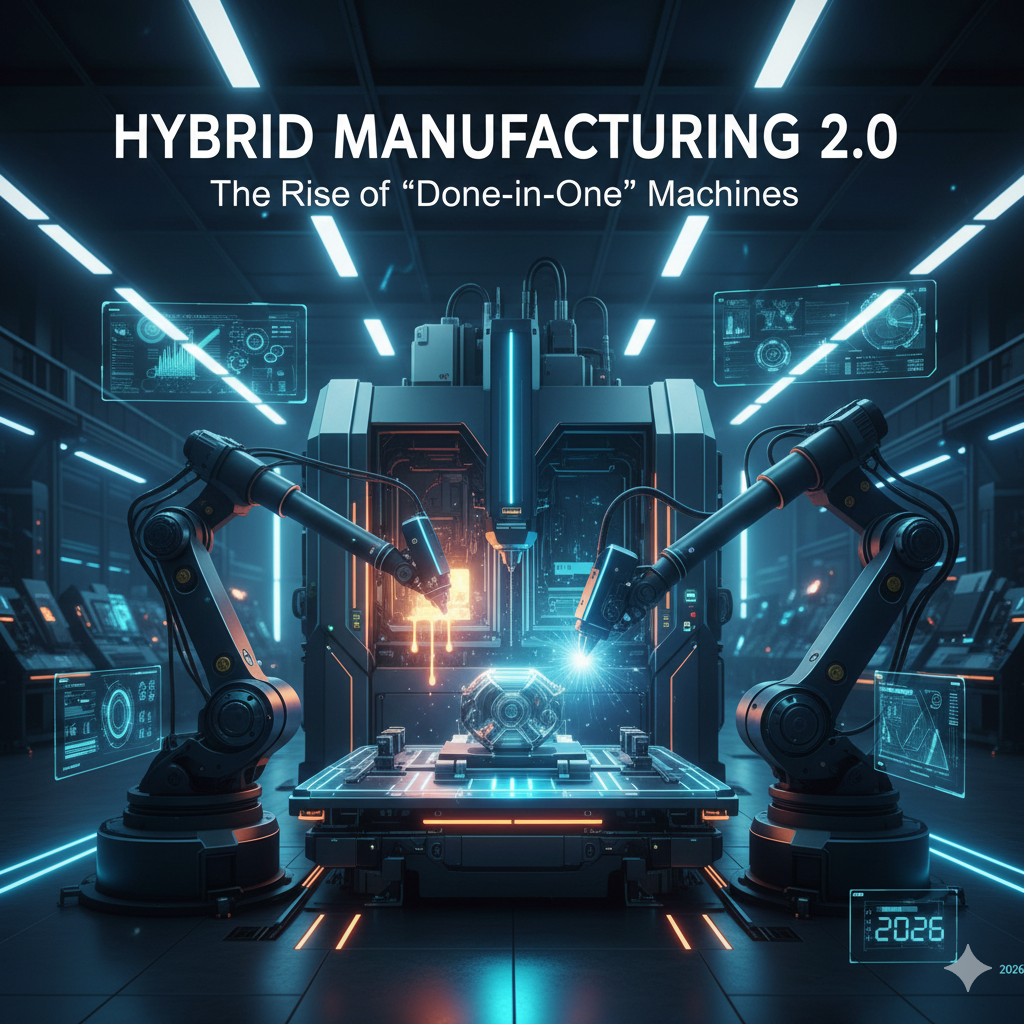
Imagine a single machine where a block of raw material enters one side and a finished, high-precision, heat-treated aerospace component emerges from the other—without a single human hand touching the part or a forklift moving it between departments.
For decades, the factory floor was a linear, fragmented landscape where parts traveled for weeks between casting houses, CNC workshops, and heat-treatment facilities.
This era, often called Factory 1.0, is officially ending as Hybrid Manufacturing 2.0 takes hold, collapsing entire zip codes of logistics into a single, "Done-in-One" machine footprint.
The Paradigm Shift: From Fragmented to Integrated
The global manufacturing landscape is currently navigating a structural transformation that moves away from the siloed production models of the past.
In the legacy model, additive manufacturing (3D printing) was largely a prototyping tool, while subtractive manufacturing (CNC machining) was the workhorse of production.
The advent of Hybrid Manufacturing 2.0 marks the obsolescence of this divide, ushering in an era where integrated platforms leverage the geometric freedom of 3D printing alongside the exacting tolerances of machining.
At the core of this evolution is the "Done-in-One" philosophy, a term that has moved from a marketing moniker to an engineering standard.
It describes the ability of a single machine tool to handle every aspect of a part’s creation—from raw material to a finished, high-precision component—within a single setup.
By combining Directed Energy Deposition (DED) with 5-axis milling, manufacturers are finally achieving the "best of both worlds" that the industry has promised for a decade.
The Technical Synergy: Additive Meets Subtractive
The primary technical driver of this shift is the marriage of material deposition and material removal.
Traditional metal 3D printing often leaves parts with a "stepping" effect and surface roughness that requires extensive post-processing.
Hybrid machines solve this by alternating between processes: the machine deposits a layer of metal, then immediately uses a milling tool to refine the surface to micron-level precision while the part is still in the same orientation.
This integration eliminates the "setup error" that occurs when a part is moved from a printer to a separate CNC machine.
Furthermore, hybrid systems allow for the creation of multi-material parts, where a base material like low-carbon steel is printed, and then a high-performance "cladding" of Inconel or Titanium is added only where it is needed for wear resistance.
This "zonal" material engineering significantly reduces the cost of expensive superalloys, as they are no longer used for the entire bulk of the component.
Managing the Thermal Ghost: Residual Stress and AI
Perhaps the greatest challenge in metal manufacturing is the "thermal ghost" of residual stress.
As metal is melted and rapidly cooled during the 3D printing phase, internal tensions build up that can cause the part to crack or warp—a phenomenon documented extensively in recent metallurgical studies.
Hybrid Manufacturing 2.0 addresses this through in-situ heat treatment, using the same laser or electron beam that deposits the metal to "anneal" or stress-relieve the part in real-time.
Advanced monitoring systems now utilize AI and Machine Learning to observe the melt pool at thousands of frames per second.
These algorithms can detect a microscopic defect as it happens and automatically adjust the laser power or travel speed to "heal" the part before the next layer is even applied.
This level of intelligent control is moving the industry toward a "90% first-time yield" target, a massive leap from the trial-and-error days of early additive manufacturing.
The Resilience Play: Hyperlocal Supply Chains
Beyond the technical specs, the rise of hybrid machines is a strategic response to the supply chain volatility of the 2020s.
Legislative shifts, such as the passage of domestic investment acts, are reshaping the economics of "onshoring" and encouraging companies to build parts where they are consumed.
Hybrid platforms enable a "Supply Chain as a Service" model, where a digital file is sent to a decentralized hub near the end-user, and the part is manufactured on-demand.
This eliminates the need for massive inventories of "just-in-case" spare parts sitting in warehouses across the globe.
For industries like aerospace and defense, the ability to repair a turbine blade by printing new metal onto a damaged area—rather than replacing the entire component—saves millions in lead times and material waste.
The "Factory-in-a-Box" concept is no longer a futuristic dream; it is a prerequisite for companies aiming to survive in a 2026 economy defined by speed and autonomy.
The Rise of the Hybrid Engineer
As machines become more capable, the human requirement is also shifting.
The industry is seeing the emergence of the "Hybrid Engineer"—a professional who must understand CAD/CAM software, materials science, and CNC programming simultaneously.
The traditional boundaries between the "design guy" and the "shop floor guy" are blurring because the machine requires a holistic understanding of the entire lifecycle.
Software innovations from companies like Siemens (NX) and Open Mind (hyperMILL) are keeping pace by offering "digital twin" environments.
These allow engineers to simulate the entire hybrid process—both the additive build and the subtractive cut—long before the laser ever touches the metal, preventing costly "crashes" in the physical world.
Conclusion: The Integrated Future
Hybrid Manufacturing 2.0 is more than just a combination of two tools; it is the realization of a truly digital industrial ecosystem.
By collapsing the production chain into "Done-in-One" machines, we are reducing environmental waste, reclaiming domestic manufacturing power, and enabling designs that were once physically impossible.
The challenge for executives and professionals today is not just about buying the right machine, but about rearchitecting their entire mindset around the concept of integrated, autonomous production.
The future of manufacturing is not additive, nor is it subtractive—it is hybrid.