
The gold rush of generative AI (GenAI) experimentation is officially over. We have entered the era of industrialization, where the metric of success has shifted from "how clever is this prompt?" to "how resilient is this architecture?"
For the past two years, enterprises have been caught in a cycle of pilot purgatory, launching thousands of proof-of-concepts that rarely see the light of day in a production environment. The challenge hasn't been the intelligence of the models, but the fragility of the engineering surrounding them.
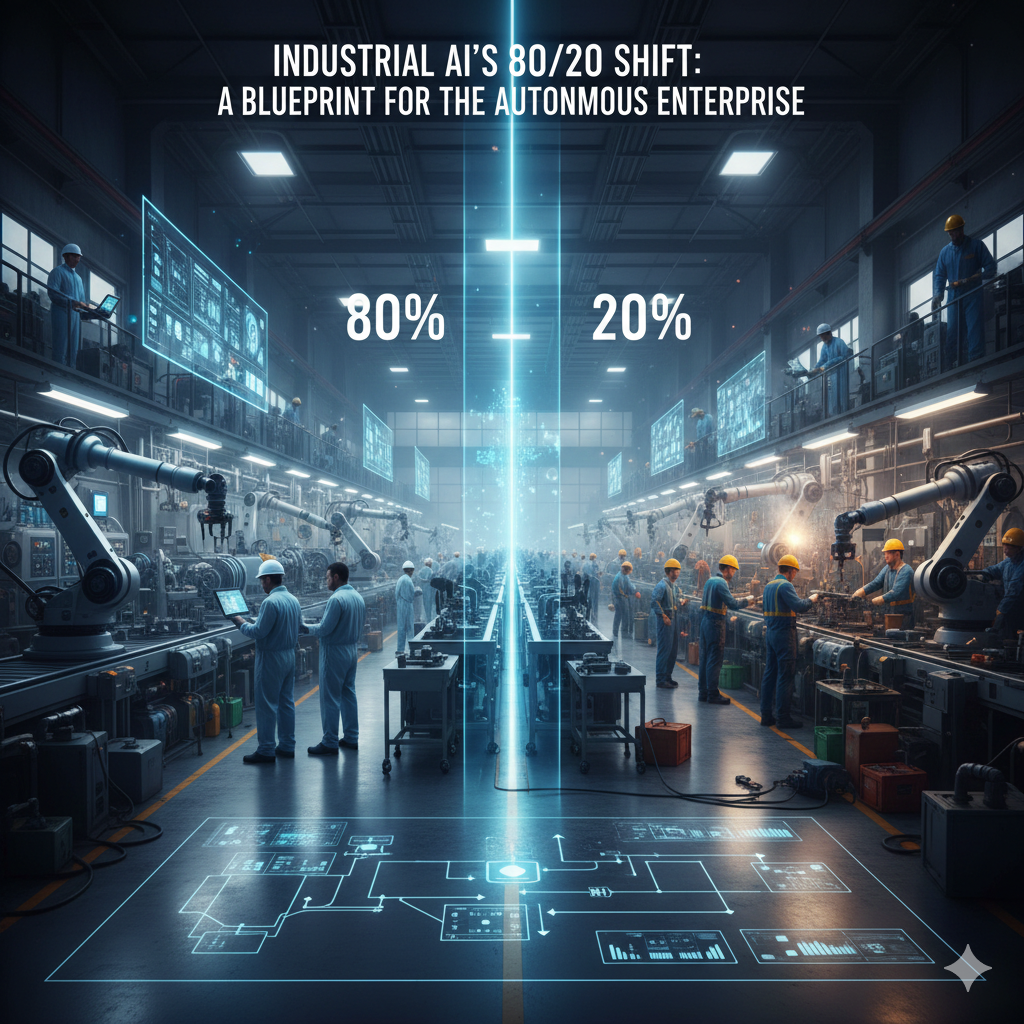
According to recent strategic outlines from Virtusa’s leadership, the solution lies in a disciplined "80/20" framework. This paradigm suggests that the future of the autonomous enterprise depends on balancing 80% standardized, platform-driven automation with 20% bespoke, domain-specific engineering.
The Graduation from Experimentation to Industrialization
In 2023, AI was a laboratory curiosity; by 2025, it has become mission-critical infrastructure. This transition, often called the "Industrial AI Shift," represents a fundamental reorganization of how technological value is created within the modern corporation.
Industrialization means moving away from isolated use cases toward comprehensive architectural governance. It’s the difference between a blacksmith forging a single sword and an automated factory producing precision instruments at scale.
The focus is no longer just on Large Language Model (LLM) performance. Instead, organizations are obsessed with scalability, security, and measurable business impact. If an AI solution cannot be governed, audited, and scaled, it simply doesn't belong in the enterprise stack.
Deconstructing the 80/20 Framework
The "80/20" rule in this context isn't just a catchy heuristic; it’s an architectural mandate. It addresses the two most common failure points in digital transformation: over-customization and under-specialization.
The "80" represents the standardized foundation. This includes the automated extraction of legacy business logic, the generation of boilerplate code, and the implementation of universal governance guardrails. By automating these "table stakes" activities, companies can reduce technical debt and accelerate their speed to market.
The "20" is where the competitive advantage lives. This is the bespoke engineering required to handle a company’s unique domain complexities—whether that’s the specific regulatory nuances of a healthcare payer or the intricate risk models of an investment bank.
From Legacy Complexity to AI-Native Clarity
One of the most persistent hurdles to this shift is the weight of legacy systems. Most Global 2000 companies are sitting on decades of "spaghetti code" that no living employee fully understands.
Virtusa’s approach to "cracking the complexity code" involves using agentic AI to reverse-engineer these systems. By using metadata-driven code generation and domain-aligned value chain mapping, enterprises can translate ancient COBOL or rigid Java monoliths into modern, AI-native microservices.
A primary example is seen in the telecommunications sector. As providers transition into "tech-cos," they are modernizing legacy Business Support Systems (BSS) that were originally designed for a voice-only era. By applying the 80/20 rule, they automate the migration of billing and customer data while hand-coding the hyper-personalized experience layers that define their brand.
The Rise of Architectural Governance
As AI becomes industrialized, "Architectural Governance" has emerged as the new North Star. Without it, enterprises risk "shadow AI"—a sprawl of ungoverned models that create massive security holes and uncontrollable costs.
True governance in the 80/20 era requires a "Privacy-by-Design" philosophy. This ensures that data lineage is tracked, bias is mitigated, and FinOps-optimized implementations keep cloud costs from spiraling out of control.
"Success in this new era depends as much on architectural discipline and rigorous governance as it does on the underlying performance of LLMs."
This shift is why midsize providers are often outperforming larger peers in current ISG Provider Lens™ assessments. Their ability to move enterprises from pilot to production hinges on lifecycle governance rather than just selling more "seats" or compute hours.
Navigating the Challenges of the Shift
While the optimism surrounding Industrial AI is high, the path is not without friction. The primary objection from many executives is the "black box" nature of AI—how can we trust an autonomous system with our core business logic?
The answer lies in the "Human-in-the-loop" (HITL) model. The 80/20 framework doesn't remove the engineer; it elevates them. In this future, the AI handles the 80% that is repetitive and soul-crushing, allowing the human expert to focus their 20% on validation, ethics, and high-level strategy.
Furthermore, there is the challenge of talent. As Shine’s recent job market data suggests, there is a massive surge in demand for Full Stack Developers who understand microservices, Docker, and AI orchestration. The "Industrial AI Shift" is creating a new class of "AI-Native Engineers" who view LLMs as just another component in a broader system.
The Bottom Line: Engineering the Future
The "80/20" future is not a distant dream; it is the current trajectory of the most successful digital transformations. By treating AI as an engineering discipline rather than a standalone tool, organizations can finally realize the promise of the autonomous enterprise.
Standardization provides the speed, but bespoke engineering provides the soul. For the modern COO, the goal is no longer to "do AI," but to build an enterprise that is AI-native by design.
The shift toward industrialization is ultimately a shift toward maturity. It is the moment we stop playing with the tools and start building the future. Those who master the 80/20 balance will lead the next decade of industry; those who don't will be left managing the legacy of the past.