
It’s Tuesday morning. You open XCode, but you aren't reaching for the keyboard to type out Swift syntax. Instead, you are staring at a pull request created by an autonomous swarm of AI agents. They spent the night rewriting your entire networking stack to align with the new Model Context Protocol (MCP), and now you have to review it. You aren’t coding; you are essentially arguing with a robot about memory safety on a device with 12GB of RAM.
Welcome to the reality of being an iOS engineer in 2026.
Two years ago, in 2024, we were obsessed with "Copilots"—tools that helped us type faster. Now, we are deep in the "Integration Era." The magic of generative text is gone. It has been replaced by the headache of architectural orchestration. We aren't just making apps anymore; we are building skill sets for a global network of digital agents.
As we get used to the iPhone 17 Pro and the divisive iOS 26 update, one thing is obvious: we aren't bricklayers anymore. We are Editors-in-Chief.
The Hardware Shift: Heat Management is Everything
For a decade, we bragged about Geekbench scores. In 2026, raw burst speed is irrelevant. The only metric that counts is Neural Capacity—can the device run a complex, multi-step AI workflow without overheating?
The A19 Pro chip (built on TSMC’s N3P process) is impressive, but not because it’s fast. It’s impressive because of its thermal stamina. Apple finally admitted that you can’t run a local Large Language Model (LLM) for twenty minutes using just a graphite cooling sheet. The vapor chamber in the iPhone 17 Pro wasn’t added for gamers; it was a necessity for the agentic era.
We used to design for a memory budget. Now, we design for a thermal budget. If your app’s agent is trying to book a flight while cross-referencing three other apps and negotiating with an API, it is hammering the Neural Engine. If the phone gets too hot and throttles, your agent fails. And if the agent fails, the user loses trust immediately.
iOS 26 and the "Liquid Glass" Headache
We have to talk about "Liquid Glass." When Apple showed off the new iOS 26 design, they called it a "refractive interface." In reality, it was a battery killer. The real-time rendering needed for those translucent layers absolutely destroyed the battery life on older models like the iPhone 16 Pro, leading to months of angry Reddit threads.
But if you look past the bad battery life, the philosophy is clear. "Liquid Glass" represents the dissolving walls between applications. In iOS 26, the idea of an "app" as a visual destination is dying. Users don't navigate into your app; they interact with your services through Siri or the Action Button. If your app doesn’t have rock-solid App Intents, it might as well not exist. You aren't fighting for screen time anymore; you are fighting for a slice of the AI’s context window.
RIP View Controllers: The MCP Era
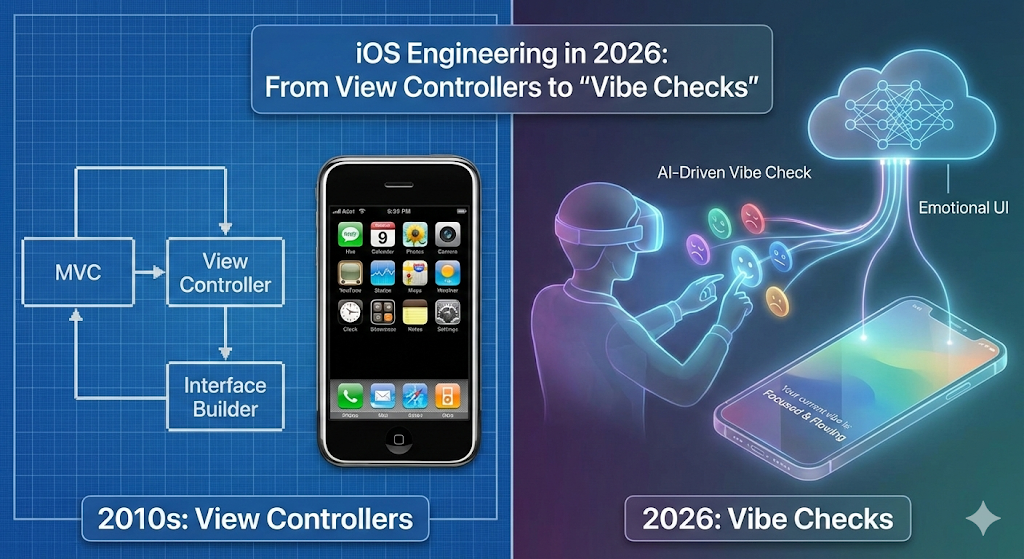
Forget MVC or MVVM. The only acronym that matters in 2026 is MCP (Model Context Protocol). This is the standard for hooking AI models up to your data. When Apple adopted MCP in iOS 26, it killed the "walled garden" approach to data. Previously, you built a UI so a user could search your database. Now, you build an MCP server so Siri (or Gemini, or Claude) can search your database for the user. Your actual visual screens are just backup tools for when the headless logic gets confused.
The 2026 Architecture: "Sandboxed Agency"
The Core: A headless logic layer connected via MCP.
The Guardrails: Security layers to stop prompt injections from stealing user data.
The UI: An adaptive interface that only pops up when the user needs to take manual control.
This has created a weird skills gap. Senior engineers are frantically learning how to debug non-deterministic AI behavior, while Junior devs are actually doing better because they are good at negotiating with models, even if they can’t write optimized Swift.
"Vibe Coding" and the Quality Drop
This leads to the most annoying trend of the year: "Vibe Coding." Tools like Cursor and the new Xcode AI let you build features just by describing the "vibe" you want. No code required. It feels like magic—until it breaks.
There is a flood of apps right now that look great but crash the moment you hit an edge case. Because the "creator" didn't write the code, they have no idea how to fix it. They just keep prompting the AI to "fix the bug," which results in a tangled mess of spaghetti code. As engineering leads, we don't do code reviews anymore. We do Logic Reviews. We aren't looking for syntax errors; we are looking for hallucinations and security holes where an agent might approve a transaction it shouldn't.
The Black Box of Private Cloud Compute
Apple’s Private Cloud Compute (PCC) is great for privacy, but it is a nightmare for debugging. We are now dealing with a split runtime:
On-Device: Fast and private, but limited by heat and battery.
PCC: Infinite power, but totally opaque.
When a bug only happens during a handoff to the cloud, you can’t attach a debugger. You are debugging a black box running in a data center you’ll never see. This has birthed "Observability Engineering." We are now tracking "intent confidence scores" rather than stack traces.
The Bottom Line
Engineering in 2026 is chaotic and a little scary. The "10x Developer" isn't the fast typer anymore; it's the person who can conduct a symphony of AI agents without the whole thing collapsing.
We traded memory leaks for context leaks. We traded UI bugs for logic hallucinations. But, we are also building software that can actually think. If you feel overwhelmed by vapor chambers, battery drain, and MCP configs, take a breath. We are all in the same boat. We are figuring out how to be Architects in a world that is trying very hard to code itself.
The code doesn't matter. The intent is the only thing that counts.