
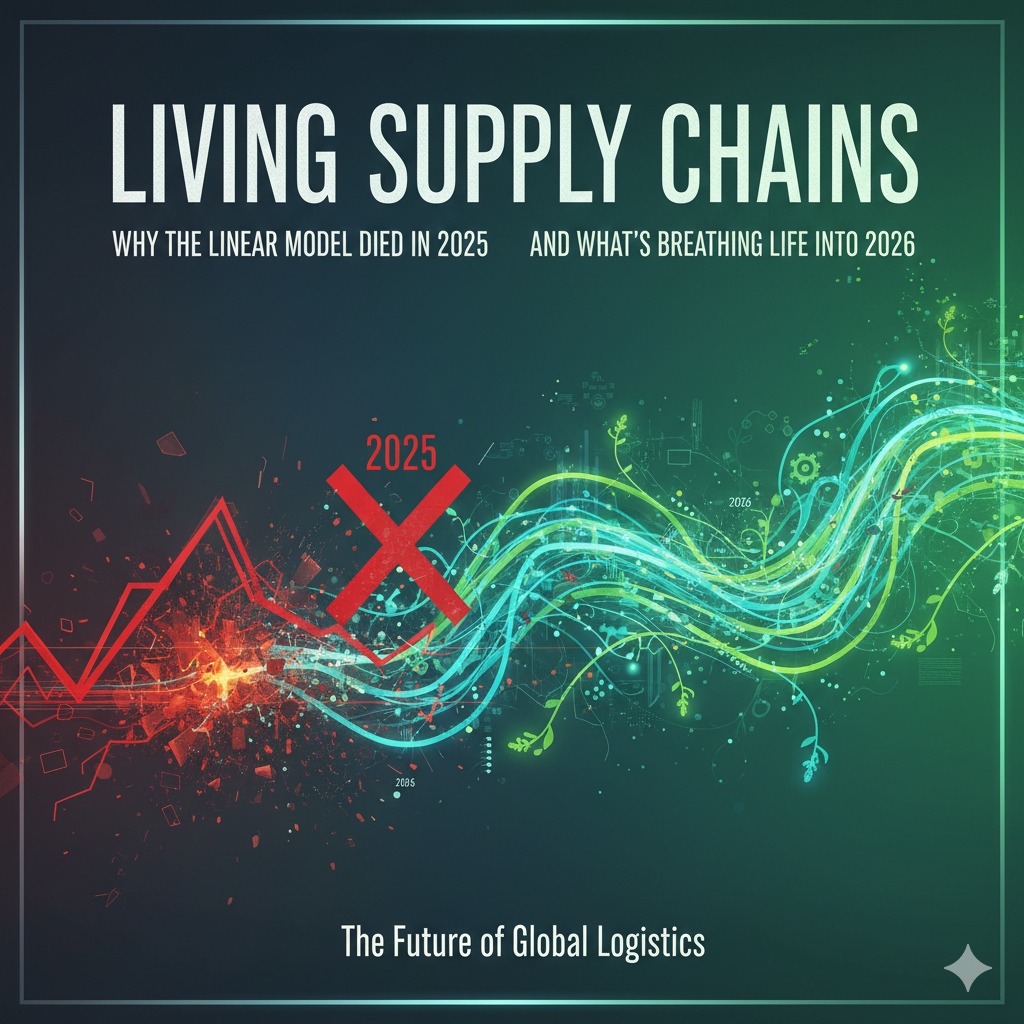
The industrial landscape of 2026 represents a definitive rupture from the rigid, linear supply chain architectures that dominated the first two decades of the twenty-first century.
For years, we treated our global networks like clocks—mechanical, predictable, and prone to total failure if a single gear slipped. But as global volatility transitioned from an occasional disruptor to a permanent operating condition, the clock stopped ticking.
In 2026, the concept of the supply chain has undergone a profound ontological shift. We no longer view it as a series of static, transactional links, but as a "living" ecosystem—a dynamic, self-improving organism capable of sensing, adapting, and growing in response to environmental stimuli.
This evolution is driven by a convergence of technological titans: Agentic Artificial Intelligence (AI), ubiquitous connectivity, and sophisticated, ontology-driven digital twins. The result is an intelligent manufacturing paradigm where resilience is not just a reactive capability but an inherent, structural characteristic of the value chain.
From Generative Chat to Agentic Action
The biggest shift between 2024 and 2026 was the move from Generative AI to Agentic AI. While we once marveled at chatbots that could summarize reports, we now rely on autonomous agents that can execute complex, multi-step industrial processes without human hand-holding.
According to research from Deloitte, agentic AI is no longer a pilot project; it is the "industrial brain" of the modern factory. These systems don't just predict a delay; they negotiate with alternative suppliers, re-route logistics, and update production schedules in real-time.
"The journey toward adaptive autonomy is not about replacing human intelligence but about enhancing it by enabling organizations to thrive in unpredictable environments." — MSRcosmos
This level of autonomy is made possible by "self-healing" IT systems. When a data pipeline breaks or a sensor drifts, the AI agent diagnoses the exception and applies a fix, learning from the resolution to prevent future occurrences. This has effectively ended the era of "dumb" automation, where a single missing comma in an invoice could halt a multi-million dollar production line.
The Five-Stage Blueprint for Autonomy
Most leading manufacturers in 2026 have moved through a five-stage maturity model. They began with basic robotic process automation, moved through predictive analytics, and have now reached the stage of "Cognitive Orchestration."
At this level, the AI doesn't just follow a script; it understands the intent of the business. If a CEO sets a goal to reduce carbon emissions by 15%, the agentic system autonomously adjusts the sourcing of raw materials and the energy consumption of the shop floor to meet that target without needing a thousand manual sub-tasks.
Connectivity as the Industrial Nervous System
If AI is the brain, then the emerging connectivity landscape of 2026 is the nervous system. We are currently witnessing the transition from 5G-Advanced to early 6G trials, a shift that Juniper Research identifies as a fundamental rebuilding of network intelligence.
6G is being positioned not just as "faster internet," but as a distributed computing platform. It allows for "Edge Renaissance," where processing happens directly at the sensor or the machine tool, reducing latency to near-zero and enabling "holographic communication" between designers in different hemispheres.
The European Smart Networks and Services Joint Undertaking (SNS JU) has already showcased 2025’s top achievements in zero-energy devices and AI-native networks. These technologies ensure that every pallet, every motor, and every technician is a live data point in the living supply chain.
The Death of Data Silos: Manufacturing-X and Interoperability
For decades, the "interoperability roadblock" was the dirty secret of Industry 4.0. Plants operated with different processes, produced different products, and reported metrics in incompatible formats, making a "global view" of the supply chain a pipe dream.
In 2026, this hurdle is being cleared by the Manufacturing-X initiative. This open, federated data ecosystem ensures that security, sovereignty, and interoperability are baked into the sharing of product and manufacturing data.
We are seeing the practical fruits of this in projects like Catena-X for the automotive industry and Factory-X for networked production. These platforms allow manufacturers to share "Digital Product Passports" (DPPs) across company boundaries.
For instance, Ford, Flex, and Micron have successfully used these dataspaces to track Product Carbon Footprints (PCF) across multiple tiers of the supply chain. This isn't just about compliance; it's about gaining a competitive edge through radical transparency.
The Circular Imperative: Closing the Loop
The traditional linear model—extract, produce, use, dispose—has reached its breaking point. With global waste generation expected to reach nearly 4 billion metric tonnes by 2050, the "take-make-dispose" mindset is now a financial liability.
In 2026, circularity is no longer an ESG "nice-to-have"; it is a survival strategy. Schneider Electric has demonstrated how refurbishment centers and waste-to-resource sites can transform a manufacturer from a consumer of raw materials into a manager of a "perpetual material loop."
The circular economy revolution is now estimated to be worth roughly $4.5 trillion. By 2026, over 60% of major enterprises will have the capabilities to drive profitability through circularity, using AI to track the lifecycle of every component and predict when it needs to be reclaimed or repaired.
Advanced Materials and Self-Healing Hardware
The hardware is becoming as "living" as the software. The market for advanced materials is surging, with a particular focus on "self-healing" polymers and metals.
Imagine a turbine blade that can repair microscopic cracks in flight, or a composite panel that "heals" itself after a minor impact. These materials extend the lifetime of industrial assets by up to 100%, fundamentally changing the economics of maintenance and replacement.
The Human Element: From Operators to Orchestrators
A common fear is that "living" supply chains will leave humans in the dust. However, research into AI and labor share suggests a more nuanced reality: the demand for labor is shifting, not disappearing.
In 2026, the most valuable employees are those who can act as "AI Orchestrators." These are individuals who combine deep domain expertise in manufacturing with the ability to manage and audit autonomous agents. The focus has shifted from manual tasks to "higher-order" cognitive activities like system design, ethical oversight, and strategic integration.
We are seeing a "Labor Structure Upgrading" where the strategic combination of technological strengths and human expertise creates superior performance that neither could achieve alone. The factory floor of 2026 is less a assembly line and more a high-tech laboratory.
The Realistic Challenges: Geopolitics and Security
We must balance this optimism with the reality of 2026's challenges. Geopolitical fragmentation remains a significant headwind. As ResearchGate studies have noted, manufacturers must now maintain "Structural Ambidexterity"—the ability to be globally integrated yet locally resilient.
Furthermore, as our supply chains become more intelligent and connected, they become larger targets for cyber-attacks. The transition to TISAX Level 2 and other mandatory security certifications has become a prerequisite for participating in global data spaces.
There is also the "Silicon Chasm"—the widening gap between those who can afford the infrastructure for agentic AI and those who are still struggling with legacy ERP systems. The risk of a two-tier industrial economy is very real.
Conclusion: Embracing the Organism
The "Living Supply Chain" of 2026 is not a finished product; it is a process of constant becoming. It is an ecosystem that learns from its failures, adapts to its environment, and prioritizes resilience over fragile, narrow efficiency.
For the modern executive, the lesson is clear: you cannot control the volatility of the 2020s, but you can build a system that thrives because of it. Success no longer belongs to the biggest or the leanest, but to the most responsive.
The linear world is gone. The era of the industrial organism has arrived. It is time to stop managing links and start nurturing the life of your supply chain.