
Introduction
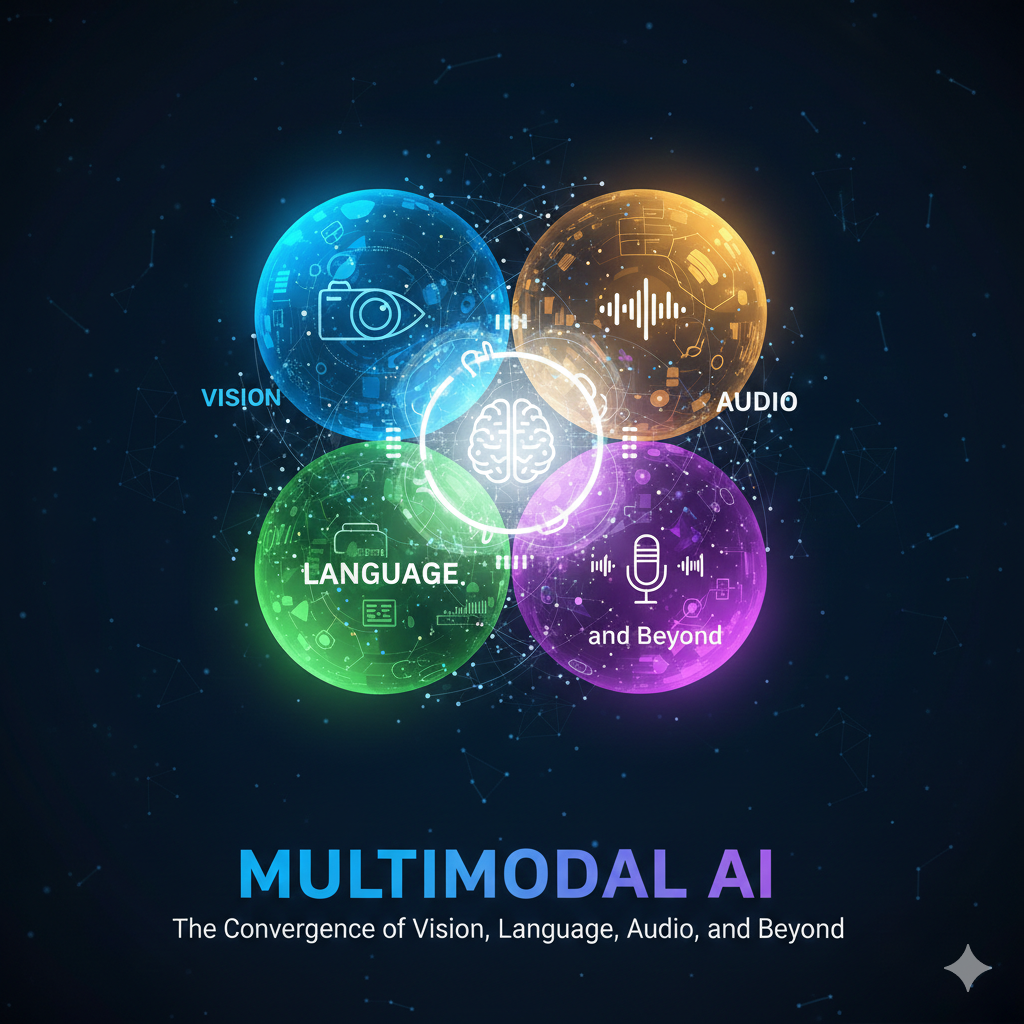
Multimodal AI represents the next stage in artificial intelligence evolution, moving beyond text-based interaction toward systems that can understand and generate content across multiple data types simultaneously—including text, images, audio, video, and spatial information. This mirrors how humans process the world, combining visual, verbal, and auditory cues to reason and act.
By 2025, multimodal capability is no longer defined by the ability to accept an image or audio input. Instead, it refers to end-to-end systems that seamlessly operate across modalities within a single workflow, enabling entirely new classes of applications that were impossible with text-only models.
From Feature to Foundation
Early multimodal systems relied on stitched pipelines—image recognition feeding text models, speech transcribed before reasoning, or video analyzed frame by frame. Today’s frontier models process multiple modalities natively within a unified architecture.
This shift has transformed multimodal AI from a differentiating feature into a foundational requirement. Leading models now compete on how deeply and efficiently they integrate modalities rather than whether they support them at all.
Advances in Multimodal Model Design
Recent progress in multimodal AI has been driven by architectural innovation rather than simple scale:
Unified models that process vision, language, and audio without intermediate conversion
Native audio understanding, including tone, rhythm, and emphasis
Real-time multimodal interaction with minimal latency
End-to-end reasoning from raw input to structured output
Research breakthroughs have shown that binding multiple sensory representations into a shared embedding space can outperform much larger single-modality systems, significantly improving efficiency and generalization.
Industry Leaders and Ecosystem
Major AI providers have rapidly expanded their multimodal offerings:
OpenAI delivers native multimodal reasoning, image generation, and low-latency voice interaction
Google DeepMind emphasizes creative multimodal output and deep integration with search and productivity tools
Anthropic focuses on safe, document-aware multimodal reasoning
Meta advances open multimodal research within its LLM ecosystem
Microsoft integrates multimodal AI across enterprise cloud and productivity platforms
At the same time, open-source initiatives have lowered barriers to entry, enabling multimodal models to run on consumer hardware and accelerating global experimentation.
Practical Applications Across Industries
Multimodal AI is already reshaping how digital systems interact with the physical and human world:
Customer Support
AI systems can analyze screenshots, interpret spoken explanations, detect emotional signals in voice, and provide visual guidance—reducing resolution time and improving satisfaction.
Education
Students interact with AI by showing their work, explaining problems verbally, and receiving immediate, adaptive feedback. Multimodal interfaces also improve accessibility for diverse learning needs.
Healthcare
AI systems combine medical imaging, physician notes, lab results, and spoken consultations to support diagnostics and monitoring, offering richer clinical context than any single data source alone.
Creative and Productivity Tools
Multimodal models enable natural content creation across text, images, audio, and video, allowing users to ideate, edit, and refine outputs within one continuous interaction.
Infrastructure and Enablement
The rise of multimodal AI has been supported by advances in infrastructure:
Native multimodal support in major ML frameworks
Cloud platforms optimized for multimodal inference
Standardized benchmarks for evaluating cross-modal understanding
These foundations are making multimodal systems easier to deploy at enterprise scale.
Challenges and Considerations
Despite rapid progress, multimodal AI introduces new complexities:
Higher computational and memory demands
Increased difficulty in evaluation and debugging
Data alignment and bias across modalities
Privacy concerns when combining visual, audio, and textual data
Addressing these challenges will be critical as multimodal systems become more deeply embedded in real-world workflows.
The Road Ahead
Multimodal AI is moving toward continuous, real-time interaction, where systems see, hear, reason, and respond simultaneously. As models improve at integrating sensory information, they will become more intuitive collaborators—closer to how humans naturally communicate and problem-solve.
Future advances are expected to focus on efficiency, robustness, and deeper contextual understanding, pushing multimodal AI from impressive demos into indispensable digital infrastructure.
Conclusion
Multimodal AI marks a fundamental shift in how machines perceive and interact with the world. By unifying vision, language, and sound into coherent reasoning systems, it unlocks richer experiences, more capable products, and entirely new applications. As this convergence accelerates, multimodal intelligence will define the next generation of AI-powered systems.