
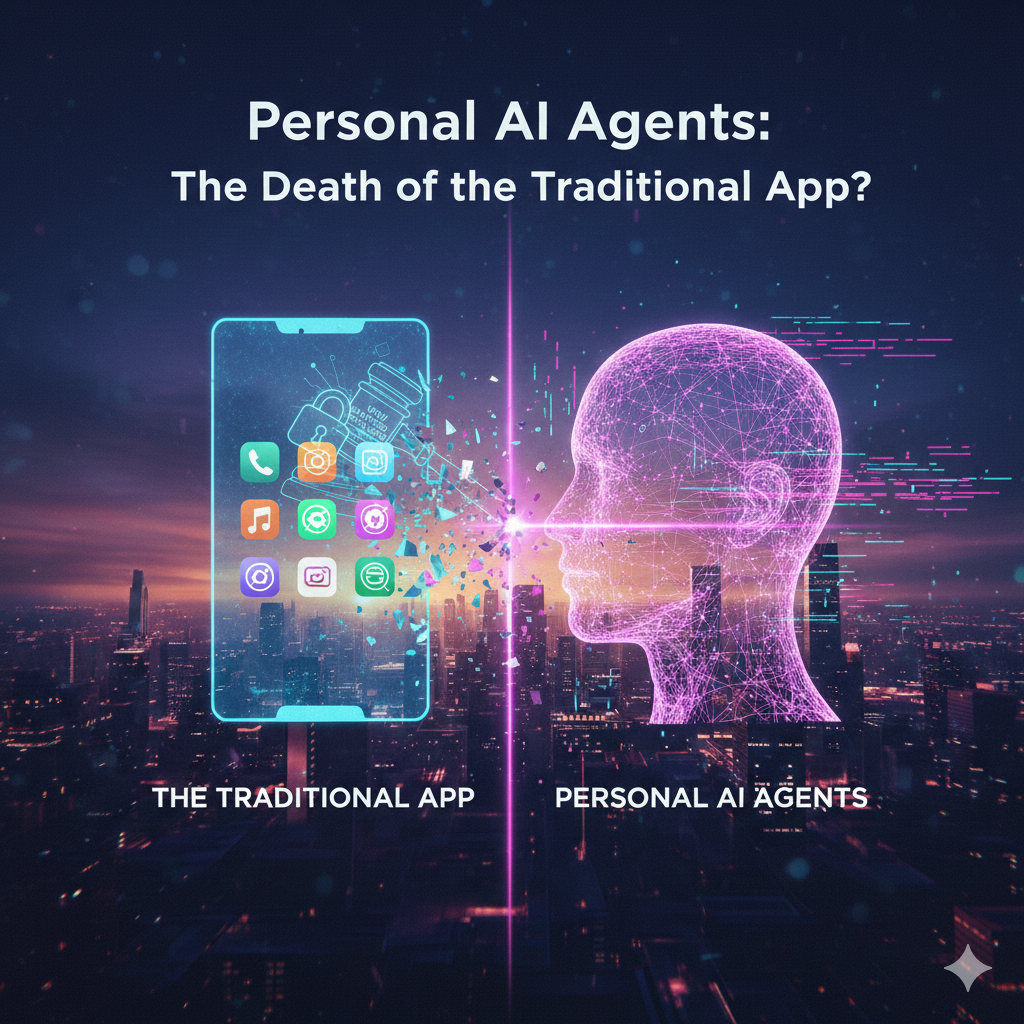
For the last fifteen years, our digital lives have been governed by a single, undisputed mantra: "There’s an app for that." We’ve meticulously organized folders, mastered complex menus, and adapted our own mental workflows to fit the rigid structures of software developers.
But we are currently witnessing the beginning of the end for the traditional application as we know it. The friction of the Graphical User Interface (GUI) is finally being outweighed by its utility, paving the way for a single, intelligent orchestration layer that doesn't just wait for your command but understands your goals.
The Great Migration from GUI to LUI
For decades, the standard for digital interaction has been the graphical interface, requiring us to act as the manual bridge between our intent and the tool’s specific functions. This process of "technical translation"—where you must know exactly which button in a specific sub-menu triggers a desired action—is becoming a legacy skill.
The emergence of the Language User Interface (LUI) represents a shift from manual labor to executive direction. Instead of navigating through three different apps to book a trip, you simply state your intention to a personal AI agent.
This isn't just a faster way to use apps; it is a fundamental shift in the unit of value. In the GUI era, professional value was often tied to tool proficiency—how well you knew Excel or Photoshop. In the era of agentic computing, value is migrating toward strategic intention.
Apple vs. Google: The Battle for the Orchestration Layer
The race to become your primary digital orchestrator has reached a fever pitch in 2025 and 2026. Apple Intelligence and Google’s Gemini are no longer just "smart assistants" but are evolving into deep system-level agents capable of cross-app action.
Apple’s approach focuses heavily on on-device processing and Private Cloud Compute, ensuring that your most personal data never leaves the hardware. By using App Intents, Apple is essentially turning every app on your iPhone into a backend command hub that Siri can pilot on your behalf.
Google, meanwhile, is leveraging its massive cloud advantage to weave Gemini into the Android desktop experience and Chrome. Their strategy suggests a world where the browser itself becomes an active assistant, automating web-based tasks like research and shopping through "auto-browse" features.
The winner won't necessarily be the one with the best "apps," but the one with the agent that most reliably interprets human intent across the largest ecosystem.
Agentic Commerce and the $1 Trillion Shift
The most profound economic impact of this shift will likely be felt in how we buy things. McKinsey research suggests that by 2030, the US B2C retail market could see up to $1 trillion in orchestrated revenue from agentic commerce.
Shopping is transforming from a search-and-compare exercise into a delegation task. Imagine an agent that doesn't just find a pair of shoes but negotiates a discount, checks your calendar for the best delivery time, and executes the transaction based on your prior style preferences.
This creates a "new era for consumers and merchants" where the brand-to-consumer relationship is mediated by an AI gatekeeper. Merchants will have to learn how to market not just to humans, but to the algorithms that represent those humans’ best interests.
The Hardware Dilemma: Beyond the Smartphone
While the phone remains the dominant gateway for AI, we’ve seen a wave of experimental hardware trying to kill the screen entirely. The Humane AI Pin and the Rabbit R1 were bold attempts to move us into a "post-app" world, though they largely struggled to find a footing due to latency and reliability issues.
However, the hardware dream isn't dead; it’s just changing form factors. GlobalData projects the wearable technology market to hit $232 billion by 2030, driven largely by smart glasses and "hearables."
Smart glasses, such as those being developed under Android XR, offer a multimodal understanding of the world. An agent that can see what you see through a camera is infinitely more capable than one that only lives behind a glass screen in your pocket.
Even the most storied designers are entering the fray, with Jony Ive and OpenAI reportedly collaborating on a secret AI device, though recent filings suggest we won't see it until at least 2027.
The Risks: Security, Tax, and the "Agent Tax" Crisis
As we hand over the keys to our digital lives, the security stakes rise exponentially. IBM has highlighted that agentic AI brings new vulnerabilities that go beyond standard chatbots, as agents can participate in real-time decision-making and call external tools autonomously.
There is also a bizarre new regulatory frontier: the "Agent Tax" crisis. Recent studies reveal a $2.7 billion legal arbitrage where AI companies are structuring their agents as "professional services" rather than "taxable software" to avoid state taxes.
This reflects a broader tension: our legal and economic systems are built for a world where humans do work and software is a tool. When the software becomes the worker, every assumption from liability to taxation begins to crumble.
The Outcome-Focused Future
The shift from apps to agents is essentially a shift from "how" to "what." In the old world, you spent your day managing the how—how to format a document, how to sync a calendar, how to navigate a CRM. In the new world, your primary skill is defining the what and the why.
Productivity is no longer about the speed of your clicks; it’s about the clarity of your thought. If you can't clearly instruct an AI on the desired outcome, all the agentic power in the world won't help you.
We are entering the era of the "AI Director," where the most successful individuals will be those who can think strategically and direct a fleet of autonomous systems. The apps aren't disappearing entirely, but they are retreating into the background, becoming the invisible plumbing for a more human-centric digital experience.
The era of digital friction is ending. The era of pure intention is just beginning.