
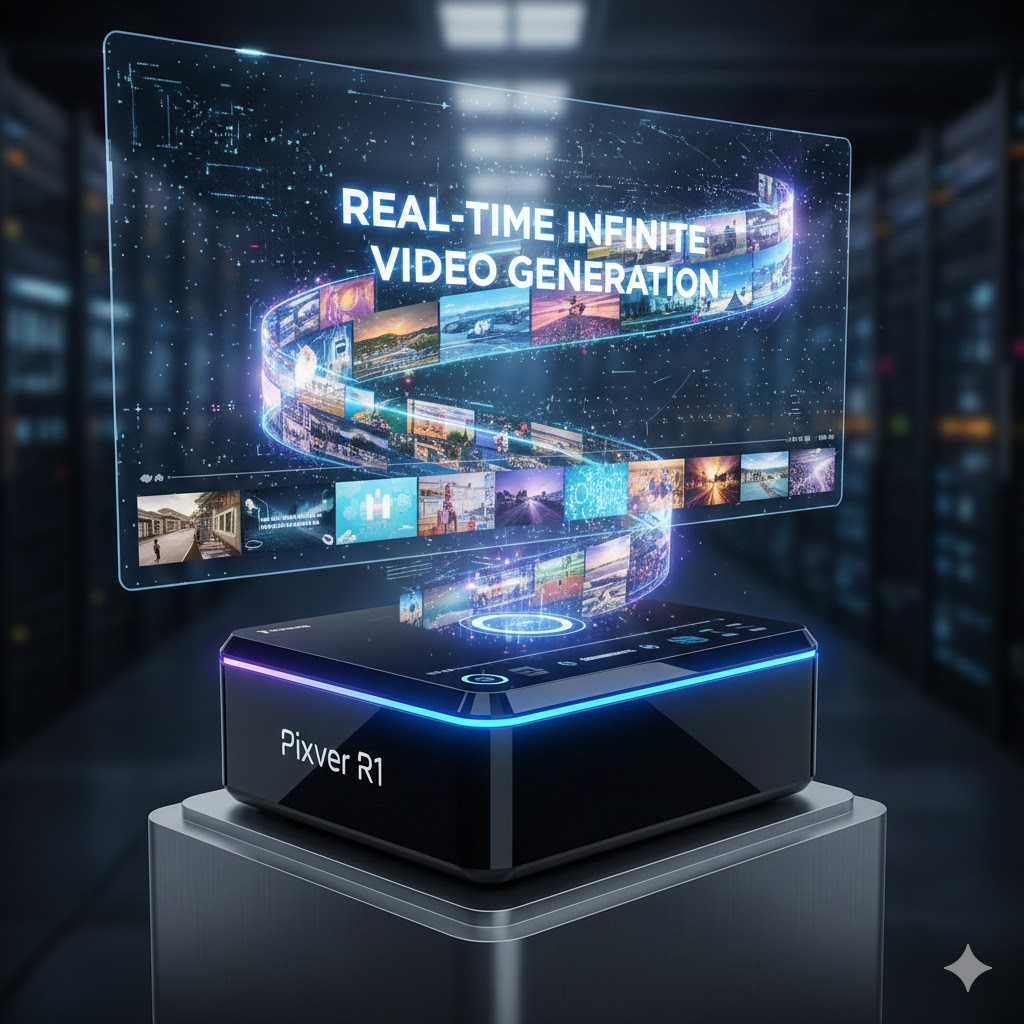
Introduction to PixVerse R1: The Dawn of Real-Time Video
In January 2026, Beijing-based startup AIsphere effectively redefined the speed limit for generative media. With the official unveiling of PixVerse R1, we moved past the era of queuing up prompts and waiting minutes to see if the result matched the vision. This is the world's first universal real-time world model, and the shift in utility is substantial.
The friction of the traditional "prompt-wait-render" cycle is gone. Instead, R1 offers a near-instant, interactive workflow where high-definition 1080P visuals are generated as fast as you can direct them. It’s no longer about rendering a static file; it’s about interacting with a visual stream that evolves dynamically.
R1 Launch Snapshot
Developer: AIsphere (Beijing)
Official Launch: January 2026
Output Resolution: High-definition 1080P
Core Innovation: Eliminates rendering wait times for a fully interactive, real-time experience
The Architecture of Instant Response: IRE and Omni
R1 moves away from the "prompt-wait-render" fatigue by rebuilding the generation pipeline from scratch. It relies on two specific architectural breakthroughs to achieve real-time interactivity.
First, there's the Instant Response Engine (IRE). Instead of brute-forcing the generation, the IRE employs temporal trajectory folding to radically compress the computing workload.
Efficiency at a Glance
Traditional Diffusion: Typically requires 50+ sampling steps to resolve noise into a coherent image.
R1 Architecture: Delivers 1080p fidelity in just 1–4 steps.
Under the hood, this engine is supported by Omni, a native multimodal foundation model. Unlike previous iterations that patched audio onto finished clips, Omni processes video and audio streams simultaneously. This ensures that when your visual narrative pivots, the acoustic layer adapts in perfect lockstep, maintaining the illusion of a cohesive world.
Infinite Streaming: How R1 Maintains Long-Horizon Consistency
The Memory Problem
Most video generators suffer from amnesia—they render a short clip and reset. R1 takes a different approach by treating video as a continuous, evolving stream. It utilizes an autoregressive memory system that predicts subsequent frames based on the immediate history of the visual data.
Instead of generating a fixed block of time, the model sequentially "reads" what just happened to decide what happens next. This allows for infinite streaming, where spatial logic and object permanence remain intact over long durations.
Note: While this is a massive leap forward, it’s not magic. We do see "temporal error accumulation" in very long sequences—where physics might get slightly floaty as the model drifts from the original reference—but the continuity holds surprisingly well.
Case Study: The 'Dragons Cave' Demo To prove the stability of this system, AIsphere ran a 15-minute continuous fantasy simulation.
The Scenario: A dragon moving through a complex cave system.
The "Aha" Moment: Persistent Destruction. When the creature smashed a rock formation early in the stream, the rubble remained on the ground minutes later. The model didn't "heal" the environment; it remembered the change.
Directing the Stream: Real-Time User Interaction
Forget the old "render and pray" workflow where you wait minutes just to see if a prompt worked. With R1, you aren't just a prompter; you’re a director standing in a live control room. The distinction is crucial: you are interacting with a continuous stream, not a static file.
Here is how you actually control the chaos:
Initiate the Stream: Start your generation. The video begins flowing immediately via the Instant Response Engine—there are no loading bars here.
Inject Live Commands: This is the "zero-restart" phase. Don't hit stop. While the video plays, input a new direction. You might type "shift to heavy rain," "change lighting to neon," or "character turns left."
Watch the Morph: The model doesn't cut to black. It morphs the current frame into your new intent. The background shifts or the character reacts instantly, maintaining the narrative thread.
The Feedback Loop: Because the visual feedback is immediate, you can correct course instantly. If the "sunset" looks too orange, dial it back in the next second. You are sculpting the video, not just requesting it.
Tutorial: Manually Expanding Video into Infinite Narratives
While R1 offers an infinite stream natively, achieving similar results with the high-fidelity V5 model requires a bit of manual engineering. You generally have two paths: the built-in tools for short extensions, or manual stitching for truly long-form content.
Using the Native 'Extend' Function
For quick additions, the interface handles the heavy lifting. If your base clip is standard length, the Extend feature analyzes the final segment and predicts the next 5 to 8 seconds of motion. This is perfect for extending a scene up to about 30 seconds, but beyond that, you'll hit hard limits.
The Frame-Stitching Method
To break past the 30-second barrier, you need to treat the end of one generation as the seed for the next. This manual loop allows for infinite narrative expansion.
Logic: Infinite Loop_ Sequence

1. Source: Take the LAST frame of Clip A.
2. Input: Upload that frame to "Image-to-Video".
3. Configuration:
   - Prompt: Retain original keywords + new action.
   - Seed: MUST match Clip A's seed.
4. Generate: Produces Clip B.
5. Repeat: Last frame of Clip B becomes input for Clip C.
Expert Note: Visual continuity relies entirely on your metadata. If you change the Seed number between stitches, the lighting and character structure will drift immediately. Keep your core prompt keywords locked; only modify the verbs describing the movement.
#Comparison: PixVerse R1 vs. PixVerse V3/V5
Choosing Your Engine: Speed vs. Polish
It’s crucial to understand that R1 isn't just an upgrade to V5—it’s a different species entirely. While V3 and V5 are your traditional production workhorses (you prompt, you wait, you get a polished clip), R1 is built for the now.
We are effectively looking at a split between interactive streaming and high-fidelity rendering.
If you're building a narrative short film where lighting and texture must be perfect, V5 is still your go-to. However, if you are experimenting with game mechanics or need a responsive visual flow, R1 changes the rules.
Here is the breakdown of the trade-offs:
FeaturePixVerse R1 (Real-Time)PixVerse V3/V5 (Storytelling)Workflow Interactive Stream: Modify actions/lighting live without restarting. Linear: Prompt $\right arrow$ Wait $\right arrow$ Render. Speed Instant generation (1-4 denoising steps).~5-10 seconds for high-quality renders.Resolution1080P (Native Streaming).Up to 4K (via Upscaling).Tooling Live modifiers & infinite context window. Magic Brush, Lip-sync, & Transitions. Trade-off Minor physical drift over long durations. Slower iteration time.
Pro Tip: Don't abandon V5 yet. R1 is incredible for "live" content, but for precise control—like syncing dialogue to a script—the specialized tools in V3/V5 (specifically Lip-sync and Magic Brush) remain superior.
Industry Applications: Gaming, Cinema, and VR
The shift from pre-rendered clips to real-time generation fundamentally changes the logic of digital entertainment. We aren't just speeding up production workflows here; we are enabling entirely new media formats that rely on immediate feedback loops rather than static assets.
Core Market Opportunities
AI-Native Gaming: This represents a massive architectural shift. Instead of scripting every potential interaction, developers can build "infinite" worlds where environments physically evolve based on player intent. If you destroy a wall, the rubble generates dynamically—no pre-baked textures required.
Interactive Cinema: We are moving past simple branching storylines. R1 allows viewers to visually steer the narrative—altering lighting, character actions, or plot direction mid-stream—without the "prompt-wait" friction that breaks immersion.
VR/XR Environments: Immersion relies on speed. By compressing diffusion steps, R1 handles the low-latency dynamic rendering critical for XR, ensuring the visual stream keeps up with head tracking and spatial movement in real-time.
Technical Specifications and Known Limitations
Under the Hood
Let’s look at the engine driving this. PixVerse R1 isn't just speeding up traditional rendering; it uses an Instant Response Engine that compresses the standard ~50 diffusion sampling steps down to just 1–4. This architecture supports the autoregressive memory system required for infinite streaming, but it adheres to specific output parameters.
Core Specifications:
Native Resolution: 1080P High-Definition.
Upscaling: Options for 4K resolution are available (requires additional credits).
Frame Rates: Defaults to 16 FPS for standard generation; 24 FPS available for cinematic motion.
Architecture: Autoregressive memory allows for continuous, "infinite" visual streaming.
Caution: The Speed Trade-off
You can't cheat physics without a cost. To maintain near-zero latency, R1 prioritizes speed over perfect simulation. In extended sequences, you may encounter temporal error accumulation. Essentially, visual logic might "drift," leading to minor losses in physical fidelity or consistency the longer a stream runs without user intervention.
Market Impact and the Future of AIsphere
Beyond the Tech Demo
It’s easy to get lost in the technical nuances of "infinite streaming" and "trajectory folding," but the commercial reality here is just as interesting. AIsphere isn't just releasing a research paper; they are capitalizing on a massive user base that is clearly hungry for speed over perfection.
By the time R1 hit the public in January 2026, the Beijing-based startup had already cemented itself as a dominant force. The numbers from late 2025 paint a clear picture of their trajectory:
Massive Adoption: They captured a 20% market share in the crowded AI video application sector.
Active User Base: Approximately 16 million monthly active users are currently on the platform.
Capital Injection: The company secured over $60 million in funding, with strategic backing from heavyweights like Alibaba.
Expert Take: This specific combination of high user volume and deep-pocketed backing suggests AIsphere is pivoting. They aren't just building a video tool anymore; they are building the real-time infrastructure for the next generation of the immersive web.