
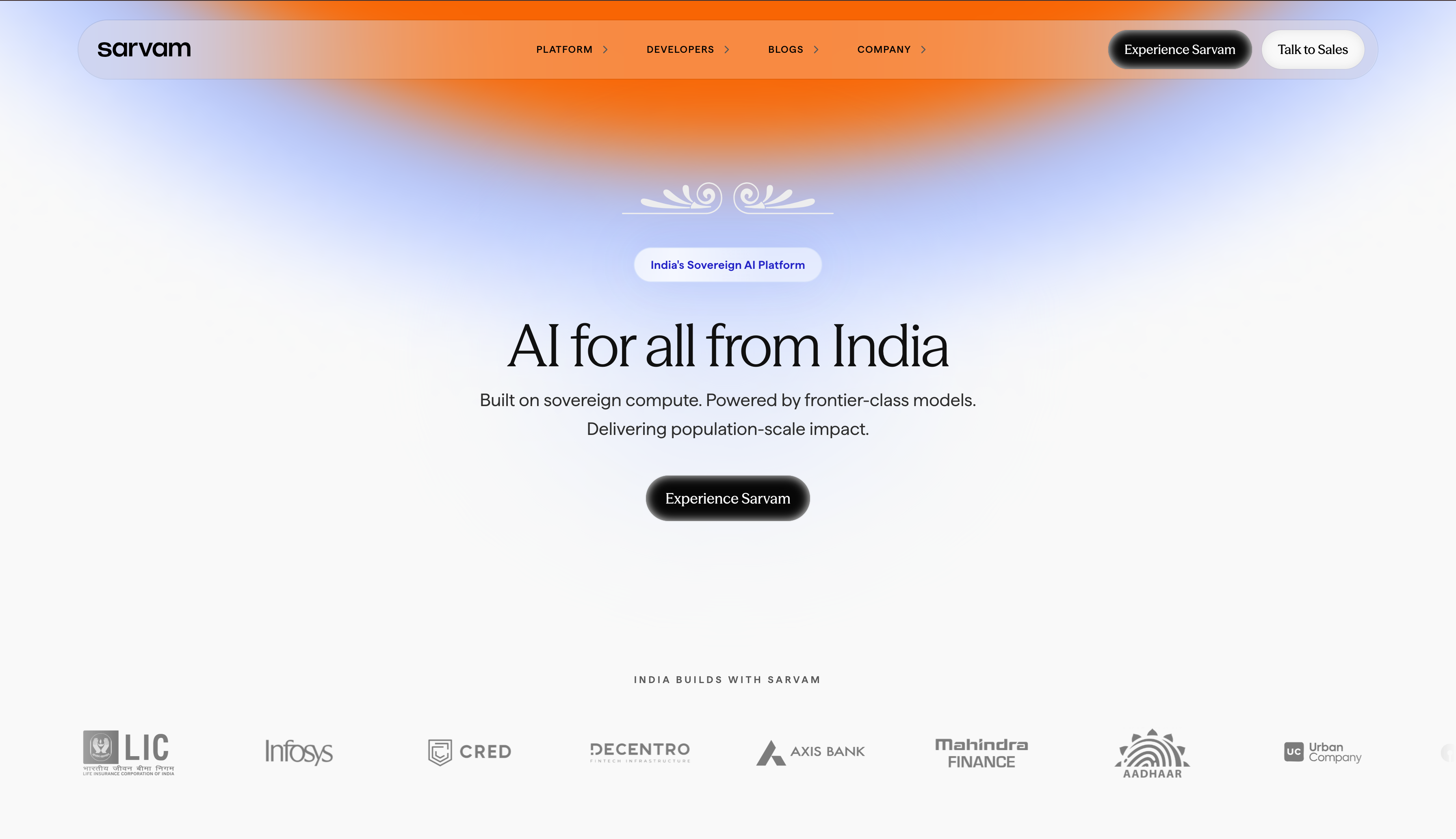
Building the AI Stack for a Billion Voices
There is a quiet revolution unfolding in Bengaluru, in the offices of a startup that believes the future of artificial intelligence doesn't have to be written in English. Sarvam AI — the name itself means "everything" or "all" in Sanskrit — is India's most ambitious attempt yet to build a full-stack, sovereign AI platform for the world's most linguistically diverse democracy. In just over two years since its founding, it has gone from a research-driven startup to the company entrusted by the Government of India to build the nation's first indigenous large language model. This is its story.
The Genesis: Why Sarvam Exists
India is home to over 1.4 billion people and more than 20 officially recognized languages, with hundreds of dialects layered on top of those. Yet, when the global AI boom arrived — GPT-4, Gemini, Claude, Llama — almost every one of these frontier models was designed around English-first architectures. For the vast majority of Indians who communicate primarily in Hindi, Tamil, Telugu, Bengali, Kannada, Marathi, Odia, Gujarati, or Punjabi, these tools were either inaccessible or deeply inaccurate.
Sarvam AI was founded in August 2023 to fix precisely that gap.
The Founders: Where Policy Meets Research
The company was co-founded by two figures who bring unusually complementary backgrounds to the AI frontier.
Dr. Pratyush Kumar serves as CEO. An IIT Bombay alumnus with a PhD in Computer Engineering, his career spans research roles at IBM and Microsoft and a faculty stint at IIT Madras. Before founding Sarvam, he co-founded AI4Bharat — the open-source initiative that became India's canonical repository for Indic language AI research — and One Fourth Labs, an AI education venture. His deep immersion in low-resource language modeling made him a natural anchor for the technical direction of Sarvam.
Dr. Vivek Raghavan, the co-founder, brings a different but equally powerful lens: the architecture of population-scale public infrastructure. He was a key figure in building Aadhaar, the world's largest biometric identity program, and later became an AI evangelist at the EkStep Foundation, advising on Bhashini and AI4Bharat. His experience navigating the intersection of government, scale, and technology gives Sarvam a credibility and network that few pure-play startups can claim.
Together, their thesis was simple and audacious: India needed AI built for India — not adapted from the West, not fine-tuned on a handful of Indian tokens, but trained ground-up on Indian data, Indian languages, Indian cultural contexts, and deployed on Indian compute.
The Funding Journey
Sarvam AI's fundraising history reflects the conviction investors have placed in this thesis.
December 2023 saw the company close a landmark $41 million Series A round — one of the largest early-stage AI raises in Indian startup history at the time. Lightspeed Venture Partners led the round, with participation from Peak XV Partners (formerly Sequoia India) and Khosla Ventures. The size of the round signaled that global investors viewed India's AI infrastructure play as a real opportunity, not merely a regional curiosity.
This capitalization gave Sarvam the runway to invest in its own model training, data acquisition, and infrastructure — a capital-intensive endeavor that most Indian AI startups have sidestepped in favor of building on top of Western APIs.
The Platform: A Full-Stack Architecture
Sarvam's positioning as a "full-stack sovereign AI platform" is more than marketing language. It reflects a deliberate architectural choice to own the entire value chain from foundational model training to enterprise deployment tools.
Models
Sarvam-1 (October 2024) was the company's first major public model release — a 2-billion-parameter LLM trained on a custom corpus of 2 trillion tokens (dubbed Sarvam-2T) that was carefully assembled to represent Indian languages and cultural contexts. The model handles code-mixed inputs — Hinglish, Tanglish, and other hybrid registers — which are a defining feature of how Indians actually communicate online. On Indic language benchmarks, Sarvam-1 proved competitive with significantly larger models like Gemma-2 and Llama variants, demonstrating the efficiency gains possible when a model is optimized for a specific linguistic domain rather than English-first generalization.
Sarvam-M (May 2025) was the company's leap into the mid-size model tier. Built on a 24-billion-parameter architecture derived from Mistral-Small's open-source foundations and heavily post-trained on Indic data, Sarvam-M focuses on reasoning, mathematics, programming, and conversational depth across 10 Indian languages including Hindi, Tamil, Bengali, and Marathi. The model uses supervised fine-tuning and reinforcement learning techniques to punch well above its weight class on Indian benchmarks.
Sarvam Vision (February 2026) is a 3-billion-parameter vision-language model that represents Sarvam's most striking competitive claim yet. Designed for Optical Character Recognition (OCR) and document intelligence with a focus on Indian-language documents, Sarvam Vision reportedly achieved 84.3% accuracy on olmOCR-Bench for Indian languages — surpassing Google Gemini Pro (81.2%) and ChatGPT (62.4%) on the same benchmark. It also recorded over 90% accuracy on OmniDocBench v1.5 for Indian language formats, particularly excelling at tables, forms, and mixed-text regions. For a country drowning in legacy paper documentation — land records, court filings, government forms, medical documents — this is a practically transformative capability.
Bulbul V3 (February 2026) is Sarvam's latest text-to-speech model. Supporting 30+ voices across 11 Indian languages, it is engineered for naturalness and consistency across mixed-language inputs — a notoriously difficult problem where sentences blend English terms into Indian language sentences mid-conversation. Third-party evaluators have found Bulbul V3 more fluent on mixed Indic inputs than comparable global TTS offerings.
Sarvam RAINBOW is the multimodal LLM that powers Sarvam's consumer-facing chat and agent experiences, combining text, voice, and visual modalities.
Sarvam Samvaad: The Conversational Agent Platform
At the product level, Sarvam Samvaad is the company's flagship enterprise offering — a platform for building, deploying, and managing conversational AI agents that are fluent in Indian languages. Use cases demonstrated on the platform span cart recovery, appointment booking, payment follow-ups, and customer support automation. What distinguishes Samvaad from generic chatbot builders is its native multilingual voice stack: agents can conduct full conversations in Hindi, Tamil, Telugu, or other languages without losing coherence, intent recognition accuracy, or natural prosody.
Speech APIs
Sarvam exposes both Speech-to-Text and Text-to-Speech as standalone APIs for developers who want to integrate language capabilities into their own applications without building agents. These APIs power a growing ecosystem of third-party integrations across fintech, healthcare, ed-tech, and logistics.
Sarvam Studio (February 2026)
Launched as part of an ambitious 14-day launch streak, Sarvam Studio is a developer-facing workspace for building, testing, and fine-tuning production-ready AI applications. It includes pre-built templates for chatbots, translators, and content generators, and is compatible with standard ML frameworks.
Sarvam Akshar (February 2026)
A specialized product focused on Indian script rendering, typography, and text processing — addressing a long-underserved need for developers working with complex Indian scripts like Devanagari, Tamil, Telugu, and Bengali in digital interfaces.
Sarvam Edge (February 2026)
Edge-optimized model variants designed for on-device deployment on mobile and embedded hardware. This is critical for India's vast semi-connected population: latency-sensitive applications in agriculture, healthcare, and education need to work reliably even on low-bandwidth or offline connections.
The Infrastructure Layer
Sarvam's platform runs across three deployment models:
Sarvam Cloud is the fully managed, auto-scaling SaaS offering, optimized for the fastest time-to-production.
Private Cloud (VPC) deploys within the customer's own security perimeter while Sarvam handles operations and model updates — a popular option for regulated industries like banking and insurance.
On-Premises deployments provide complete air-gapped infrastructure control for government agencies and defense clients where data residency is non-negotiable.
The company holds ISO 27001 certification and SOC 2 Type II compliance, establishing enterprise-grade security credentials.
The Sovereign LLM: India's Moonshot
The most consequential chapter in Sarvam's journey arrived in April 2025, when the Ministry of Electronics and Information Technology (MeitY) selected Sarvam AI — out of 67 applicants — to build India's first sovereign large language model under the IndiaAI Mission, the government's ₹10,370 crore national AI infrastructure program.
The parameters of the mandate are extraordinary. Sarvam will build a 70-billion-parameter model using entirely Indian talent and infrastructure, with a training corpus that includes 15–20% Indian language data — a much higher proportion than any globally available model. The company will receive access to 4,000 high-end GPUs for six months, provisioned through Indian data center operators Yotta Data Services, Tata Communications, and E2E Networks.
Three model variants are planned:
Sarvam-Large — Built for advanced reasoning and complex generation tasks, designed to compete with frontier global models on Indic benchmarks.
Sarvam-Small — An efficient mid-tier model for production enterprise deployments requiring lower latency and cost.
Sarvam-Edge — A compact, on-device variant for mobile and resource-constrained applications.
The company has also committed to open-sourcing models developed under the IndiaAI Mission, a decision that could significantly accelerate the broader Indian AI developer ecosystem.
Enterprise Traction and Use Cases
Sarvam's customer base reads like a cross-section of Indian enterprise:
Tata Capital has deployed Sarvam's multilingual conversational agents to power "highly personalized, product and segment-specific conversations" across its consumer loan products, according to Shallu Kaushik, Chief Digital Officer. The deployment enables customers to interact about loan products in their native languages, reportedly increasing engagement and reducing access barriers.
UIDAI (Aadhaar) has partnered with Sarvam to enhance user interactions via AI-powered voice interfaces, enabling Aadhaar holders to receive real-time feedback on overcharging during enrolment, instant fraud notifications, and multilingual support for over a billion users.
Beyond named customers, the platform is reported to serve fintech, healthcare, ed-tech, and logistics verticals, with e-commerce players using Sarvam APIs to localize product catalogs and customer communications across languages.
Competitive Positioning: Where Sarvam Stands
Against OpenAI (ChatGPT) and Google (Gemini): Sarvam does not compete head-to-head on general English intelligence. Where it plays is in the Indic-language vertical — and here its domain specificity gives it genuine advantages in OCR accuracy, speech naturalness, code-mixed comprehension, and cultural context. On Sarvam Vision's OCR benchmarks, the lead over GPT-4o and Gemini Pro is measurable. On voice, Bulbul V3's mixed-language fluency is a practical differentiator for Indian enterprises.
Against Meta's Llama: Llama is an open-weights model but not India-optimized. Sarvam's open-source commitment (for sovereign LLM models) will eventually produce open Indic-specialized weights that can serve a similar developer function with dramatically better performance on Indian tasks.
Against other Indian AI startups: Sarvam is unusual in the depth of its vertical integration — from model training to APIs to enterprise deployment platforms. Most Indian AI companies are application-layer builders on top of Western APIs, which makes them dependent on foreign infrastructure and susceptible to pricing changes. Sarvam's full-stack approach, though capital-intensive, creates a more defensible position.
Against AI4Bharat: Sarvam was founded by the same people and maintains a collaborative rather than competitive relationship. AI4Bharat remains the research commons; Sarvam is the commercialization vehicle.
Shortcomings and Honest Critiques
For all its promise, Sarvam AI faces real challenges that honest observers have raised:
Early adoption metrics were underwhelming. When Sarvam-M launched on Hugging Face in May 2025, it received a reported 23 downloads in its first two days — a data point that sparked sharp criticism on X (formerly Twitter). By comparison, smaller models from independent creators in other countries were being downloaded hundreds of thousands of times. Defenders rightly noted that deployment numbers and HuggingFace downloads are very different metrics, but the episode exposed a perception gap between the company's government-backed significance and its grassroots developer momentum.
Scarce Indic training data. Less than 0.01% of public datasets like CommonCrawl represent Indian languages. Building quality training corpora for 20+ languages, including low-resource languages like Gondi and Santhali, is an ongoing challenge that no amount of funding can instantly solve.
Marketing and emotional resonance. Critics have argued that Sarvam's communication leans heavily on technical benchmarks and government partnerships, while failing to create the kind of compelling narrative around real-world human impact that drives consumer and developer adoption. The ghost of failed "desi alternatives" — Koo shutting down after 80 million downloads, Hike's collapse — haunts any India-first tech story.
Sovereign LLM timeline pressures. Building a 70-billion-parameter model on sovereign infrastructure, with limited GPU access and scarce Indic training data, within the constraints of a government contract, is an enormously complex undertaking. Execution risk is real.
Digital literacy barriers. Even the most sophisticated multilingual voice AI faces adoption friction if rural users don't have reliable internet, smartphones capable of running the apps, or baseline digital literacy to navigate the interfaces.
Regulatory uncertainty. India's AI governance framework is still evolving, and enterprise customers in regulated industries — banking, healthcare, insurance — may hold back deployments until the regulatory landscape clarifies.
The Road Ahead
As of early 2026, Sarvam has positioned itself at the intersection of three powerful tailwinds: India's demographic scale, the government's strategic investment in AI sovereignty, and the growing enterprise demand for multilingual automation.
The 14-day product launch streak in February 2026 — Vision, Bulbul V3, Akshar, Edge, Studio, and more — signaled a company shifting gears from research-mode to product-velocity mode. The pace is deliberate: Sarvam needs to build a developer ecosystem and enterprise customer base fast enough to justify its sovereign mandate and its investor valuations.
The long-term roadmap points toward multimodal models integrating text, speech, and video for Indian languages; expansion into African and Southeast Asian markets with similar linguistic diversity; and a growing platform play where Sarvam becomes the infrastructure layer that India's AI-first enterprises build on.
Conclusion: The Weight of a Billion Voices
Sarvam AI is not just another AI company. It is a deliberate infrastructure bet — by founders, investors, and a government — that India's AI future should be authored in India, on Indian data, in Indian languages, running on Indian compute.
The technical achievements are real: benchmark-topping OCR, expressive multilingual speech synthesis, efficient Indic LLMs, and an enterprise platform already serving clients like Tata Capital and UIDAI. The challenges are equally real: data scarcity, adoption gaps, marketing deficits, and the enormous complexity of the sovereign LLM mission.
What makes Sarvam worth watching is not just the technology. It is the audacity of the bet — that a country of 1.4 billion people, most of whom don't speak English as a first language, deserves AI that speaks their language, understands their context, and runs on their soil. If Sarvam can pull it off, it won't just be a successful Indian startup. It will be proof that the AI revolution can be built for everyone, not just the English-speaking world.
Article based on publicly available information as of February 2026. Benchmark figures and product details are as reported by Sarvam AI and third-party observers.