

Comprehensive Guide to AI Language Models: Specifications and Use Cases (2025)
The landscape of large language models has evolved dramatically, with providers offering diverse options across performance tiers, context windows, and pricing structures. This guide examines the leading AI models available in 2025, breaking down their specifications and ideal use cases to help you choose the right model for your needs.
OpenAI Models
OpenAI continues to lead with its GPT series, offering models that balance cutting-edge capabilities with practical deployment options.
GPT-5.2
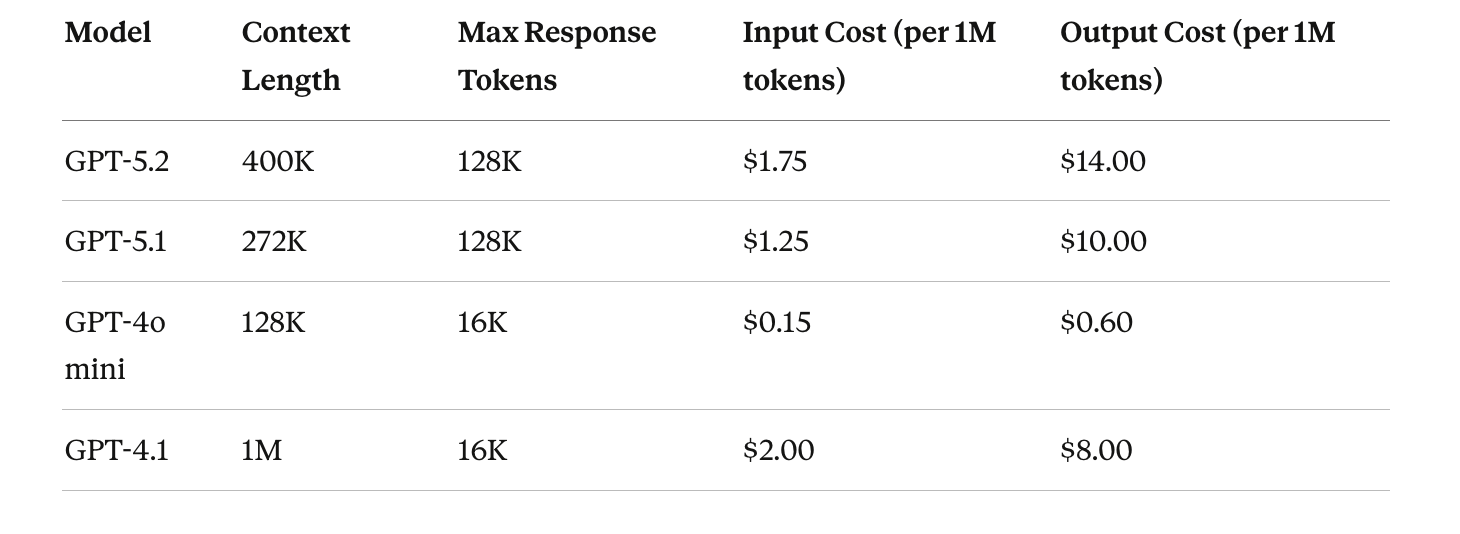
GPT-5.2 represents OpenAI's flagship model with a substantial 400,000 token context window and the ability to generate responses up to 128,000 tokens. This massive context capacity makes it ideal for processing entire codebases, lengthy legal documents, or comprehensive research papers in a single pass.
The pricing at $1.75 per million input tokens and $14.00 per million output tokens positions this as a premium option. However, for use cases requiring the highest reasoning capabilities and extensive context understanding, the investment is justified. This model excels at complex multi-document analysis, advanced code generation spanning multiple files, and sophisticated reasoning tasks that require maintaining coherence across vast amounts of information.
Best for: Enterprise-level document analysis, comprehensive codebase refactoring, multi-document legal review, advanced research synthesis
GPT-5.1
With a 272,000 token context window and 128,000 token response capability, GPT-5.1 offers a more economical alternative to GPT-5.2 while maintaining impressive performance. At $1.25 per million input tokens and $10.00 per million output tokens, it provides approximately 30% cost savings compared to GPT-5.2.
This model strikes an excellent balance for organizations that need substantial context windows but can work within the slightly reduced capacity. The 272K context still accommodates most real-world documents, including technical specifications, lengthy reports, and substantial codebases.
Best for: Technical documentation generation, moderate-scale code analysis, business intelligence reports, content creation requiring extensive context
GPT-4o mini
GPT-4o mini is OpenAI's efficiency champion, offering a 128,000 token context window with 16,000 token responses at remarkably low costs of $0.15 per million input tokens and $0.60 per million output tokens. This represents approximately 90% cost savings compared to GPT-5.2 for output generation.
The model is optimized for high-volume applications where speed and cost-efficiency matter more than absolute cutting-edge performance. Despite being a "mini" model, it handles most common tasks effectively, including customer support, content moderation, data extraction, and standard code assistance.
Best for: High-volume customer service chatbots, automated content moderation, data extraction pipelines, API integrations requiring cost efficiency, routine coding assistance
GPT-4.1
GPT-4.1 stands out with its exceptional 1 million token context window, though it maintains a more conservative 16,000 token response limit. Priced at $2.00 per million input tokens and $8.00 per million output tokens, it offers the largest context window in OpenAI's lineup at a mid-tier price point.
This model is particularly valuable when you need to ingest massive amounts of information but don't require equally massive outputs. Think of scenarios where you're analyzing entire repositories, processing comprehensive datasets, or working with collections of documents that need to be understood holistically before generating focused insights.
Best for: Full repository code analysis, comprehensive dataset processing, multi-document question answering, large-scale content summarization
Anthropic (Claude) Models
Anthropic's Claude family offers exceptional performance with a strong emphasis on safety, nuanced understanding, and extended output capabilities. The Claude models are particularly renowned for their coherent long-form generation.
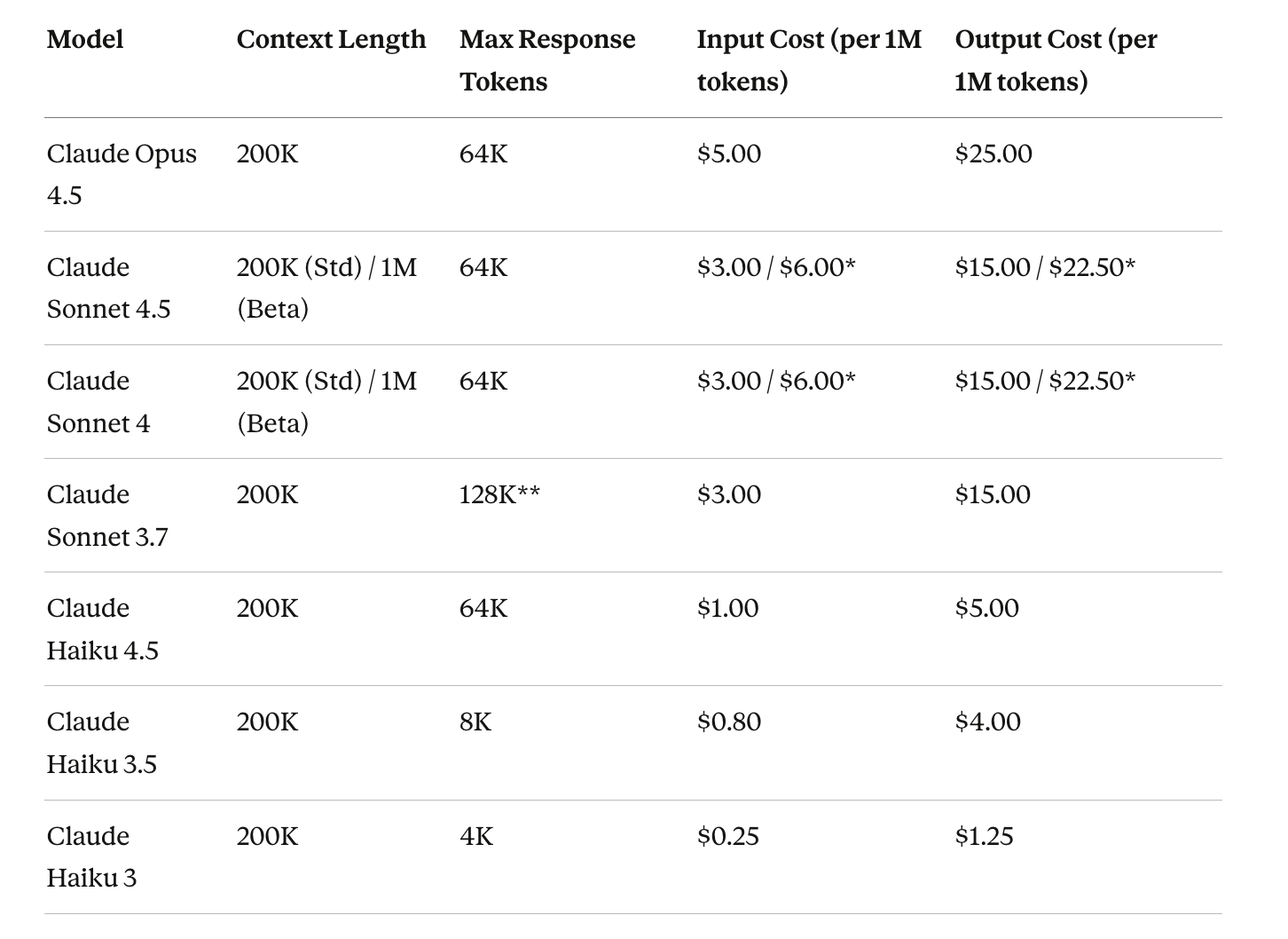
*Tiered pricing: Standard rates apply for prompts ≤200K tokens; beta 1M context charges premium rates (2x input, 1.5x output)
**Extended thinking mode with beta flag enables 128K responses
Claude Opus 4.5
Claude Opus 4.5 is Anthropic's most capable model, offering a 200,000 token context window with 64,000 token response capacity. At $5.00 per million input tokens and $25.00 per million output tokens, it's positioned as a premium offering that justifies its cost through exceptional reasoning, nuanced understanding, and sophisticated output quality.
Opus excels at complex analytical tasks requiring deep comprehension, creative writing with stylistic consistency, advanced coding with architectural understanding, and situations where accuracy and thoughtfulness are paramount. The 64K response window allows for generating comprehensive reports, detailed technical documentation, or complete code modules in a single response.
Best for: Complex strategic analysis, high-stakes decision support, sophisticated creative writing, architectural code design, detailed technical documentation, nuanced content requiring deep understanding
Claude Sonnet 4.5
Claude Sonnet 4.5 represents the sweet spot in Anthropic's lineup, offering excellent performance at $3.00 per million input tokens and $15.00 per million output tokens for standard 200K context usage. For users who need the extended 1M context window (currently in beta), pricing increases to $6.00 input and $22.50 output, still competitive given the capability.
The 64,000 token response capacity combined with Sonnet's balanced performance makes this the go-to choice for most professional applications. It handles complex reasoning, maintains quality across long conversations, and produces coherent long-form content while being significantly more affordable than Opus.
Best for: Professional content creation, moderate complexity coding tasks, business document analysis, extended research synthesis, multi-turn conversational applications, general-purpose enterprise AI
Claude Sonnet 4
Claude Sonnet 4 offers specifications identical to Sonnet 4.5 with the same pricing structure: $3.00/$15.00 for standard 200K context and $6.00/$22.50 for the 1M beta context. While Sonnet 4.5 represents the latest iteration with incremental improvements, Sonnet 4 remains a powerful option with proven reliability.
Some organizations may prefer Sonnet 4 for stability reasons or specific performance characteristics that suit their particular use cases. The choice between Sonnet 4 and 4.5 often comes down to specific benchmarks relevant to your application.
Best for: Similar use cases to Sonnet 4.5, organizations requiring specific version stability, applications where Sonnet 4's particular strengths align with requirements
Claude Sonnet 3.7
Claude Sonnet 3.7 is unique in offering a 200,000 token context window with the ability to generate up to 128,000 tokens in extended thinking mode (activated via the beta flag output-128k-2025-02-19). At $3.00 per million input tokens and $15.00 per million output tokens, it provides exceptional value for applications requiring very long outputs.
This model is particularly valuable for generating comprehensive documentation, extensive creative works, detailed analytical reports, or complete code implementations. The 128K response capability is the highest among Claude models, making it ideal when output length is a critical requirement.
Best for: Comprehensive documentation generation, long-form creative writing, extensive analytical reports, complete application code generation, detailed research papers
Claude Haiku 4.5
Claude Haiku 4.5 delivers impressive performance at budget-friendly pricing: $1.00 per million input tokens and $5.00 per million output tokens. With a 200,000 token context window and 64,000 token response capacity, it offers specifications that match the premium Sonnet models at a fraction of the cost.
This makes Haiku 4.5 an excellent choice for cost-sensitive applications that still require substantial context and response capabilities. It's particularly well-suited for high-volume deployments, customer-facing applications, and scenarios where you need Claude's quality but must optimize for cost.
Best for: High-volume customer support, cost-optimized content generation, automated documentation, budget-conscious enterprise deployments, customer-facing chatbots requiring quality responses
Claude Haiku 3.5
Claude Haiku 3.5 offers a 200,000 token context window with an 8,000 token response limit at $0.80 per million input tokens and $4.00 per million output tokens. This model provides an even more economical option when response length requirements are moderate.
The reduced response capacity compared to Haiku 4.5 is offset by lower costs, making it ideal for applications where you need to process large contexts but generate shorter, focused outputs.
Best for: Question answering systems, data extraction from large documents, summarization tasks, cost-efficient chat applications, moderate-length content generation
Claude Haiku 3
Claude Haiku 3 is Anthropic's most economical offering at $0.25 per million input tokens and $1.25 per million output tokens. Despite the budget pricing, it maintains a 200,000 token context window, though responses are limited to 4,000 tokens.
This model is perfect for high-volume, cost-critical applications where you need to maintain context but outputs are naturally brief, such as classification tasks, simple Q&A, or routine processing operations.
Best for: Classification and categorization, simple question answering, high-volume data processing, cost-critical applications, basic content moderation
Google (Gemini) Models
Google's Gemini family offers exceptional value with massive context windows and competitive pricing, particularly in the Flash variants that deliver impressive performance at remarkably low costs.
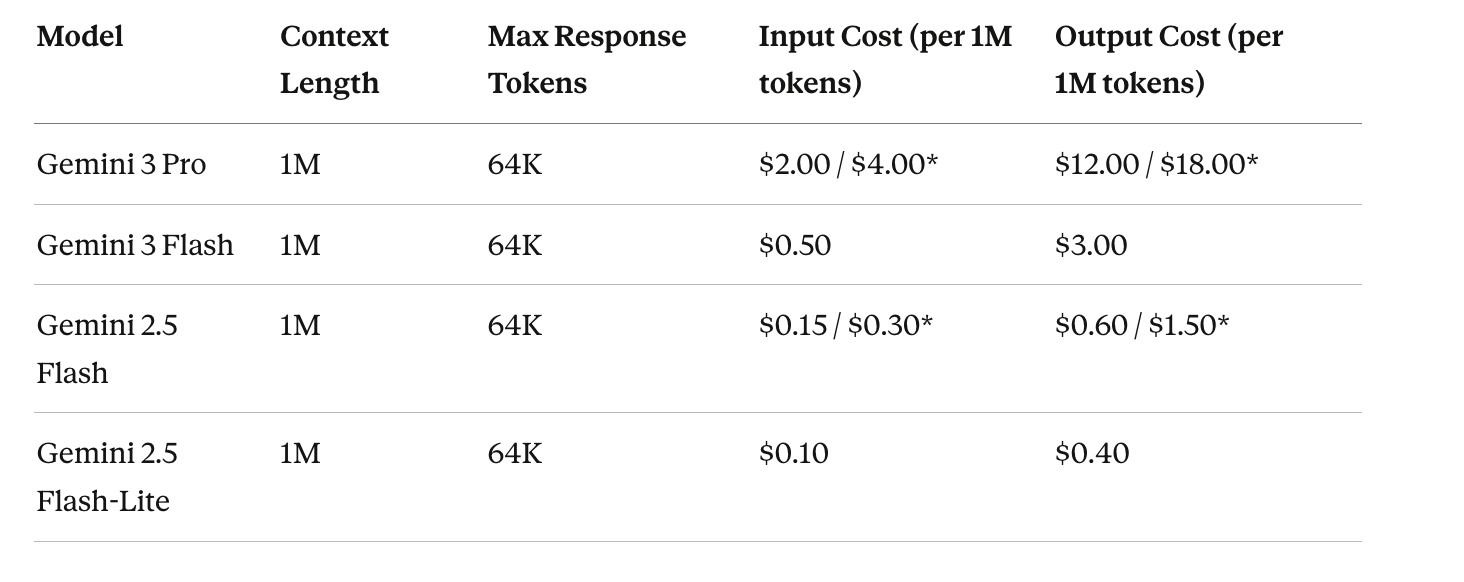
*Tiered pricing: First price for prompts ≤200K tokens, second for >200K tokens
Gemini 3 Pro
Gemini 3 Pro offers an impressive 1 million token context window with 64,000 token response capacity, making it one of the most capable models for handling massive contexts. The tiered pricing structure charges $2.00/$12.00 (input/output per million tokens) for prompts up to 200K tokens, and $4.00/$18.00 for prompts exceeding 200K tokens.
This pricing strategy makes Gemini 3 Pro economical for standard use while scaling costs for truly massive context requirements. The model excels at multimodal understanding, complex reasoning across large information sets, and maintaining coherence in extended interactions.
Best for: Large-scale document analysis, multimodal applications combining text and images, comprehensive research synthesis, complex reasoning over extensive contexts, enterprise knowledge base queries
Gemini 3 Flash
Gemini 3 Flash delivers exceptional value with a 1 million token context window, 64,000 token responses, and remarkably low pricing at $0.50 per million input tokens and $3.00 per million output tokens. This represents one of the best price-to-performance ratios in the market.
The model maintains strong performance across reasoning, generation, and understanding tasks while being affordable enough for high-volume production deployments. It's particularly attractive for organizations building applications that need substantial context without premium pricing.
Best for: Production applications requiring cost efficiency, high-volume content generation, large document processing, multi-document Q&A systems, cost-conscious enterprise deployments
Gemini 2.5 Flash
Gemini 2.5 Flash represents Google's most competitive offering in terms of pricing, with costs starting at just $0.15 per million input tokens and $0.60 per million output tokens for prompts up to 200K tokens. For larger prompts exceeding 200K tokens, pricing scales to $0.30/$1.50, still highly competitive.
With a 1 million token context window and 64,000 token response capacity, this model offers premium specifications at budget pricing. It's ideal for startups, high-volume applications, and any scenario where you need to optimize costs without sacrificing context capacity.
Best for: Startup applications with budget constraints, extremely high-volume processing, cost-optimized customer service, automated content workflows, API-based applications requiring affordability
Gemini 2.5 Flash-Lite
Gemini 2.5 Flash-Lite is Google's most economical option, priced at just $0.10 per million input tokens and $0.40 per million output tokens while maintaining the full 1 million token context window and 64,000 token response capacity. This is the lowest-cost model in the market with such specifications.
The "Lite" designation suggests some performance trade-offs compared to the standard Flash variants, but for many applications, the cost savings are substantial enough to make this the preferred choice, particularly for high-volume deployments where cost per request is critical.
Best for: Maximum cost efficiency, extremely high-volume deployments, batch processing, non-critical applications, experimental projects, automated systems with tight budget constraints
xAI (Grok) Models
xAI's Grok family stands out with exceptional context windows and competitive pricing, particularly the Grok 4 Fast model which offers unprecedented 2 million token context capacity at budget-friendly rates.
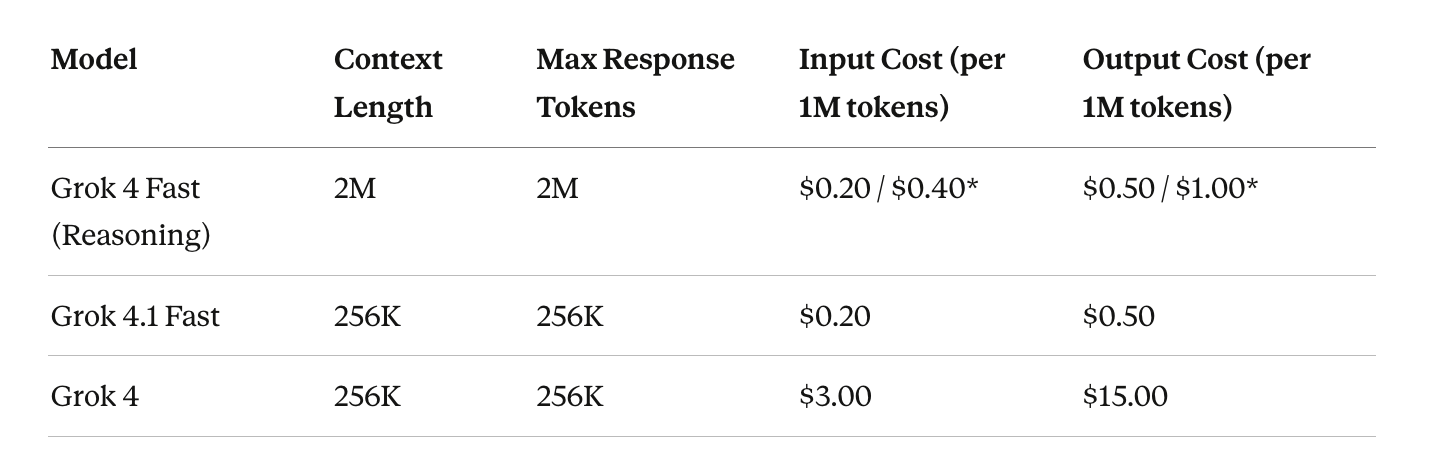
*Tiered pricing: First price for ≤128K tokens, second for >128K tokens; cached inputs cost $0.05 per million tokens
Grok 4 Fast (Reasoning)
Grok 4 Fast represents a paradigm shift in context capacity, offering an extraordinary 2 million token context window with matching 2 million token response capability. At $0.20 per million input tokens for prompts up to 128K tokens ($0.40 for larger prompts) and $0.50 per million output tokens ($1.00 for larger outputs), it delivers unprecedented value.
The massive 2M context window allows processing entire large codebases, multiple books, comprehensive research collections, or extensive conversation histories in a single pass. The ability to generate up to 2M tokens in response enables producing complete applications, entire documentation sets, or comprehensive analytical reports.
The cached input pricing at just $0.05 per million tokens makes it extremely economical for applications with repeated context usage, such as chatbots with persistent knowledge bases or applications processing similar document sets repeatedly.
Best for: Processing entire large codebases, comprehensive multi-book analysis, massive dataset exploration, generating complete applications, extensive technical documentation, persistent context applications benefiting from caching
Grok 4.1 Fast
Grok 4.1 Fast offers a more conventional but still impressive 256,000 token context window with matching 256K response capacity at $0.20 per million input tokens and $0.50 per million output tokens. This represents excellent value for applications that don't require the massive 2M context of Grok 4 Fast.
The symmetrical context and response capacity at 256K tokens provides flexibility for applications requiring extended outputs without context limitations. The pricing makes it highly competitive with other mid-tier models while offering generous specifications.
Best for: Extended conversation applications, comprehensive code generation, detailed analytical reports, multi-document processing within reasonable bounds, cost-efficient general-purpose AI
Grok 4
Grok 4 is xAI's premium offering with 256,000 token context and response windows, priced at $3.00 per million input tokens and $15.00 per million output tokens. This positions it competitively with models like Claude Sonnet while offering the extended 256K response capability.
The model is designed for applications requiring the highest quality reasoning and generation within the Grok family, justifying the premium pricing through enhanced performance characteristics.
Best for: High-stakes analytical work, sophisticated reasoning tasks, premium content generation, applications requiring top-tier Grok performance, extended technical documentation
Meta (LLaMA-4) Models
Meta's LLaMA-4 family offers open-source models with impressive specifications, though pricing varies significantly depending on the deployment provider. These models are particularly attractive for organizations seeking flexible deployment options.
LLaMA-4 Maverick
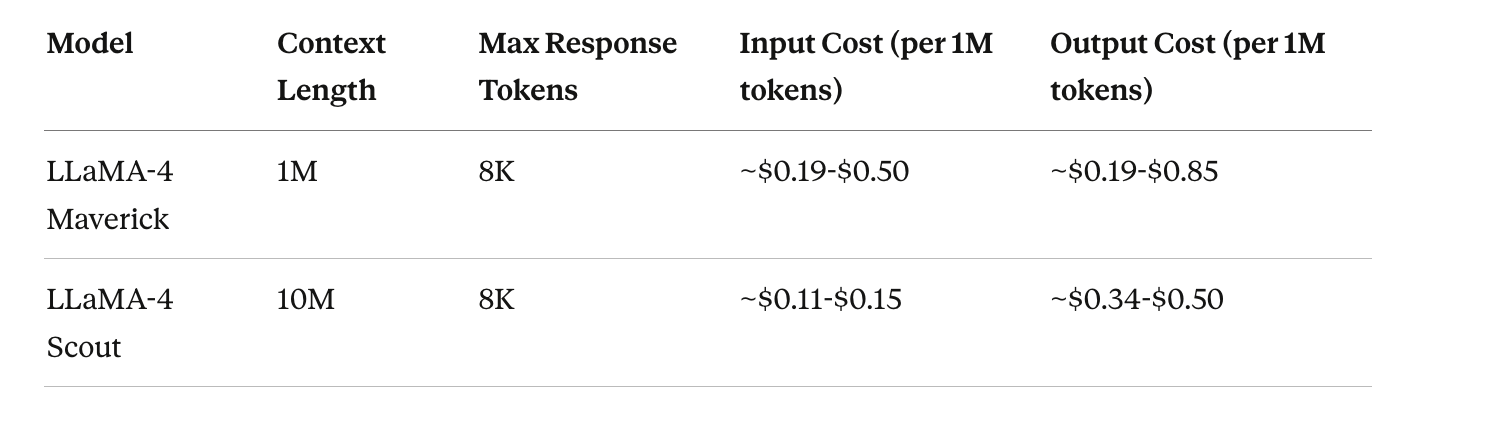
LLaMA-4 Maverick provides a 1 million token context window with 8,000 token response capacity. Pricing varies by deployment provider, ranging approximately from $0.19 to $0.50 per million input tokens and $0.19 to $0.85 per million output tokens.
The substantial context window makes it suitable for processing large documents, though the 8K response limit means outputs are more constrained compared to models offering 64K or larger responses. The open-source nature allows for self-hosting options, potentially reducing costs further for organizations with infrastructure.
Best for: Organizations preferring open-source models, applications requiring large context with moderate outputs, flexible deployment scenarios, cost-sensitive projects with self-hosting capability
LLaMA-4 Scout
LLaMA-4 Scout stands out with an exceptional 10 million token context window, the largest among all models discussed. Despite this massive context capacity, responses are limited to 8,000 tokens. Pricing ranges from approximately $0.11 to $0.15 per million input tokens and $0.34 to $0.50 per million output tokens.
The 10M context window enables truly unprecedented applications: analyzing entire multi-repository codebases, processing collections of hundreds of documents simultaneously, or maintaining extremely long conversation histories. However, the 8K response limit means this model is optimized for understanding vast contexts and providing focused, concise outputs rather than generating extensive responses.
Best for: Massive codebase analysis, processing document collections, extremely long conversation histories, applications requiring maximum context understanding with focused outputs, research requiring analysis of extensive source materials
DeepSeek Models
DeepSeek offers competitive models with a unique pricing structure that differentiates between cache hits and misses, rewarding efficient context reuse. This makes their models particularly attractive for applications with repetitive context patterns.
DeepSeek-V3
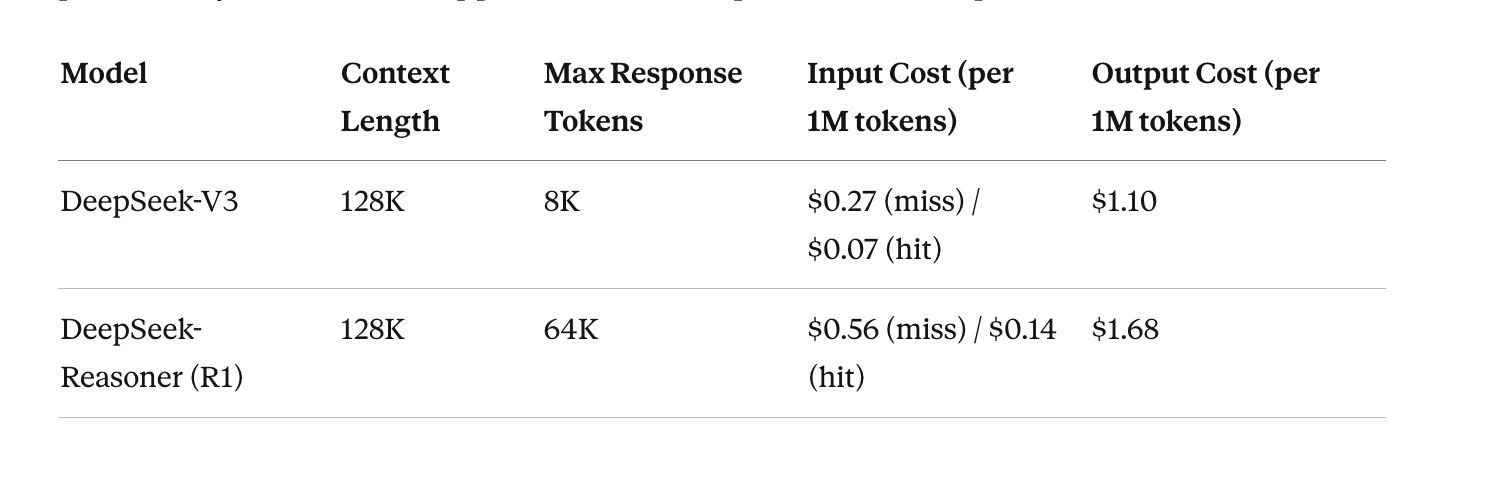
DeepSeek-V3 offers a 128,000 token context window with 8,000 token response capacity. The innovative pricing structure charges $0.27 per million input tokens for cache misses but only $0.07 for cache hits, representing a 74% discount when context is reused. Output costs remain at $1.10 per million tokens regardless of caching.
This pricing model is particularly beneficial for applications like chatbots with persistent knowledge bases, repeated document processing, or any scenario where the same context is referenced multiple times. The 8K response limit keeps it focused on applications requiring concise outputs.
Best for: Chatbots with persistent knowledge, repeated document processing, applications with reusable context, cost-optimized Q&A systems, efficient data extraction workflows
DeepSeek-Reasoner (R1)
DeepSeek-Reasoner (R1) provides a 128,000 token context window with an enhanced 64,000 token response capacity. Pricing follows the same cache-aware structure at $0.56 per million input tokens for misses, $0.14 for hits, and $1.68 per million output tokens.
The substantially larger response capacity compared to V3 makes R1 suitable for applications requiring more comprehensive outputs while maintaining the efficiency benefits of cache-aware pricing. The "Reasoner" designation suggests enhanced capabilities for complex reasoning tasks.
Best for: Complex reasoning requiring extended outputs, applications benefiting from caching with substantial response needs, analytical tasks with moderate context, efficient content generation with context reuse
Alibaba (Qwen) Models
Alibaba's Qwen family offers competitive specifications with international availability, providing alternatives to Western providers with strong performance characteristics.
Qwen3-Max
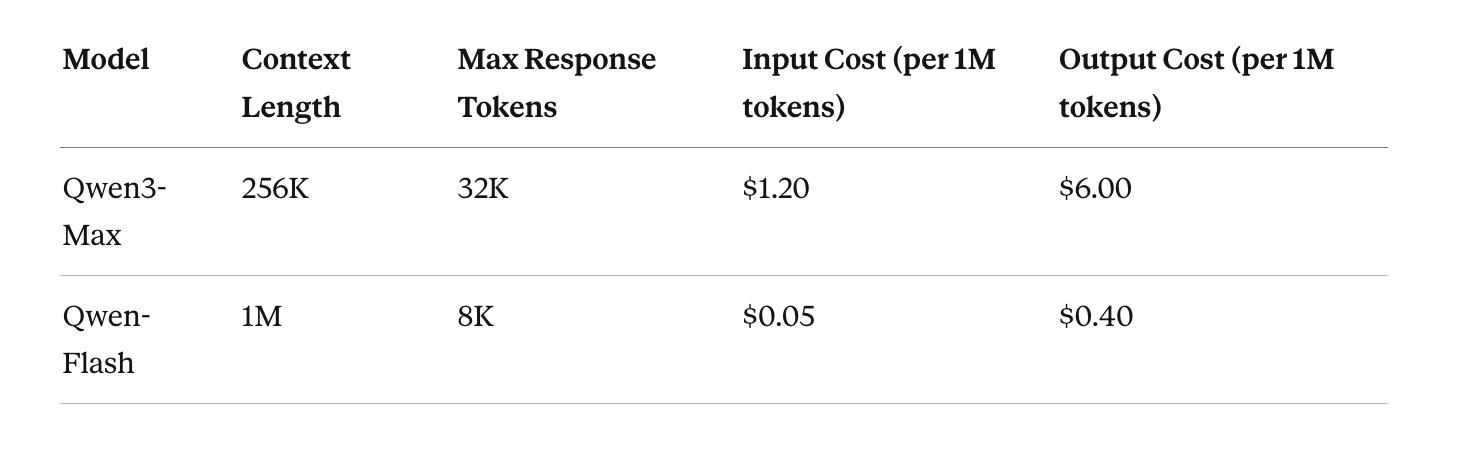
Qwen3-Max offers a 256,000 token context window with 32,000 token response capacity at $1.20 per million input tokens and $6.00 per million output tokens. This positions it as a mid-tier option that balances substantial context and response capabilities with competitive pricing.
The 32K response capacity is suitable for generating comprehensive documents, detailed code implementations, or extended analytical outputs. The model provides a good balance for organizations seeking alternatives to the dominant Western providers.
Best for: Organizations seeking provider diversity, comprehensive document generation, moderate-scale code development, detailed analytical reports, international deployment scenarios
Qwen-Flash
Qwen-Flash delivers exceptional value with a 1 million token context window at just $0.05 per million input tokens and $0.40 per million output tokens, making it one of the most economical options available. The 8,000 token response limit keeps it focused on efficient, concise outputs.
The combination of massive context capacity and minimal pricing makes Qwen-Flash extremely attractive for high-volume applications, particularly those that don't require extended responses but benefit from large context windows.
Best for: High-volume cost-critical applications, large document processing with concise outputs, budget-optimized deployments, international markets, Q&A systems requiring affordability
Choosing the Right Model
The selection of an appropriate AI model depends on several key factors:
Context Requirements: Consider whether your application processes single documents (128K-256K sufficient), multiple documents (512K-1M recommended), or massive collections (1M-10M necessary). Models like LLaMA-4 Scout (10M), Grok 4 Fast (2M), and the various 1M context options from Google and others cater to different scales.
Response Length Needs: Applications requiring brief answers (4K-8K) can save significantly with models like Claude Haiku 3 or DeepSeek-V3. Moderate responses (16K-32K) are well-served by most mid-tier models. Comprehensive outputs (64K-128K) require models like Claude Sonnet 3.7, Anthropic's 64K-capable models, or Gemini's Flash variants. For extreme cases, Grok 4 Fast's 2M response capability is unmatched.
Budget Constraints: For maximum cost efficiency, consider Gemini 2.5 Flash-Lite ($0.10/$0.40), Qwen-Flash ($0.05/$0.40), or Grok 4 Fast ($0.20/$0.50). Mid-tier budgets are well-served by models like Claude Haiku 4.5 ($1.00/$5.00) or Gemini 3 Flash ($0.50/$3.00). Premium applications justify models like Claude Opus 4.5 ($5.00/$25.00) or GPT-5.2 ($1.75/$14.00).
Use Case Specificity: Customer service applications benefit from cost-efficient models with moderate capabilities. Code generation requires strong reasoning and appropriate response lengths. Content creation needs models with coherent long-form generation. Data analysis applications prioritize large context windows over response lengths. Research synthesis requires both substantial context and comprehensive outputs.
Deployment Patterns: Applications with persistent contexts benefit from DeepSeek's cache-aware pricing or Grok's cached input discounts. High-volume deployments prioritize per-token costs. Variable workloads may benefit from providers with flexible pricing tiers.
The modern AI landscape offers unprecedented choice, allowing organizations to precisely match models to their specific requirements across performance, cost, and capability dimensions. By understanding these specifications and use cases, you can optimize both performance and expenditure for your AI applications.