
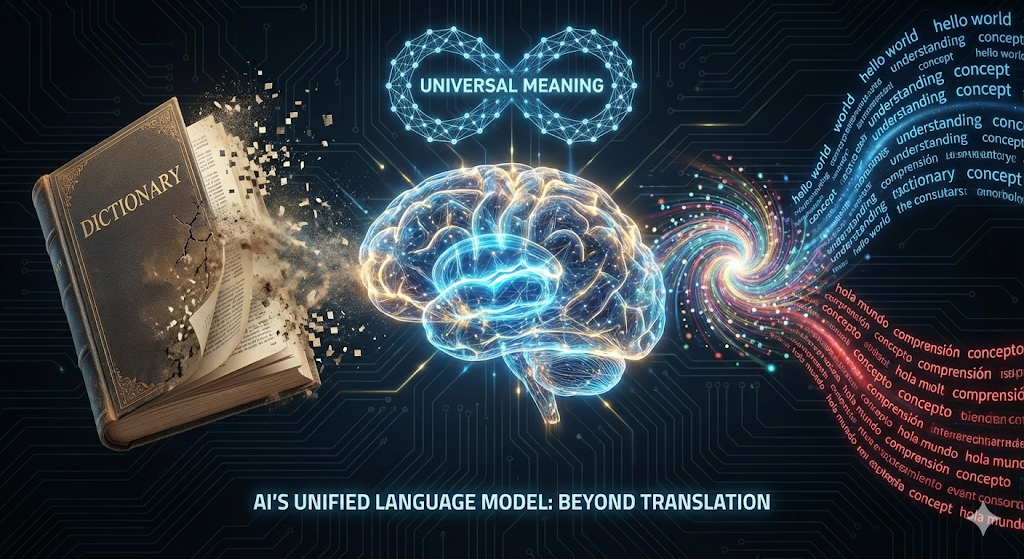
If you ask a human to translate the word "cat" into Spanish, they perform a mental lookup. They access a lexicon, find the corresponding label gato, and swap the words. For centuries, we assumed computers would learn languages the same way: by memorizing massive, rule-based dictionaries.
We were wrong.
The reason modern Large Language Models (LLMs) are so startlingly fluent isn't that they have memorized every dictionary in existence. It is because they have stopped using dictionaries altogether. In the high-dimensional darkness of a neural network, "cat" and "gato" represent nearly the exact same mathematical coordinate.
To an AI, Spanish and English are not distinct systems that need to be bridged. They are simply different textures draped over the same underlying shape of reality. This phenomenon, known as geometric convergence, is one of the most beautiful discoveries in computer science.
But as recent research reveals, this mathematical elegance comes with a hidden cost: when you treat all languages as the same thing, you risk erasing the very differences that make them human.
The Death of the Symbolic Dictionary
For decades, Artificial Intelligence was dominated by what we call Symbolic AI. This was the era of "Good Old-Fashioned AI" (GOFAI), where programmers explicitly coded rules. If Input equals "Hello", then Output equals "Hola".
Symbolic AI is rigid. It treats language like a fragile glass structure; one wrong move and the logic shatters. As noted in recent comparisons of Symbolic vs. Connectionist AI, this approach offers high transparency but fails miserably at the messy, fluid reality of human speech. You cannot hard-code sarcasm, and you certainly cannot write an "if-then" statement for poetic longing.
The revolution happened when we shifted to Connectionist AI. Instead of distinct symbols, we began feeding models massive amounts of text and asking them to predict the next word. To do this, the model assigns every word a vector—a long list of numbers representing its position in a multidimensional space.
Imagine a 3D map of the galaxy. In this map, the stars for "King" and "Queen" are close together. The distance between "King" and "Man" is roughly the same as the distance between "Queen" and "Woman." The model doesn't know what a Queen is, but it understands the geometry of royalty.
Now, here is the breakthrough: It turns out that the "galaxy" of English looks almost identical to the "galaxy" of Spanish.
The Shared Semantic Universe
When researchers analyze the latent spaces of multilingual models, they find something startling. If you train a model on English data and separately on Spanish data, the resulting geometric shapes of the languages are isomorphic—they have the same structure.
If you were to take the English vector space and rotate it, it would align almost perfectly with the Spanish vector space.
This means the AI doesn't need a dictionary to translate. It just needs to know the rotation angle. It treats language as a shared semantic manifold. As discussed in the paper Stop Thinking Like a Dictionary, the model abstracts away the lexical form (the sound or spelling of the word) and focuses entirely on the semantic feature (the meaning coordinates).
This is why you can ask ChatGPT a question in English and tell it to answer in Python code or French poetry. To the model, these aren't separate disciplines; they are just different output filters for the same thought.
The Efficiency Trap: Why English is the "Default"
While the math suggests equality, the infrastructure does not. The reality of training these models introduces a severe hierarchy, often driven by the hidden mechanics of tokenization.
As highlighted by Jorge Moreno Blázquez at Sngular, tokenizers are the "sous chefs" of AI, chopping words into bite-sized numbers. Because these tokenizers are overwhelmingly trained on English text, they are optimized for English efficiency.
The word "Apple" might be one token in English. The same concept in a lower-resource language might be broken into three or four fragment tokens. This means non-English languages are literally more expensive to process—they take up more memory and compute power to say the exact same thing.
This technical bias encourages developers and users to default to English, reinforcing a feedback loop where English becomes the "operating system" of the latent space, and other languages become mere plugins.
The Danger of "Concept Spilling"
The most concerning consequence of this geometric convergence is a phenomenon researchers are calling Concept Spilling.
If English and Spanish share the same coordinate for a concept, the dominant language (English) often overwrites the nuance of the secondary language.
A striking example from the paper Benchmarking Concept-Spilling Across Languages involves the Hindi word antariksh. In Hindi, this word specifically refers to "outer space"—the cosmic void. However, in English, the word "space" is polysemous; it can mean outer space, but it can also mean "personal space" or "a blank space" on a page.
When current LLMs generate text in Hindi, they often force the word antariksh to carry those English metaphors. They might talk about "needing some antariksh from my partner," a phrase that sounds nonsensical to a native Hindi speaker. The English concept has "spilled" over, colonizing the Hindi definition.
The AI sees the geometric overlap and assumes the concepts are identical. It ignores the cultural Sapir-Whorf hypothesis, which suggests that the specific structure of a language encodes unique emotional and cultural truths that cannot simply be rotated into a new vector space.
Reclaiming the Nuance
The future of multilingual AI depends on solving this tension. We are currently seeing a surge in "Post-English" development. New frameworks like MAMUT are being designed to modify mathematical and linguistic datasets to be more robust, preventing models from memorizing surface-level patterns. Similarly, researchers are exploring Code-Switched NLP, pushing models to understand the fluid way bilingual humans actually speak, mixing grammars rather than keeping them in rigid silos.
We are moving toward what some call a Polymorphic Computation Framework, where the solution isn't just to translate X to Y, but to understand the context-dependent execution of meaning.
Conclusion
We must stop thinking of AI translation as a digital dictionary. It is something far more profound: a universal geometry of thought. This convergence suggests that, mathematically speaking, humanity shares a single consciousness expressed through different filters.
However, we must remain vigilant. If we allow the "geometry" of English to become the universal standard, we risk flattening the rich topography of human expression into a single, homogenized plane. The goal of AI shouldn't be to make Spanish and English the same thing. It should be to build a map detailed enough to prove why they are different.