
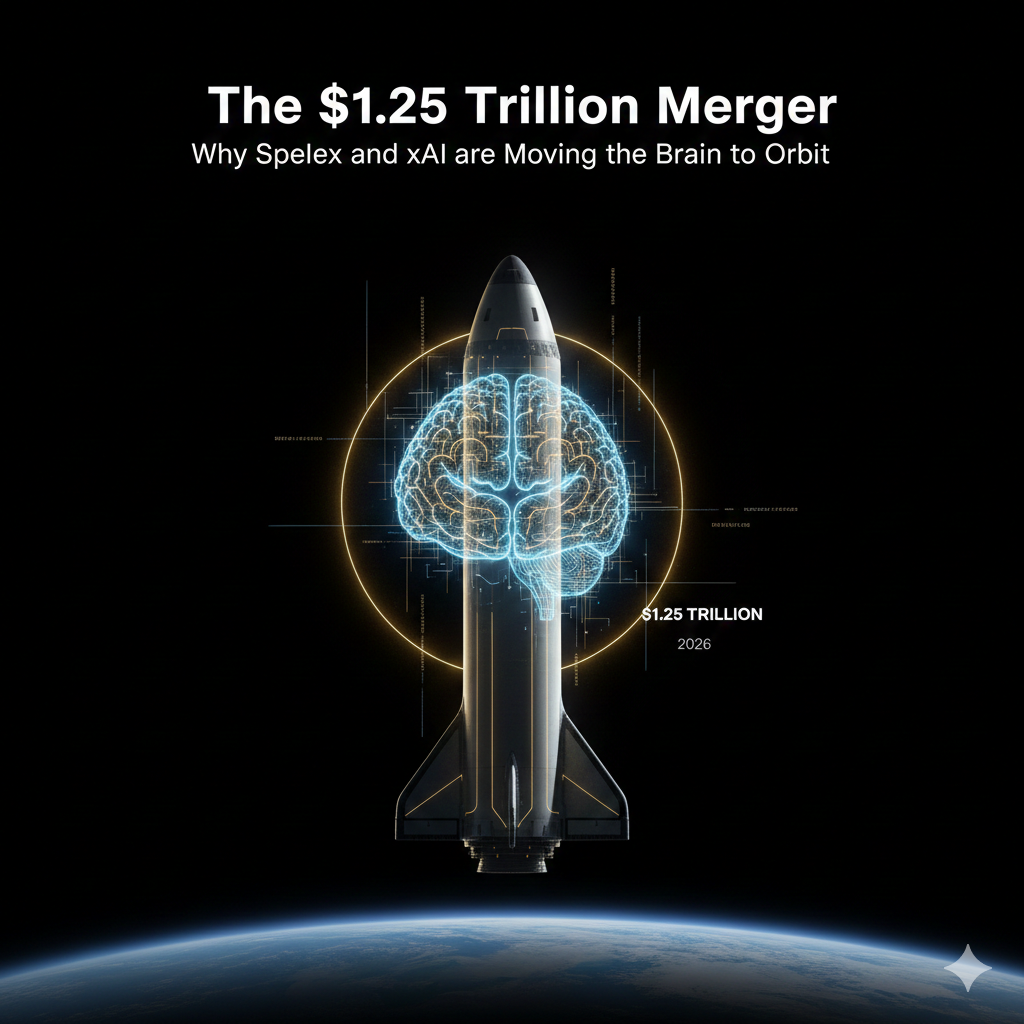
On February 2, 2026, the boundary between space exploration and artificial intelligence officially dissolved. In a memo that sent tremors through both Wall Street and Silicon Valley, Elon Musk announced that SpaceX had acquired xAI in a record-breaking stock swap, valuing the combined entity at a staggering $1.25 trillion.
This isn’t merely a corporate consolidation or a billionaire tidying up his portfolio. It is the first step in a radical architectural shift: the migration of the world's most powerful computational "brains" from the energy-starved surface of Earth into the limitless cold of low-Earth orbit.
By merging the infrastructure of Starlink with the intelligence of Grok, Musk is attempting to solve the one problem currently stymying the AI revolution—the physical world.
The Financial Mechanics of a Trillion-Dollar Marriage
The merger operates on a scale that is difficult to visualize, effectively creating a "vertically integrated innovation engine" that spans from the launchpad to the neural network. The transaction was executed via a comprehensive stock swap, valuing SpaceX at a baseline of $1 trillion and xAI at approximately $250 billion.
Under the terms of the deal, xAI shareholders received 0.1433 shares of SpaceX for every xAI share held. This move provides xAI with the stable balance sheet of a defense and aerospace giant while giving SpaceX investors a direct stake in the high-growth AI sector.
This consolidation comes at a critical time. SpaceX is currently preparing for a massive initial public offering (IPO) planned for June 2026, with valuation targets reportedly reaching $1.5 trillion. Folding xAI into the mix ensures that the "SpaceX" the public eventually buys isn't just a logistics company—it’s a compute company.
Bypassing Earth: The Infrastructure Bottleneck
To understand why this merger makes sense, you have to look at the "Ground-to-Space" problem. Terrestrial data centers are currently hitting a wall of three major constraints: energy, cooling, and regulation.
On Earth, AI models like Grok require gigawatts of power, often straining local grids and leading to public backlash over resource consumption. Furthermore, the heat generated by hundreds of thousands of H100 GPUs requires massive, water-hungry cooling systems that are increasingly difficult to permit and maintain.
Space offers a different deal. By placing data centers in orbit, SpaceX can tap into nearly constant, unfiltered solar energy. The vacuum of space also provides a natural, though complex, heat sink, potentially allowing for much higher compute densities than are possible on the ground.
The Starlink V3 Backbone
The technical heart of this merger lies in the upcoming V3 Starlink satellites. While previous generations were focused on simple data relay, the V3 architecture is designed to host "orbital compute nodes."
These satellites will essentially act as floating servers, processing data in real-time before it ever hits the ground. This reduces latency and, more importantly, keeps the heavy lifting of AI training away from the terrestrial energy grid. Musk's vision involves a constellation of up to one million satellites, creating a planetary-scale supercomputer that never sees a sunset.
Strategic Risks and the "Key Person" Problem
Despite the technical logic, the merger faces significant headwinds. Critics and engineers have pointed out several "unhinged" elements of the plan, primarily concerning space debris and hardware longevity.
Operating advanced silicon in orbit means dealing with cosmic radiation, which can cause "bit flips" and hardware degradation. While SpaceX has experience with radiation-hardened electronics, the sheer volume of chips required for a frontier AI model like Grok presents a massive reliability challenge.
Furthermore, the concentration of power in a single entity is already drawing the eyes of regulators. The Department of Justice (DOJ) and the Federal Trade Commission (FTC) are closely monitoring the deal for potential antitrust violations, particularly concerning the overlap between government defense contracts and private AI development.
The Volatility Factor
We also cannot ignore the "key person risk" associated with Musk himself. Recent disclosures of historic email correspondence and ongoing legal battles over executive compensation at Tesla have created a layer of "distraction cost" that makes some institutional investors nervous.
For the $1.25 trillion valuation to hold through the June IPO, the unified entity must prove it can execute on the technical milestones of space-based compute without getting bogged down in corporate governance scandals.
The Competition: Bezos and the 6-Terabit Counterstrike
Musk is not alone in this race. Jeff Bezos’ Blue Origin recently unveiled "TeraWave," a 6-terabit-per-second space network designed to deliver high-capacity connectivity for enterprise data centers.
While Blue Origin is focusing more on the connectivity between ground-based centers, the SpaceX-xAI merger is focused on the processing itself. This represents two different bets on the future of the internet:
The Bezos Bet: Space is the pipe that connects our data.
The Musk Bet: Space is the brain where our data lives.
A New Era of Orbital Sovereignty
The SpaceX-xAI merger represents the ultimate hedge against geopolitical and terrestrial risks. By moving compute off-planet, Musk is effectively creating a new kind of "orbital sovereignty" where the infrastructure of intelligence is no longer bound by the laws or the power grids of any single nation.
Whether this vision is prescient or pure hubris will likely be decided by the success of the Starlink V3 launches over the next 18 months. If SpaceX can successfully train a frontier model in orbit, the $1.25 trillion valuation might actually look like a bargain in hindsight.
In the end, this merger tells us everything we need to know about the next decade of tech: the most valuable real estate isn't in Silicon Valley anymore. It’s 340 miles up.