
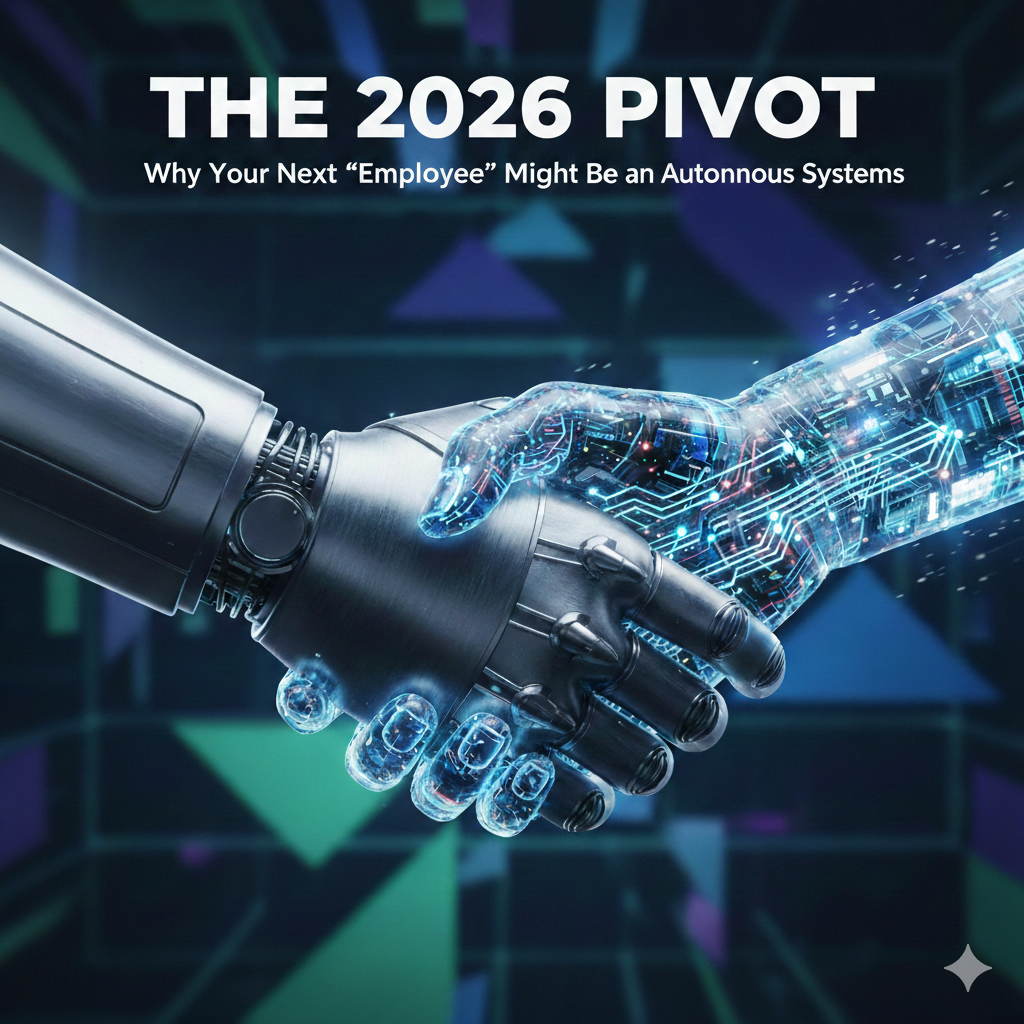
The days of treating artificial intelligence like a high-end search engine or a clever ghostwriter are quickly becoming a memory. As we navigate through 2026, the tech industry has moved beyond the novelty of "chatting" with a bot and entered what experts are calling the Age of Autonomy.
It's no longer impressive if an AI can draft an email or summarize a transcript. The real value now lies in Agentic AI—systems that don't just suggest work, but actually do it through independent reasoning and strategic execution.
This change is more than a simple upgrade; it's a complete overhaul of how businesses function. We're moving away from managing isolated software projects and toward orchestrating an entire digital workforce.
The numbers tell a clear story. Analysts at Gartner now project that 40% of all enterprise software will have built-in AI agents by the end of this year, a massive jump from the niche 5% we saw just a year ago. This isn't a trend; it's a $52 billion market shift that will redefine corporate operations by the end of the decade.
Moving Beyond the Chatbox: The New Architecture of Action
The most obvious change in the 2026 landscape is that "action" has replaced "conversation" as the primary goal. Old-school AI was reactive; it waited for a human to type a prompt before it did anything.
Modern agentic systems are different. They use a multi-layered architecture that allows them to function as independent operators. This foundation rests on four key pillars: perception, memory, planning, and action.
Perception allows these agents to "see" their digital environment in real-time, ingesting everything from system logs to visual interfaces. Meanwhile, memory has evolved from simple text history into complex state management using vector databases and knowledge graphs.
This gives agents a sense of time and context. When a system can remember past interactions and see current data, it stops being a tool and starts acting like an employee.
The cognitive "brain" of these systems lies in their planning engines, which take a broad goal—like "optimize our Q3 shipping costs"—and break it down into a sequence of small, manageable tasks. Finally, the action layer uses protocols like the Model Context Protocol (MCP) to actually interact with the outside world.
The Power of the Swarm: How Multi-Agent Teams Collaborate
In 2026, the smartest companies aren't looking for one "god-model" to solve every problem. Instead, they’re deploying "swarms"—specialized teams of agents that work together like a digital microservices architecture.
Think of it as a relay race rather than a solo sprint. You might have one agent focused entirely on research, another that specializes in writing code, and a third that handles final quality control.
This modular approach is much more efficient. It allows companies to use smaller, cheaper models for simple tasks while saving the heavy-duty processing power for complex reasoning.
Building these swarms has become much easier thanks to a new ecosystem of developer tools. Some teams prefer Google’s Agent Development Kit (ADK) for its code-centric focus, while others use Microsoft’s AutoGen for its ability to handle complex, event-driven workflows.
Standardization is the glue holding this all together. Anthropic’s MCP has become the universal language for connecting agents to tools, and the Agent-to-Agent (A2A) protocol now allows agents from different vendors to negotiate with each other, creating what many call the "Agentic Internet."
The Science of Strategy: How Agents Actually Think
The leap from reactive to proactive AI is powered by advanced planning algorithms that give agents a long-term perspective. One of the heavy hitters in 2026 is Hierarchical Task Network (HTN) planning.
HTN planning works by taking a massive, abstract goal and systematically peeling it back until only simple, executable steps remain. It’s like a master chef breaking down a complex five-course meal into individual prep lists.
Many organizations are now pairing this with reinforcement learning to create agents that actually get smarter with experience. A new technique called Discrete Hierarchical Planning (DHP) is becoming a popular alternative to older methods because it encourages agents to find the most efficient path possible.
As these digital fleets grow, architects have to decide between two styles of leadership: centralized or decentralized. Centralized systems are predictable and safe, making them perfect for high-stakes fields like finance.
On the other hand, decentralized swarms behave like natural ecosystems, where individual agents react to their immediate surroundings. This "swarm intelligence" has proven incredibly fast, with some industrial IoT security systems reaching response times under one millisecond.
Real-World Impact: When Autonomy Meets Industry
We’re seeing the most dramatic results in sectors where every second counts. In global supply chains, AI agents have moved from being advisors to becoming full-fledged partners.
This shift has compressed decision-making times from days to mere minutes. The market for supply chain AI is on track to hit $58 billion by 2031, and companies already using these systems are reporting a 15% drop in logistics costs.
Amazon’s Project Kuiper is a prime example, using a self-healing network that can automatically reroute shipments if a local hub goes down. Similarly, Walmart uses agents to track inventory levels across thousands of stores, adjusting orders in real-time to prevent empty shelves.
The world of finance is seeing a similar revolution. SAP’s Joule agent now handles complex invoice disputes automatically, while BlackLine’s "Autonomous Close Agents" are slashing the time it takes to finalize monthly books through automated transaction matching.
Trust by Design: Navigating the New Rules of Governance
As we give agents more freedom, we also have to give them more boundaries. The old method of doing a security audit once a quarter just doesn't work when your software is making decisions every second.
Instead, IT leaders are moving toward "Governance-as-Code." This means that an agent's permissions and safety rules are baked directly into its DNA, ensuring it can never access data or make a purchase it isn't authorized for.
Two frameworks have become the gold standard for this: ISO/IEC 42001 and the NIST AI Risk Management Framework. These aren't just checklists; they are comprehensive systems for managing AI as a core business risk.
Compliance is also getting a legal teeth-sharpening. The EU AI Act is now in full force, requiring strict assessments for any high-risk system. Companies that ignore these rules face massive fines of up to 7% of their global revenue.
This has led to a new wave of legal work, with general counsels updating contracts to include "hallucination clauses" and liability protection for when an autonomous agent makes a mistake.
The Path Forward: Managing the Digital Workforce
Building an agentic organization doesn't happen overnight. It’s usually a three-step journey. Most companies start in the foundation phase, building basic infrastructure for simple tasks like internal IT support.
Right now, we are in the Operational Scalability phase. This is where agents move into core business roles, and companies start paying for "outcomes" rather than just software seats.
By 2027, we expect to see the "Mature Agentic Organization." This will lead to a "Great Flattening" of corporate hierarchies, as digital agents take over the coordination roles traditionally held by middle management.
Success in this new era requires a balance of tech, talent, and trust. Leaders must be prepared for the "J-Curve"—that initial dip in productivity where costs go up and things get complicated before the massive efficiency gains finally kick in.
Conclusion: The New Operating System for Business
By the end of 2026, the ultimate metric for AI success won't be how well it talks, but how much it gets done. The companies that thrive will be those that treat AI as a digital workforce rather than just another software tool.
The goal is to build an "Agentic Operating System"—a centralized way to manage, monitor, and scale hundreds of autonomous operators across the entire enterprise.
This isn't about robots replacing people; it's about a new kind of partnership. Human expertise and digital agency are coming together to solve problems that were previously too complex or too fast to handle. The promise of the AI revolution is finally here, and it’s time to start orchestrating.