
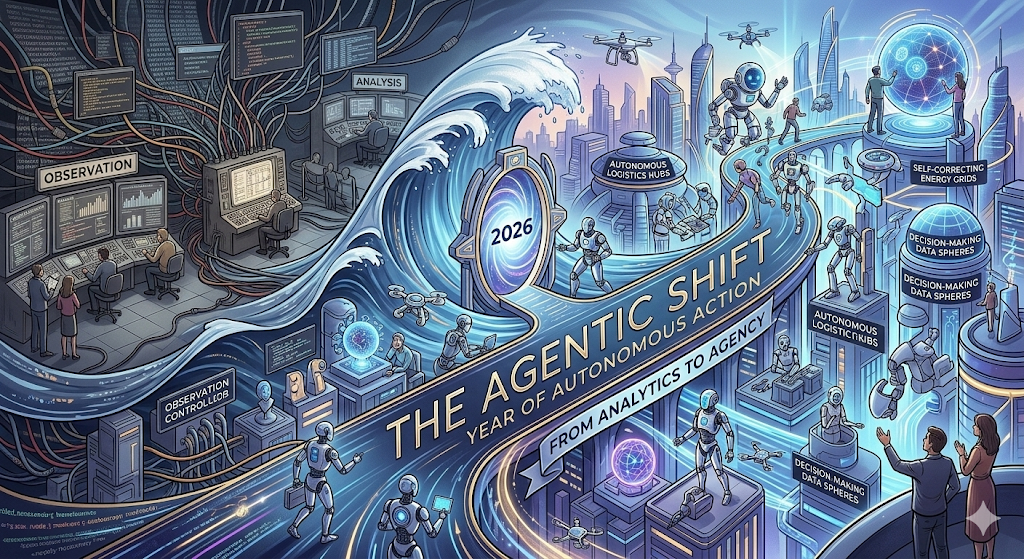
The honeymoon with conversational AI is officially over. For two years, we have been fascinated by the "magic" of LLMs that can summarize meeting notes or write poetic emails, but as we enter 2026, the novelty of "chatting" has given way to a demand for execution.
We have reached a definitive inflection point: the transition from Generative AI to Agentic AI. This isn't just a technical upgrade; it's an ontological shift where AI moves from being a reactive tool that assists human activity to an autonomous operational actor that executes complex business processes independently.
In 2026, the global enterprise is no longer building "copilots." It is hiring "digital workers" capable of reasoning, planning, and taking purposeful action across the enterprise backbone.
The Paradigm Shift: From "Prompt" to "Plan"
The core difference defining this era is the move from reactive content creation to proactive, goal-directed reasoning. While the Generative AI of 2024 waited for a human prompt to react, agentic systems in 2026 operate through continuous perception-reasoning-action (PRA) loops.
An agent doesn't just draft a refund email; it validates the transaction in the CRM, audits the logistics chain to confirm a return, triggers the payment reversal, and updates the customer’s loyalty status—all without a single human click.
This architectural shift is powered by what industry leaders call the AI Agent Runtime. According to strategic research for 2026, this infrastructure acts as the bridge between "thinking" and "doing," allowing agents to navigate multi-step workflows while maintaining a persistent memory of past actions.
The Economic Reckoning: Why Autonomy Wins ROI
The move toward agents is driven by a brutal financial truth: the ROI of traditional chatbots has begun to plateau. BCG’s 2026 survey reveals that AI agents are delivering an average ROI of 13.7%, significantly outpacing the gains seen from purely generative deployments.
This superior performance stems from the elimination of "coordination friction." In sectors like financial services, agentic orchestration has reduced loan processing cycle times by nearly 60% by automating the "hand-offs" between underwriting, compliance, and legal teams.
However, scaling these systems has revealed a new bottleneck: AI Technical Debt. High-debt organizations are finding that layering autonomous agents onto messy, fragmented legacy data is a recipe for "cascading hallucinations," where a small error at step one compounds into a massive logic failure at step ten.
The Workforce Evolution: Managing the "Digital Hybrid"
The most significant impact of 2026 isn't the technology itself, but how it is restructuring the human workforce. We are moving toward a human-augmented operating model where "workforce planning" now includes digital employees as part of the headcount.
This has triggered a radical "up-leveling" of human roles. Junior engineers and analysts are being transformed into Orchestrators, tasked with delegating goals to agentic meshes rather than executing low-level tasks themselves.
As Richard Socher of You.com notes, everyone is becoming a manager of AI agents. The critical "UI" of 2026 isn't a button or a slider; it is the Intent Architecture—the framework for how a human clearly defines a high-level goal and manages the "hand-off" when an agent reaches the limits of its autonomy.
The Risk of the "Invisible Worker"
With autonomy comes an entirely new class of risks. We are currently facing the rise of Shadow AI—the use of unsanctioned, autonomous agents by employees to bypass corporate bureaucracy.
Microsoft reports that nearly 30% of employees are using unsanctioned agents for work tasks, often inadvertently granting these "invisible workers" broad permissions to sensitive internal data. Because agents operate at "machine speed," a compromised or poorly governed agent can cause exponentially more damage than a human insider before anyone notices.
In response, 2026 has seen the emergence of Guardian Agents. These are supervisor models hard-coded with Policy-as-Code frameworks, designed to monitor other agents for "purpose drift" and ensure every autonomous action remains within the boundaries of the EU AI Act and global governance standards.
Conclusion: The Survival of the Strategic
The "Year of Truth" for Agentic AI has exposed a clear divide in the corporate world. There are companies that are merely "renting" the future by adding chatbots to their sidebars, and there are those building the future by re-engineering their entire architecture for autonomy.
As we move deeper into 2026, the organizations that succeed will be those that treat agents not as a feature upgrade, but as infrastructure. They will be the ones that have built Canonical Knowledge Models to feed their agents clean data and established zero-trust security for non-human identities.
The era of the "assistant" is ending. The era of the "agent" is here. For those who can master this orchestration, the rewards are an unprecedented level of decision velocity and structural growth; for those who cannot, the quagmire of experimentation has only just begun.