
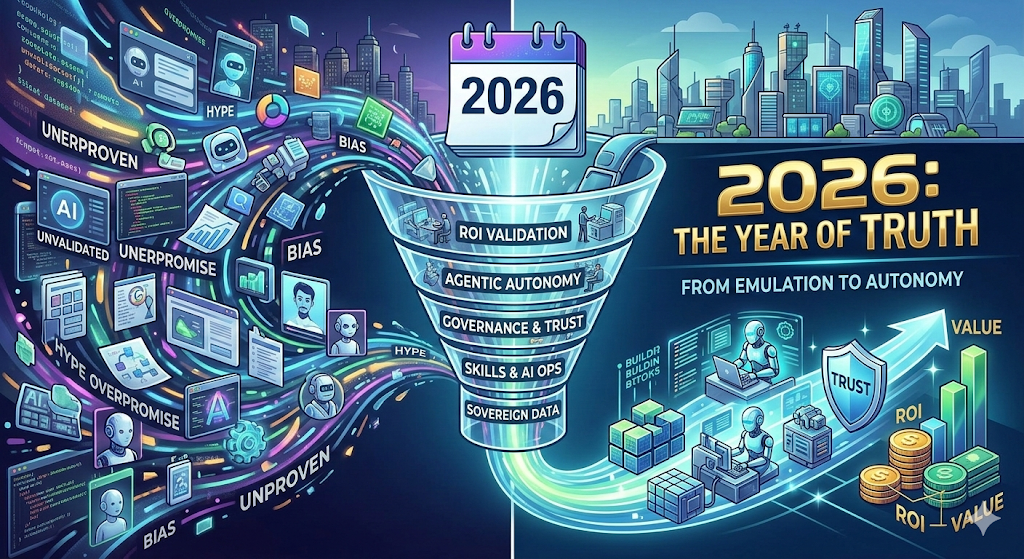
The era of the "cool demo" is officially over. For the past three years, corporate boardrooms have treated Generative AI as a high-stakes science project, pouring billions into experimental pilots and "vibes-based" innovation.
But as we settle into 2026, the mood has shifted from curiosity to a demand for the invoice. Analysts and industry leaders have codified this period as the Year of Truth, a definitive inflection point where AI must move beyond the novelty of chat boxes and into the foundational fabric of enterprise architecture.
For the global enterprise, the mandate is no longer just a "Proof of Concept." The new standard is the Proof of Impact, requiring that the staggering capital expenditures of the previous fiscal years finally translate into structural growth and measurable productivity.
The ROI Reckoning: From Hype to Maturity
The "Magnificent Seven" era established the infrastructure for the AI revolution, but 2026 is the year the bill comes due. Financial sentiment has shifted from valuation euphoria to investor discipline, focusing heavily on how companies maximize their AI ROI in 2026.
A significant portion of this reckoning comes down to a hidden tax: AI Technical Debt. Recent data suggests that high-debt organizations are spending nearly 40% more on maintenance than their peers, often shipping new features up to 50% slower because of poorly integrated legacy systems.
The companies winning this year are those that stopped "bolting on" AI as a feature and started rebuilding their core workflows around it. They are moving away from isolated experiments toward Applied AI that delivers tangible bottom-line results rather than just impressive slide decks.
The Rise of Agentic AI: From "Chat" to "Do"
One of the most profound shifts in 2026 is the transition from conversational AI to Agentic AI. While 2024 was about asking a chatbot to write an email, 2026 is about empowering autonomous agents to execute multi-step business processes with minimal human intervention.
These agents are no longer just passive interfaces; they are active participants in the workforce. In sectors like healthcare, agentic systems are now capable of reasoning across patient populations, managing clinical trials, and optimizing care workflows in real-time.
As Deloitte Insights points out, the "agentic era" is redefining human-capital strategy. The question for leadership has evolved: it is no longer about whether AI will replace tasks, but how to orchestrate a digital workforce where agents and humans collaborate on high-value strategy.
The Shift in Sovereign AI
Alongside autonomy, we are seeing the rise of Sovereign AI. Nations and corporations are increasingly viewing the ownership of AI capabilities as a matter of strategic resilience.
By building localized ecosystems that connect energy, compute, and proprietary data, organizations are insulating themselves from global supply chain shocks. This isn't just about technology; it's about the "Brussels Effect" and new regulatory transparency requirements that demand data stay within specific borders.
The Physical Ceiling: Energy, Water, and Infrastructure
Perhaps the most sobering "truth" of 2026 is that AI is not just software—it is a massive physical burden on the planet's resources. The expansion of data centers has raised critical questions about energy use and environmental impact.
Global projections indicate that AI’s water demand for cooling and electricity generation could reach billions of cubic meters annually. In the UK and parts of the US, this is already posing a substantial threat to water security, forcing a pivot toward advanced cooling technologies.
We are seeing a race to solve this "power bottleneck." Forward-thinking energy providers are now partnering with tech giants to explore small modular nuclear reactors and immersion phase-change cooling to keep the AI engine running without collapsing the local grid.
The Regulatory Reckoning and "Shadow AI"
Compliance is no longer an optional "checked box" in 2026. The full enforcement of the EU AI Act has created a global ripple effect, forcing companies in Taiwan, the US, and beyond to adopt rigorous governance frameworks.
One of the greatest risks remaining is Shadow AI—the use of unauthorized AI tools by employees to bypass corporate bureaucracy. To counter this, boards are adopting ISO/IEC 42001 standards to turn these "hidden" tools into governed assets.
Organizations that fail to implement "AI Assurance" this year face more than just fines; they face a "data crisis" where sensitive information is inadvertently leaked into public training models. Security has moved from protecting the perimeter to protecting the data integrity of the model itself.
Conclusion: The Survival of the Substantiated
If 2023 was the year of curiosity and 2025 was the year of experimentation, 2026 is the year of substantiation. The "Year of Truth" is acting as a natural filter, separating the organizations that used AI as a marketing buzzword from those that used it to fundamentally re-engineer their value proposition.
Success in this new era requires a brutal honesty about technical debt, a proactive stance on environmental constraints, and a shift in leadership from "managing tools" to "orchestrating agents."
The AI honeymoon is over. For those who have built on solid foundations, the real work—and the real value—has only just begun.