
The industrial age was defined by the clanking of massive die presses and the permanence of iron molds. If you wanted to change the shape of a jet wing or a missile casing, you didn't just tweak a line of code; you spent six months and a million dollars building a new physical tool.
But those days of rigid, "frozen" hardware are coming to a close. On February 4, 2026, Machina Labs announced the closing of a $124 million Series C financing round, signaling a massive shift from experimental technology to a national "manufacturing backbone" for defense and aerospace.
By combining AI-guided robotics with a process known as incremental sheet forming, Machina Labs is effectively turning factories into giant, programmable printers for heavy metal. This isn't just a win for venture capitalists; it’s a fundamental upgrade to the U.S. defense industrial base that has long been hamstrung by its own lack of agility.
The End of the Tooling Bottleneck
Traditional manufacturing is a game of scale, but modern warfare is increasingly a game of speed. When a defense prime needs a specific airframe panel for a legacy fighter jet, they often face "obsolescence" issues—the original manufacturer might be out of business, or the specific die used to stamp that part 30 years ago has been lost to time.
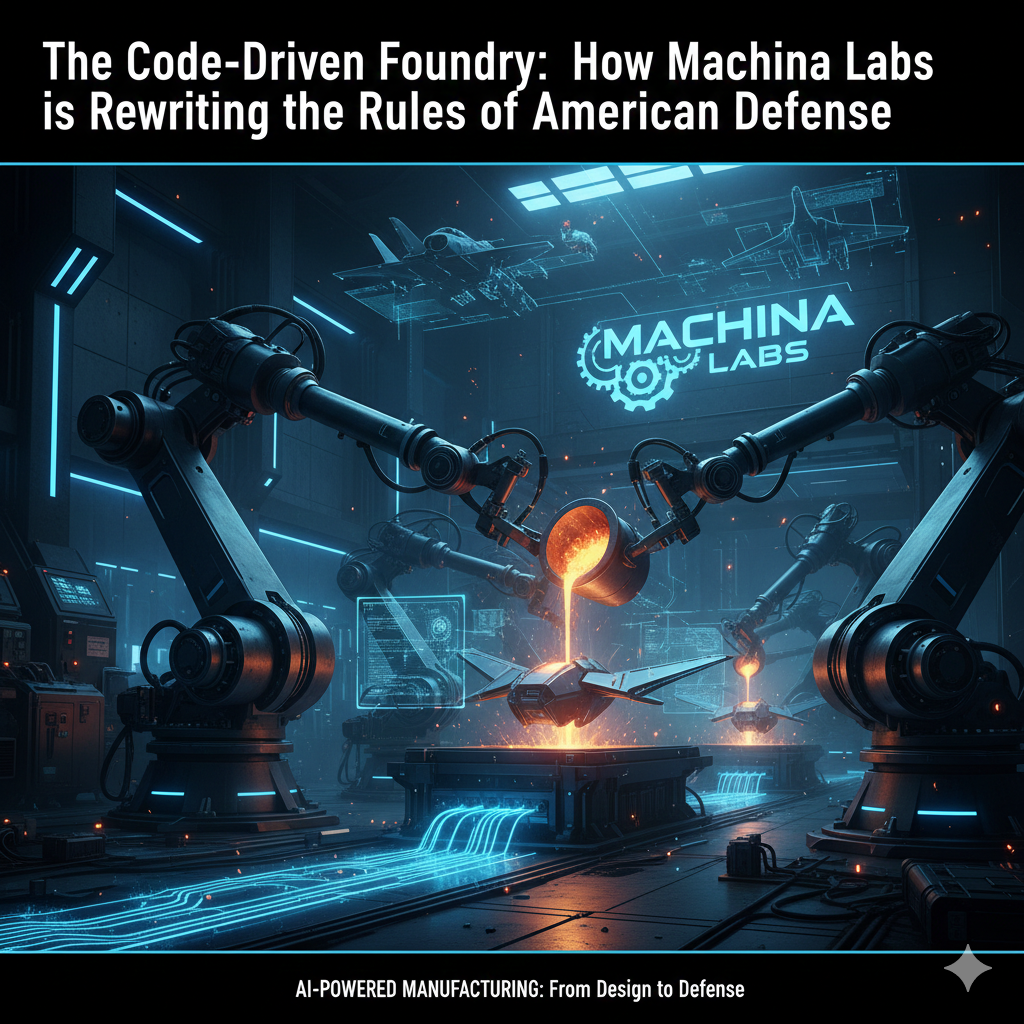
Machina Labs solves this by replacing the die with a pair of collaborative robotic arms. These "RoboCraftsmen" use AI to "feel" the metal as they deform it, essentially blacksmithing at a superhuman scale. Because the process is software-defined, the factory can switch from making a truck tailgate to a hypersonic missile shroud with a simple software update.
This flexibility is why heavy hitters like Lockheed Martin Ventures and Woven Capital (Toyota) joined the latest round. They aren't just buying parts; they are investing in an "elastic factory" that can scale up or pivot overnight in response to geopolitical shifts or supply chain shocks.
Building the First Large-Scale Intelligent Factory
The headline-grabbing $124M isn't just sitting in a bank account. A significant portion is being channeled into the launch of a 200,000-square-foot "Intelligent Factory" in the United States. This facility will house up to 50 RoboCraftsman cells, capable of churning out thousands of complex structural assemblies every year.
A Data Center for Hardware
Think of this factory less like a traditional assembly line and more like a cloud computing data center. In a data center, you don't build a new server every time you want to run a new app; you just deploy the code to existing hardware. Machina Labs is applying this logic to physical matter.
By using uncrewed ground vehicles (UGVs) and a "cell-based matrix" production model, the company can reallocate its robotic resources on the fly. This allows them to maintain "mass-production prices" even for highly customized, low-volume orders—a feat that was historically considered the "Holy Grail" of industrial engineering.
The Provenance of Every Part
One of the hidden superpowers of this AI-driven approach is data traceability. Every time a robot arm moves, sensors capture high-resolution data on the force applied and the material's response. This creates a "digital twin" of every single part produced, a level of quality assurance that is vital for mission-critical components used in high-stress environments like aerospace.
Why the Pentagon is Placing Big Bets
The Department of Defense (DoD) has become one of Machina’s most vocal supporters, recently awarding the company contracts worth over $14 million. For the U.S. Air Force, the value proposition is simple: readiness.
Currently, if a B-1 Lancer bomber needs a replacement skin panel, it can take months to source the part through traditional channels. With Machina’s portable, deployable "Expeditionary Depots," the military could potentially manufacture that part at the "point of need"—be it a domestic airbase or a forward-operating location.
This shift moves the military away from a "just-in-case" inventory model, where they store millions of dollars of spare parts in warehouses, to a "just-in-time" model where parts are fabricated on demand. It is the ultimate hedge against a brittle global supply chain.
The Road Ahead: Challenges and Realistic Optimism
Of course, the path to reindustrialization isn't without its hurdles. While Machina Labs has achieved CMMC Level 2 Certification for cybersecurity, the broader challenge remains one of cultural inertia. The defense industry is notoriously slow to adopt new standards, and "trusting the AI" with a wing spar is a different level of commitment than trusting it with a chat interface.
There is also the question of material limits. While Machina successfully works with aluminum, titanium, and Inconel, the physics of incremental forming means there are certain geometries and thicknesses that remain out of reach for robotic arms—at least for now.
However, the investment from the Strategic Development Fund (SDF) and other global partners suggests that the appetite for this technology is not just domestic but global. We are entering an era where manufacturing capability is viewed as a form of "sovereign compute."
Conclusion: The Manufacturing Backbone
The funding of Machina Labs is a signal that the "software is eating the world" mantra has finally reached the heavy industrial floor. By decoupling production from specialized tooling, Machina is building a "manufacturing backbone" that is as flexible as the code that drives it.
In an age where the ability to innovate is limited by the speed of production, the company that builds the fastest, most adaptable factory wins. For the American defense sector, this $124M round isn't just about growth—it’s about ensuring that the next generation of aircraft and spacecraft are limited only by our imagination, not by our machines.