
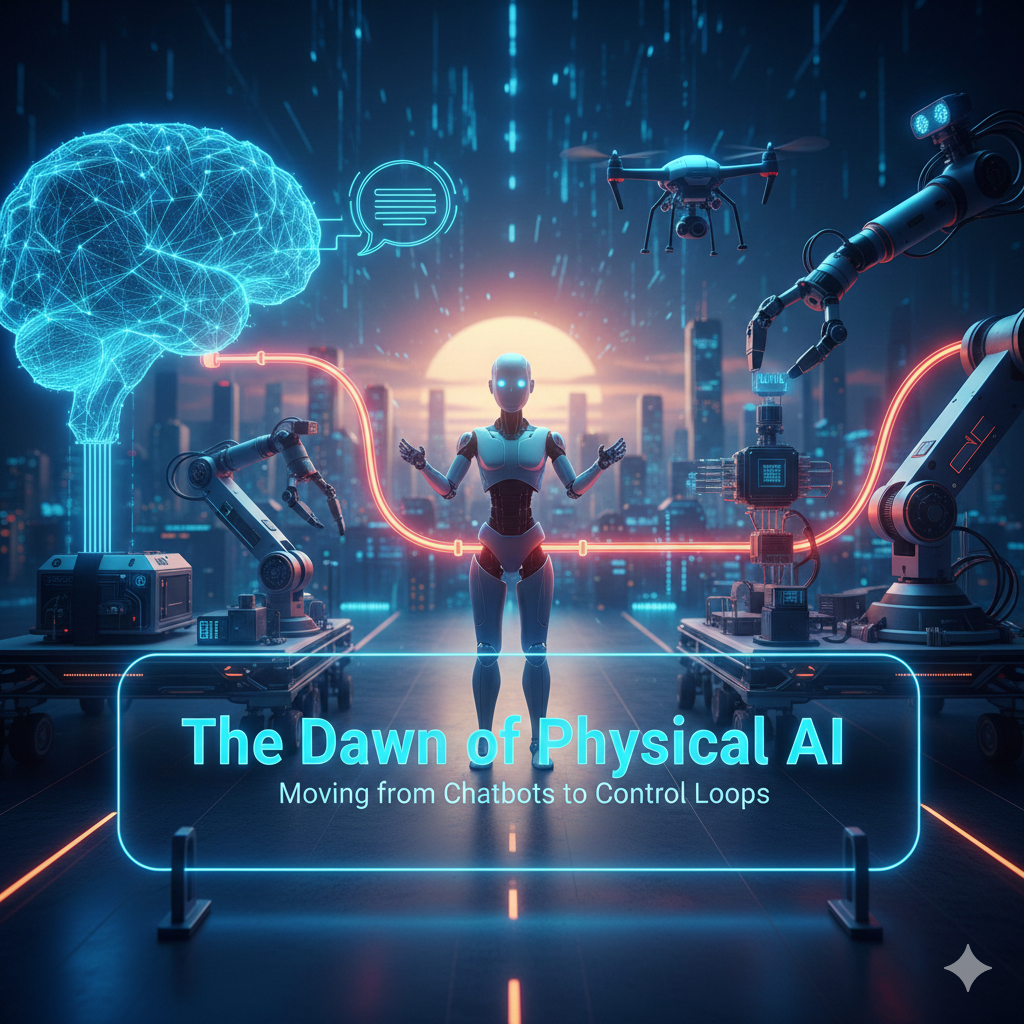
For the last three years, we have been obsessed with "wordsmiths in the dark." We marveled as Large Language Models (LLMs) wrote our emails, summarized our meetings, and occasionally hallucinated our history, all while existing entirely behind the glowing glass of our screens.
But the era of disembodied information processing is coming to a close. We are witnessing a fundamental transition toward Physical AI—systems that don't just talk about the world, but actually move within it.
This isn't just about putting ChatGPT in a metal body. It is the evolution from open-loop conversational agents to closed-loop control systems capable of real-time interaction with the messy, unpredictable, three-dimensional reality we inhabit.
From Generative Text to Generative Reality
The current trajectory of artificial intelligence is defined by a move from disembodied intelligence to embodied execution. While the previous decade focused on the success of generative content, the emerging paradigm focuses on systems that perceive the material world and directly control real-world actions.
As Stanford’s Fei-Fei Li has noted, LLMs are brilliant at abstract knowledge but remain ungrounded in physical reality. They can explain quantum physics with ease, yet they cannot tell you how much force is required to pick up a strawberry without crushing it or how to navigate a crowded factory floor.
The "Spatial Intelligence" era aims to bridge this gap. This involves teaching machines to think in three dimensions, predicting what happens when objects interact, and reasoning about the flow of time and space.
Physical AI operates through a continuous cycle often described as the Perceive-Decide-Act-Govern loop. Unlike a chatbot that waits for a prompt, a physical AI system is constantly sensing, perceiving, deciding, and acting in a millisecond-level latency cycle to maintain stability and safety.
The Architecture of Action: VLA Models
The secret sauce behind this transition is the Vision-Language-Action (VLA) model. These are foundation models trained to map visual observations and natural language instructions directly into robotic motor commands.
Instead of programming a robot with thousands of lines of "if-then" code, we are now training them on vast datasets of human movement and robotic teleoperation. Models like Google DeepMind’s RT-2 (Robotic Transformer 2) have shown that AI can generalize from web-scale data to perform tasks it was never specifically programmed for.
We are seeing a shift from monolithic models that try to do everything at once to hierarchical models that decouple high-level planning from low-level execution. This allows a robot to "reason" that it needs to find a sponge to clean a spill, while a separate "System 1" controller handles the millisecond-by-millisecond balance and grip required to hold that sponge.
Open-source breakthroughs are also democratizing this technology. Models like Stanford’s OpenVLA are outperforming massive proprietary systems, allowing smaller startups to deploy advanced robotic brains without needing the compute budget of a tech giant.
Closing the "Sim-to-Real" Gap
One of the greatest hurdles in robotics has always been the Sim-to-Real gap. It is relatively easy to train a robot in a perfect digital simulation, but those same robots often fail when faced with the lighting changes, friction, and dust of a real warehouse.
To solve this, industry leaders are turning to World Models. These are AI systems that act as internal simulators, allowing a robot to "imagine" the consequences of its actions before it takes them.
NVIDIA is leading this charge with its Omniverse and Cosmos platforms, which generate high-fidelity synthetic worlds. By training robots in these hyper-realistic environments, companies can compress months of real-world testing into hours of simulation.
The goal is what experts call "Gen2Real"—the ability for generative AI to create training data that is so accurate it can be deployed directly into physical hardware without further adjustment.
The Rise of the General-Purpose Humanoid
If 2024 was the year of the chatbot, 2026 is becoming the year of the humanoid. We are moving away from single-purpose industrial arms toward versatile machines that can adapt to human environments.
Tesla’s Optimus Gen 2, Figure AI’s Figure 02, and Boston Dynamics’ all-electric Atlas are no longer just lab experiments. They are being piloted in real-world facilities, such as BMW’s Spartanburg plant and Amazon’s massive fulfillment centers, to handle repetitive, ergonomically taxing tasks.
The business case for these humanoids is becoming undeniable. Reports suggest that companies like BMW are already seeing millions in annual savings through AI-powered robotic efficiency.
By 2030, the market for Physical AI is projected to explode from $12 billion to over $124 billion. This growth is driven by the realization that intelligent hardware can solve the global labor shortages that are currently crippling the manufacturing and logistics sectors.
The "Touch" Revolution: Beyond Vision
While vision is critical, Physical AI requires more than just "eyes." For a robot to truly interact with the world, it needs a sense of touch.
Tactile sensing is the next frontier. Companies like XELA Robotics are developing 3D tactile sensors that give robots human-like sensitivity.
This allows machines to handle delicate objects, detect slips in real-time, and operate in "blind" conditions where cameras might be obscured. Adding haptic feedback to the control loop transforms a robot from a clumsy machine into a dexterous agent capable of complex assembly and even surgical assistance.
Safety and the "Constitutional" Robot
As AI moves into our physical spaces, safety becomes the paramount concern. We can tolerate a chatbot giving a wrong answer, but we cannot tolerate a two-hundred-pound robot making a physical error in a crowded space.
Researchers are developing frameworks like the ASIMOV Benchmark to measure how well AI perceives physical danger. This involves testing whether a system understands common-sense physics, such as knowing that a hot cup of coffee shouldn't be handed to a child or that a box might be too heavy to lift.
Furthermore, we are seeing the rise of Robot Constitutional AI. This embeds ethical core values directly into the model's reasoning path, ensuring that safety constraints are not just "suggestions" but deterministic laws that govern every motor command.
Reallocating Tasks, Not Just Jobs
The specter of technological unemployment always looms over discussions of robotics, but the data suggests a more nuanced reality. Research from MIT Sloan indicates that AI adoption often leads to task reallocation rather than total job replacement.
In this model, Physical AI takes over the "Three Ds"—tasks that are Dull, Dirty, or Dangerous. This allows human workers to move into roles that require critical thinking, creativity, and emotional intelligence.
The key for organizations is to lean into this transition. Firms that proactively integrate AI while investing in human capital development will be better positioned for long-term competitiveness in the evolving labor market.
The Physicalization of Intelligence
The dawn of Physical AI represents a "coming of age" for artificial intelligence. We are finally moving beyond the novelty of digital assistants and into the era of true utility.
The transition from chatbots to control loops is not merely a technical upgrade; it is a fundamental shift in how we interact with technology. We are no longer just talking to our tools; we are co-existing with them in the material world.
As we look toward the end of the decade, the distinction between "digital" and "physical" AI will likely vanish. We will simply have intelligence—and that intelligence will have hands.
Key Industry Milestones to Watch
2025-2026: Widespread commercial pilots of humanoid robots in structured industrial environments like BMW and Amazon.
2027-2028: Breakthroughs in battery technology and edge computing, allowing robots to operate autonomously for 8+ hours.
2029-2030: The emergence of "Robot-as-a-Service" (RaaS) models, making advanced Physical AI accessible to small and medium enterprises.