
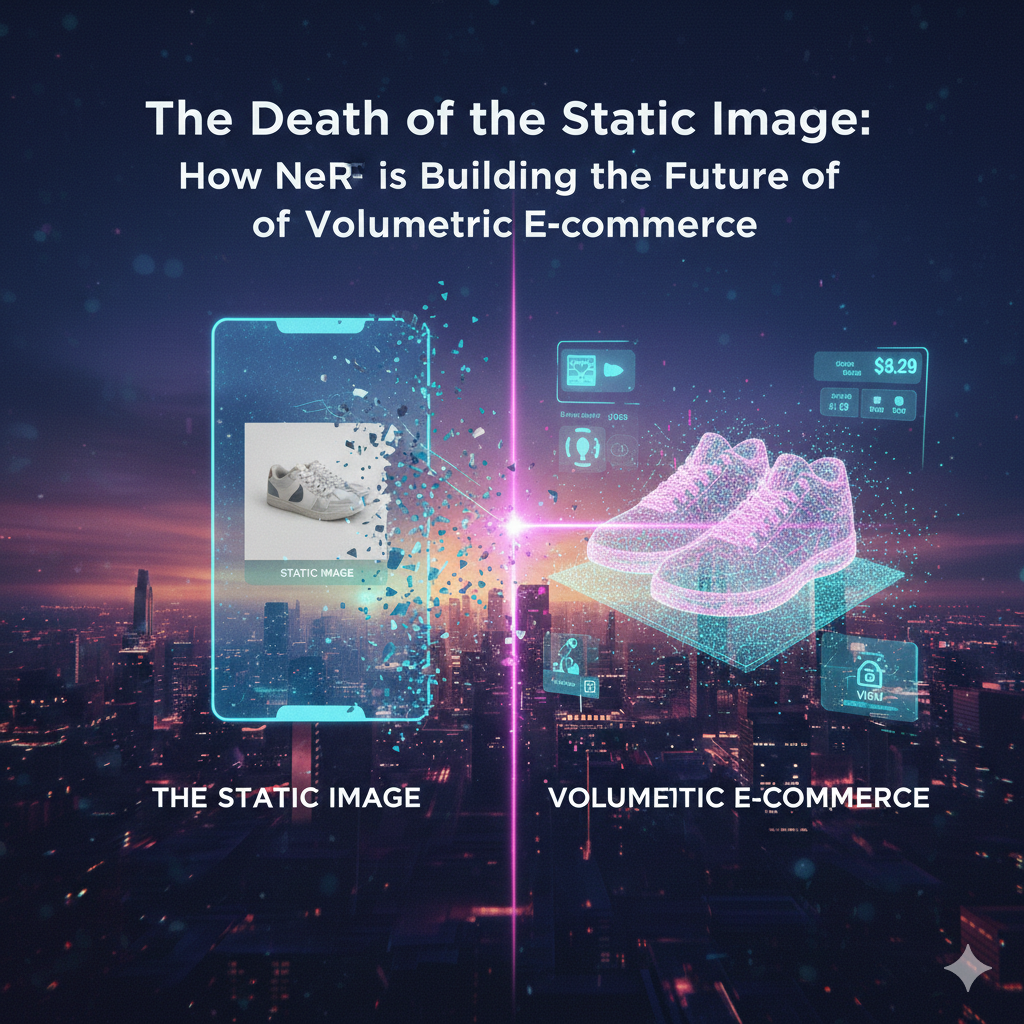
Imagine shopping for a velvet armchair online and being able to see exactly how light catches the fabric from every possible angle, not just the three curated photos the seller provided. For years, the "digital gap"—the space between what we see on a screen and what we touch in a store—has been the biggest hurdle for global e-commerce.
Despite the convenience of one-click ordering, we still live in a world where "what you see" isn't always "what you get." This uncertainty is the primary driver of the multibillion-dollar return industry, where nearly 20% of all online purchases end up back in a warehouse.
But a paradigm shift is occurring. We are moving away from traditional digital imaging toward a new era of spatial computing and volumetric realism. At the heart of this evolution is Neural Radiance Fields, or NeRFs, a technology that is rapidly transforming from a complex computer vision experiment into the cornerstone of modern retail strategy.
From Pixels to Probability: Understanding the NeRF Metaphor
To understand why NeRF is revolutionary, we have to look at how we’ve traditionally built 3D models. For decades, if you wanted a 3D version of a sneaker, an artist had to "sculpt" it digitally using a mesh of triangles—a process known as photogrammetry.
While effective for simple shapes, photogrammetry often struggles with the very things that make products look "real" to the human eye. It fumbles on shiny surfaces, fails to capture the fuzziness of a sweater, and creates jagged edges on thin objects like eyeglass frames.
NeRF flips the script. Instead of trying to define the hard geometry of an object, NeRF uses a neural network to learn how light travels through a scene. Think of it as the difference between building a statue out of clay and training a brain to remember exactly how a room looked from every possible doorway.
Because NeRF focuses on "radiance"—the way light and color interact—it can recreate the shimmer of silk or the transparency of a wine glass with a level of photorealism that traditional models simply cannot match. It doesn't just show you the product; it simulates the experience of looking at it.
The Business Case for Volumetric Reality
For executives, the appeal of NeRF isn't just about cool visuals; it's about the bottom line. Interactive 3D content has been shown to increase conversion rates by up to 40% and, perhaps more importantly, reduce returns by as much as 85%.
When a customer can virtually "place" a product in their living room using Augmented Reality (AR) and inspect the stitching on a leather bag from an inch away, the "fear of the unknown" evaporates. This is particularly critical in the B2B sector, where 70% of buyers now make their purchasing decisions before ever speaking to a sales representative.
Companies like Alibaba are already leaning into this. During the 2021 Double 11 Global Shopping Festival, Mobile Taobao implemented automatic 3D modeling to allow consumers to place virtual goods in their real homes. This transition from "viewing" a product to "interacting" with it is turning the smartphone into a high-fidelity portal for the physical world.
Bridging the Mobile Performance Gap
Historically, the biggest objection to NeRF was that it required massive computing power. In its early days, rendering a single frame of a NeRF scene could take several seconds on a high-end workstation—far too slow for a consumer scrolling through a retail app on a mid-range Android phone.
However, recent breakthroughs like MobileNeRF and ATM-NeRF have fundamentally changed the math. By "baking" neural radiance fields into traditional polygon meshes that mobile graphics chips already know how to handle, developers can now achieve real-time performance on common devices.
This means that the same photorealistic quality once reserved for Hollywood visual effects is now accessible on a standard mobile browser. This democratization of high-end 3D content is what will ultimately drive the AR/VR market toward its projected valuation of over $150 billion by 2030.
The Generative AI Synergy: Text-to-3D
The next frontier for NeRF in e-commerce isn't just capturing existing products, but creating new ones. We are entering the era of "Text-to-3D," where generative AI models can transform a simple text prompt into a fully realized 3D asset.
Google Research has been at the forefront of this, exploring view-conditioned diffusion models that allow retailers to generate 3D shoppable products from just a few 2D images. Imagine a world where a designer can type "a mid-century modern sofa in emerald green velvet" and instantly receive a photorealistic 3D model ready for a virtual showroom.
This synergy between large language models and neural rendering will drastically lower the cost of content creation. For brands managing thousands of SKUs, the ability to automate the 3D pipeline—rather than hiring studios for manual photography—is a strategic game-changer.
Navigating the Friction: Challenges and Ethics
It would be naive to suggest that the path to a NeRF-driven world is without obstacles. Latency remains a concern for large-scale environments, and the storage requirements for high-resolution neural fields can still be significant for global platforms.
There is also the question of data integrity. Because NeRF "fills in the gaps" of what it hasn't seen, there is a risk of AI "hallucinations" where the rendered 3D model might look better—or slightly different—than the actual physical product. For luxury retailers, where every millimeter of detail counts, ensuring that the neural representation is an exact digital twin is paramount.
Furthermore, as CableLabs has noted, the ability to reconstruct detailed 3D environments from simple images raises privacy concerns. If a customer uses a NeRF-based app to scan their living room, how is that spatial data being stored, and who owns the 3D map of their private home?
The Future is Volumetric
Despite these challenges, the trajectory is clear. We are witnessing the slow death of the flat, static product image. In its place, we are building a more honest, more immersive version of the internet—one where "shopping" feels less like browsing a catalog and more like walking through a gallery.
The brands that embrace NeRF early won't just be offering a better visual; they will be building a foundation of trust. In an age where digital noise is everywhere, providing a customer with the agency to explore a product on their own terms, in their own space, is the ultimate competitive advantage.
The future of retail isn't just digital—it's volumetric. And for the first time, the technology is finally ready to meet our expectations.