
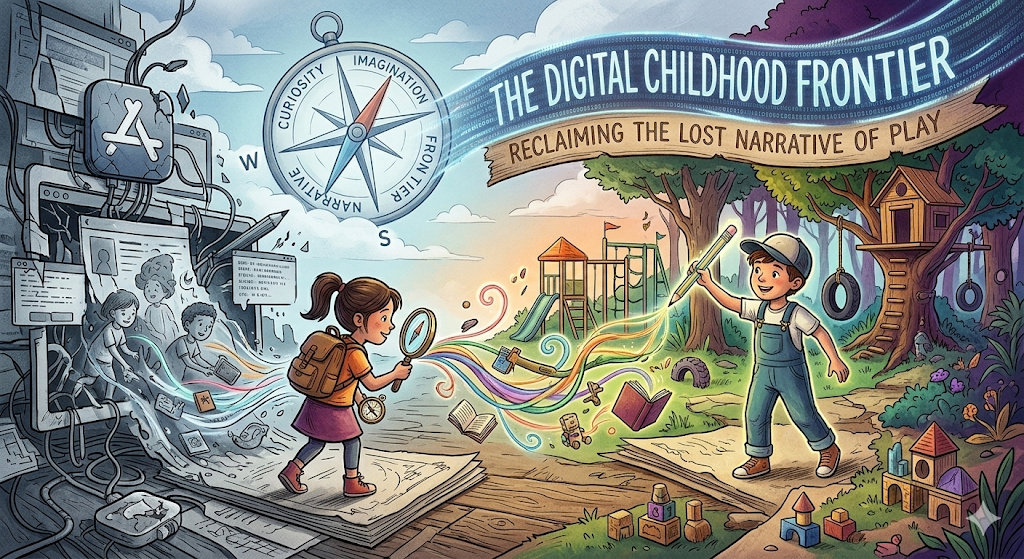
For many children born this decade, their digital footprint begins not with their first steps, but with an ultrasound photo posted to a social media feed. We have sleepwalked into a world where a child’s entire developmental trajectory is archived, analyzed, and monetized before they are old enough to understand the concept of a "cookie."
But as we settle into 2026, the cultural honeymoon with "default-digital" parenting has officially ended. Following the broader trend of the "Year of Truth," we are witnessing a global reckoning where the long-term data on mental health, social skills, and privacy is finally forcing a rewrite of the childhood social contract.
The debate has moved beyond the simplistic "screen time" limits of the early 2020s. We are now asking a much deeper question: What does it mean to be human when your first primary relationship is with an algorithm?
The Technocrisis: When Design Ignores Development
The internet was originally conceived as a utopian landscape for adult researchers, built on an ideology of universal equality. This design philosophy inadvertently ignored the graduated maturity and unique vulnerabilities of children, treating them as small adults rather than developing subjects.
We are now living through what researchers call a technocrisis, where pervasive digital infrastructures outpace the ethical frameworks intended to govern them. The resulting friction is most visible in the "neurological mismatch" between high-speed algorithmic feeds and the slow-burn requirements of biological brain development.
Recent systematic reviews have highlighted the "touchscreen paradox." While digital exposure can enhance specific cognitive tasks, excessive early exposure is increasingly linked to deficits in social-emotional learning and threat perception. In short, children are learning to navigate interfaces better than they are learning to navigate each other.
The "Sharenting" Reckoning: Consent in the Data Age
One of the most emotionally charged debates of 2026 centers on sharenting—the practice of parents excessively sharing their children's lives online. This isn't just about privacy; it's about the creation of a "digital shadow" that the child never authorized.
The average child today has thousands of data points collected about them before they reach secondary school. This has led to the rise of advocates like Sarah Adams of Mom.Uncharted, who argues that we have turned childhood into a form of "content creation by proxy."
The risk is no longer theoretical. In the era of Generative AI, a mere 20 images of a child are enough to produce a high-fidelity deepfake, leading to a data security crisis that many parents feel ill-equipped to manage. The "Year of Truth" is forcing a shift from sharing by default to privacy by design.
The "Brussels Effect" for Kids: Brazil’s Regulatory Landmark
While the US Congress continues its crusade to age-gate the internet through bills like KOSA and COPPA 2.0, the real momentum is shifting to the Global South.
In late 2025, Brazil enacted the ECA Digital (Law No. 15,211/2025), a landmark statute that has become the "gold standard" for children’s rights in the digital age. This law doesn't just suggest safety; it prohibits targeted advertising based on behavioral profiling or emotional analysis directed at minors.
Brazil’s approach recognizes "progressive autonomy"—the idea that a child’s digital rights should expand as they mature. It forces platforms to implement reliable age verification while ensuring that "the best interests of the child" are the primary filter for any algorithmic operation. This is the regulatory "truth" of 2026: platforms must now prove they are safe for children, rather than parents proving they have enough filters.
The AI Classroom: From "Tutor" to "Teammate"
The debate isn't solely about restriction; it's also about evolution. Generative AI is now a structural component of the educational backbone. We are moving from AI as a search engine to agentic AI as a learning companion.
However, the Turing Institute warns of a growing digital divide. Data suggests that 52% of private school children are utilizing advanced AI agents for research and planning, compared to only 18% in state-funded schools. This "intelligence gap" could become the defining inequality of the next decade.
The challenge for 2026 is ensuring "Immersive Equity." As we integrate Virtual Reality and AI into schools, we must ensure these tools are used to foster global digital citizenship rather than just creating highly efficient test-takers.
Conclusion: From Surveillance to Stewardship
The "Digital Childhood" debate of 2026 is ultimately a struggle for the soul of play. For decades, play was a private, unmeasured, and exploratory act. The digital era threatened to turn it into a public, measured, and performative one.
But the "Year of Truth" has provided a roadmap for reclamation. Success in this era isn't found in a total "tech blackout," but in the 10 Rules for a High-Tech World popularized by Dr. Jean Twenge: a move toward more independence in the physical world and more stewardship in the digital one.
The honeymoon of the "connected kid" is over. We are now entering the era of the protected and empowered kid. For the parents, regulators, and technologists who get this right, the reward is a generation that uses technology as a tool for creation rather than a tether for consumption.