
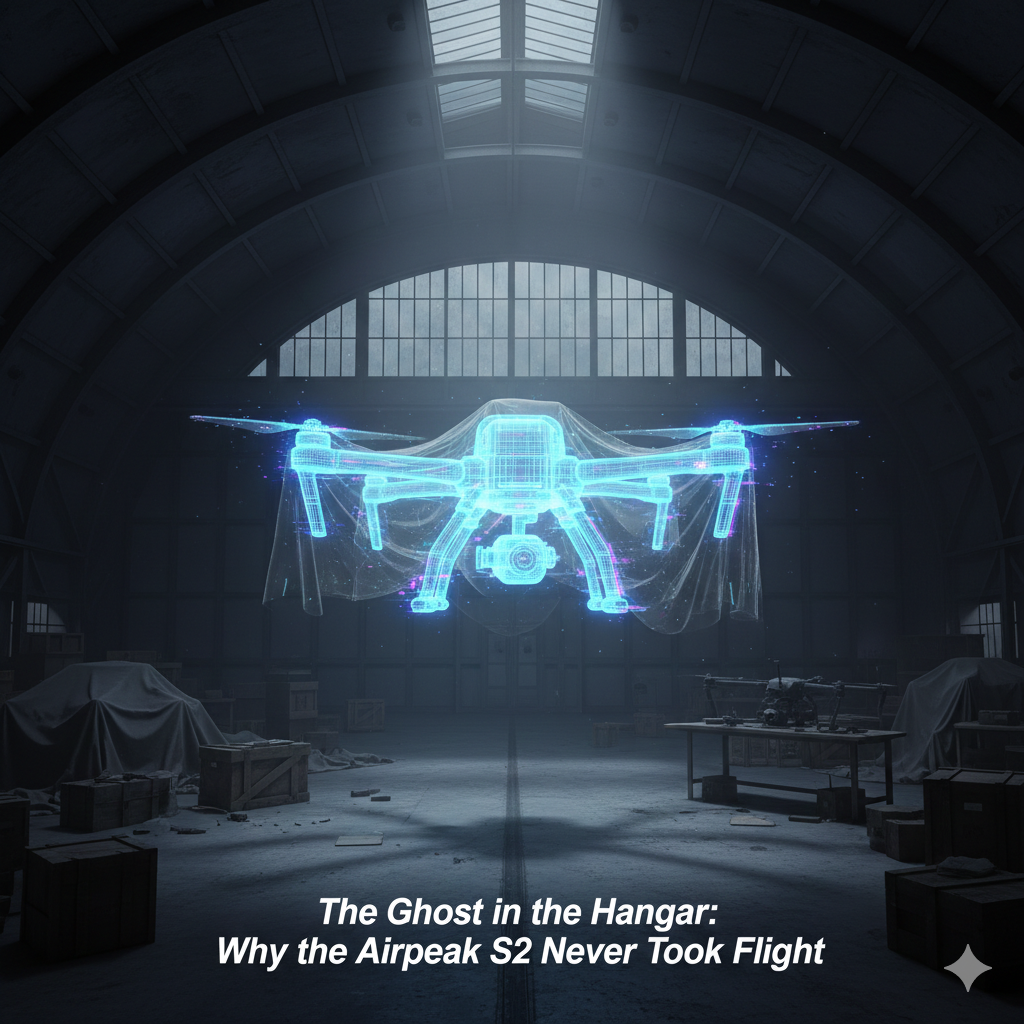
In the early months of 2021, Sony promised the world a revolution in the sky. The Airpeak project was supposed to be the bridge that finally allowed cinematographers to fly a professional Alpha camera with the same seamless ease as a consumer drone. For a moment, it felt like the DJI monopoly was finally about to be challenged by a legacy imaging titan.
But as of February 12, 2026, the hangar remains quiet. Instead of the long-rumored Airpeak S2, Sony has spent the day making waves in two entirely different oceans: high-fidelity gaming and premium personal audio.
This isn’t just a story about a discontinued product line; it’s a case study in how technological ambition often collides with the uncompromising realities of professional workflows. By dissecting the trajectory of the Airpeak project, we can see exactly why Sony decided to trade its wings for a more grounded, yet significantly more profitable, future.
The Engineering Pedigree of the Airpeak S1
To understand the absence of an S2, we have to look at the bones of its predecessor. The Airpeak S1 was a mechanical marvel, engineered specifically to carry a full-frame Alpha series camera while maintaining the agility of a much smaller quadcopter.
Sony's engineers pushed the limits of physics, testing the airframe at the Japan Aerospace Exploration Agency (JAXA) to prove it could remain stable in wind speeds of up to $20 \text{ m/s}$ (nearly 45 mph). It was fast, too—hitting $80 \text{ km/h}$ in a staggering 3.5 seconds.
On paper, it was the drone of a photographer’s dreams. It featured custom-designed 17-inch propellers and a Vision Sensing Processor that allowed for multi-directional obstacle avoidance even in "GNSS-denied" environments like dense forests or steel structures.
The Operational Friction That Grounded the Brand
Performance in a lab and performance on a high-budget film set are two very different things. The Airpeak S1 quickly encountered a "basics" problem that plagued every early user.
The most glaring issue was flight time. Sony advertised a theoretical 22-minute ceiling, but that was without a payload. Once you added the Gremsy T3 gimbal, a Sony Alpha 7S III, and a prime lens, that window shrunk to a claustrophobic 10 to 12 minutes.
For professional pilots, this was a severe bottleneck. After accounting for takeoff and positioning, a director might only have six or seven minutes of actual "rolling" time before the drone needed to return for a battery swap.
Managing a shoot required a literal fleet of batteries, each costing hundreds of dollars, and a massive Battery Station just to keep the workflow moving. The "out-of-the-box" reliability that DJI had spent a decade perfecting simply wasn't there; users reported live video feeds cutting out mid-flight and persistent calibration bugs.
The Financial Barrier to Entry
Then there was the cost. The Airpeak wasn't just a drone; it was a fragmented ecosystem of expensive components.
The $9,000 initial price tag only bought the drone body and controller. Because Sony didn’t build the gimbal in-house, users had to spend another $2,200 for a third-party mount. Add a $6,500 Alpha 1 body and several thousand dollars in lenses and batteries, and an operational kit easily cleared $20,000.
Sony attempted to salvage the platform in 2023 with "Pro" upgrades—a lighter gimbal, an enhanced battery, and a $4,000 RTK kit for centimeter-level positioning. But these high-priced bandages didn't solve the core software stability and efficiency issues.
By late 2024, the company officially signaled the end of the Airpeak line, citing "changes in the business environment." The anticipated S2 was quietly shelved, leaving the professional drone market almost entirely to DJI and niche enterprise players.
The February 12 Pivot: Gaming and Audio Take Center Stage
If you were looking for hardware reveals today, you found them—just not in the sky. Sony’s choice of February 12, 2026, for its latest announcements highlights a decisive shift back toward its most profitable "Kando"-inducing sectors.
The headline of the day was a massive, 60-minute PlayStation State of Play. This event effectively replaced the traditional "Showcase" format, focusing on heavy hitters like Marvel’s Wolverine and Bungie’s upcoming extraction shooter, Marathon.
Simultaneously, the audio division launched the WF-1000XM6. These earbuds represent the cutting edge of Sony’s AI integration, featuring the new QN3e processor and an eight-microphone array designed for adaptive noise cancellation.
This pivot isn't a retreat; it's a concentration of force. Sony realized that its true strength in the "robotics" space isn't in autonomous flying machines, but in the sensors and processing power that live inside its cameras and entertainment devices.
The Future of Sony Pro: Integrated Cinema and Static Robotics
While the Airpeak is gone, its DNA lives on in Sony’s Cinema Line roadmap. Instead of trying to build the best drone, Sony is now focusing on being the best part of every drone.
The company's professional focus has moved toward integrated workflows for the VENICE 2 and BURANO. New firmware updates (like V4.1 for the VENICE 2) are bringing "Big6" interfaces and better remote-control protocols, making these cameras easier to use on any professional heavy-lift platform, whether it's a DJI or a custom hexacopter.
We are also seeing a shift toward "Static Robotics"—advanced PTZ (Pan-Tilt-Zoom) cameras like the FR7 that use AI-based auto-framing. This technology allows a single operator to manage complex multi-camera setups for live events and podcasts, delivering high-end "robotic" cinematography without the risk of falling from the sky.
Conclusion: A Lesson in Ecosystem Dominance
The story of the Sony Airpeak S2 is ultimately a lesson in the power of ecosystems. Building a great camera is one thing; building a reliable, flight-ready platform that can compete with a decade of DJI’s refinement is quite another.
Sony’s decision to sunset Airpeak and focus on its "Imaging and Sensing" core shows a refreshing level of corporate self-awareness. By focusing on firmware roadmaps, sustainable biomass plastics in manufacturing, and high-volume entertainment, the company is ensuring it remains the "brain" of the creative industry.
The Airpeak may have been a rare misstep, but the insights gained from it have clearly sharpened Sony’s focus for the rest of 2026 and beyond. Sometimes, the best way to move forward is to admit when a dream has hit its ceiling.