
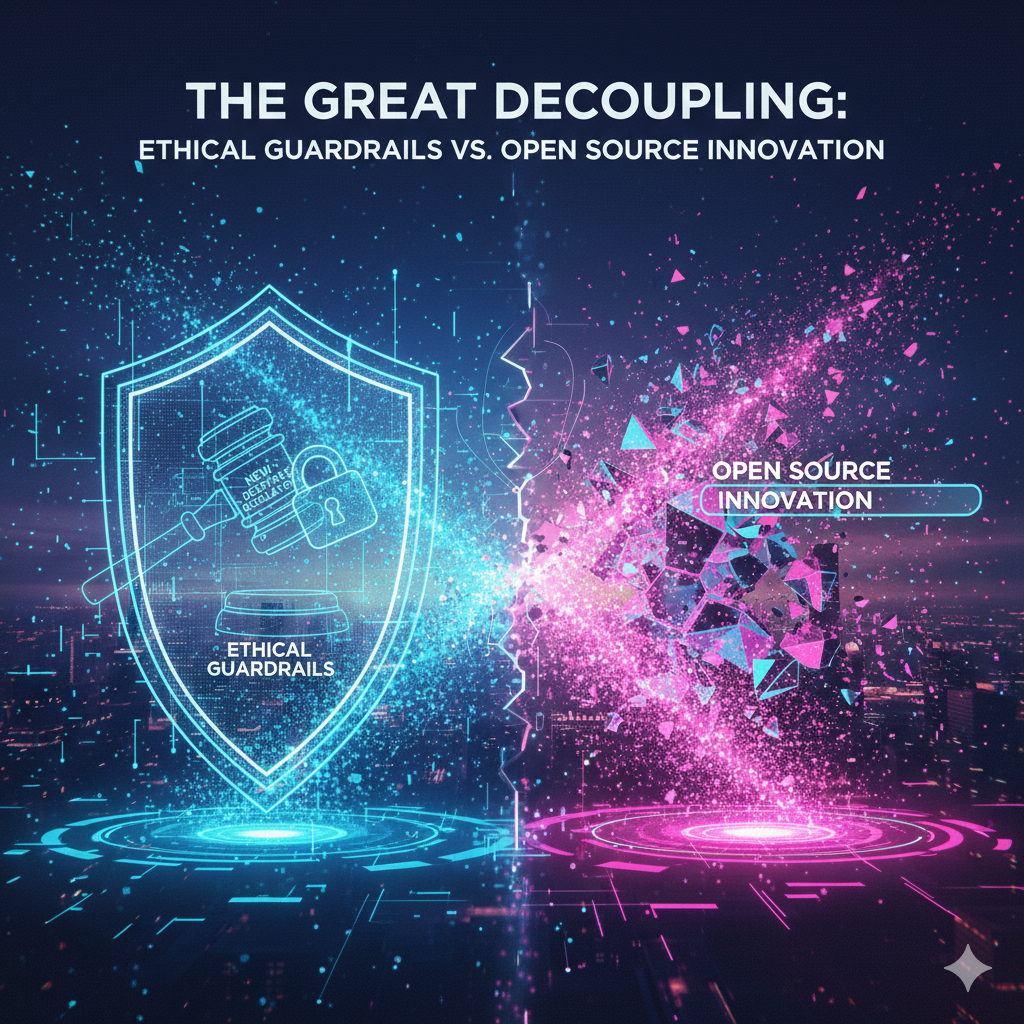
The history of technology is defined by the tension between the locked gate and the open road. Today, we find ourselves at the most consequential crossroads yet, as the explosive rise of Large Language Models (LLMs) forces a confrontation between those who want to build walls for our protection and those who believe progress requires tearing them down.
Imagine a world where the most powerful intellectual tool ever created is controlled by only three or four corporations, each deciding what you can say, what you can learn, and what problems are "appropriate" to solve. This isn't a dystopian novel; it is the central anxiety driving the current schism in the AI community.
The debate isn't just about software—it’s about who gets to hold the keys to human knowledge.
The Fortress and the Frontier
In one corner, we have the "Proponents of Alignment," led by industry giants like OpenAI and Google. They argue that because AI can be used to create biological weapons or automate disinformation, it must be developed behind closed doors with rigorous, centralized "guardrails."
In the other corner is the open-source movement, championed by companies like Meta with its Llama series and Mistral AI. Their philosophy is rooted in the belief that "security through obscurity" is a myth, and that the only way to ensure AI is safe and equitable is to let the entire world see how it works.
This creates a fundamental paradox: can we have AI that is both "safe" by corporate standards and "free" by open-source standards?
The Illusion of Perfect Safety
Corporate AI labs spend millions on "Reinforcement Learning from Human Feedback" (RLHF) to ensure their models don't say anything offensive or dangerous. While this sounds noble, it often results in what researchers call model lobotomization, where the AI becomes so risk-averse that it loses its utility for complex reasoning.
When a model is prevented from discussing "sensitive" topics, it doesn't just stop generating hate speech; it often stops being able to analyze history, law, or medical data with any degree of nuance. This "safe" AI acts like a polite but dim-witted librarian who refuses to show you books on chemistry because they might contain recipes for bleach.
Open-source advocates argue that these guardrails are often just thinly veiled attempts at "regulatory capture." By convincing governments that AI is "too dangerous" for the public to handle, incumbents can effectively pull up the ladder behind them, ensuring that no scrappy startup can ever challenge their dominance.
The democratization of risk
The most common objection to open-source AI is the "Bad Actor" argument. If you release the weights of a powerful model, what stops a terrorist from using it to design a virus? It’s a terrifying question that deserves a serious answer.
However, the open-source community points to the history of cryptography as a blueprint. For decades, the US government tried to classify high-level encryption as a "munition," fearing it would help criminals. Today, we know that open-source encryption is the only thing that keeps our global banking and communication systems secure from those very same criminals.
In this view, the "danger" of open AI is outweighed by the "collective defense" it enables. When millions of eyes are on the code, vulnerabilities are found and patched faster than any single company ever could. A closed model is a single point of failure; an open model is a global immune system.
The Cultural Cost of Alignment
Beyond the technical risks, there is a deeper, more insidious cost to centralized guardrails: cultural homogenization. Most "aligned" models are trained on Western, liberal, English-speaking data, and their ethical filters reflect those specific values.
When a developer in Lagos or Jakarta uses a model aligned in San Francisco, they aren't just getting a tool; they are getting a tool pre-loaded with Silicon Valley's worldviews. This creates a form of digital colonialism where "safety" is defined by a tiny group of engineers in a single zip code.
Open source allows for "forking" ethics. It enables a community in Brazil to fine-tune a model on their own legal and cultural norms, rather than being forced to use a model that has been "sanitized" for a different audience. True innovation requires the freedom to be different, and guardrails are, by definition, designed to make everything the same.
The Economic Engine of the Open Road
The sheer speed of open-source innovation is starting to lap the corporate giants. In early 2023, an internal Google memo leaked with the title "We Have No Moat, And Neither Does OpenAI." The author noted that while the giants were focused on massive, expensive, restricted models, the open-source community was doing things with $100 and a laptop that Google thought would take years.
Open source is the great equalizer of the AI economy. It allows a small business in Ohio to run a custom-tuned assistant on a local server without paying a per-token tax to Microsoft. It ensures that the "intelligence" of the future isn't a subscription service you can be kicked off of at any moment.
When innovation is permissionless, it moves at the speed of thought. When it is guarded, it moves at the speed of compliance.
Toward a Synthesis of Safety and Freedom
The solution likely won't be a total victory for either side, but a "layered" approach to the AI stack. We may see a future where the base "foundational" models are open and transparent, while specific "high-stakes" applications—like medical diagnostics or autonomous weapons systems—are governed by strict, application-specific regulations.
We must stop treating "open" and "safe" as opposites. In the long run, transparency is a prerequisite for safety. You cannot truly trust a system if you aren't allowed to see the gears turning inside it.
The real danger isn't that a model might say something "wrong." The real danger is that we might lose the ability to build, experiment, and disagree in our pursuit of a sanitized, corporate-approved future.
The guardrails we build today will become the cages of tomorrow if we aren't careful. Innovation requires a certain level of messiness, and progress has always belonged to the people willing to walk the open road, despite the risks. We should choose the frontier over the fortress, every single time.