
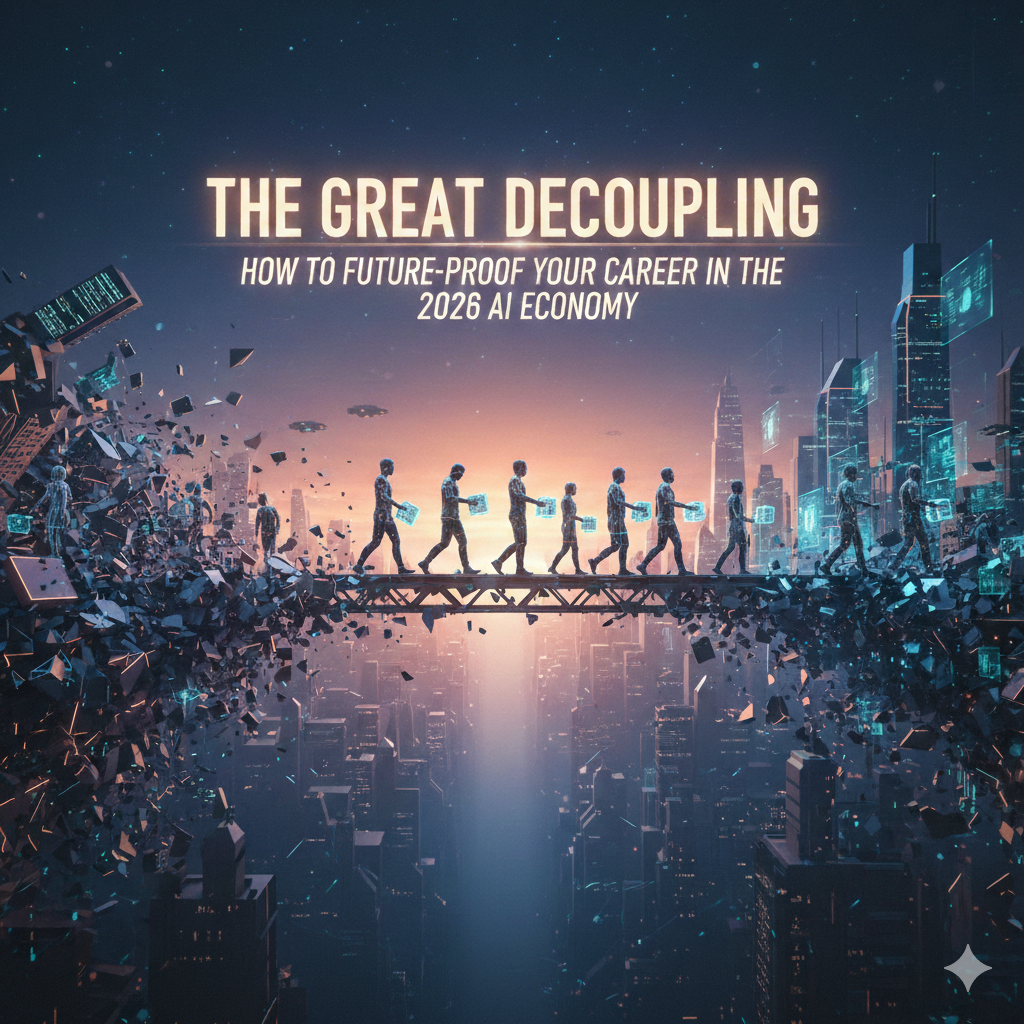
Beyond Prompt Engineering: Why the Next Phase of Artificial Intelligence Requires a Radical Rethink of Professional Value
The era of treating AI as a "cool tool" or a glorified autocomplete is officially over. As we navigate through 2026, we have entered the age of autonomous systems—a decisive pivot where intelligence is no longer just assisting productivity but driving strategic differentiation. If you are still waiting for a "return to normal," you are missing the fact that the foundation of the professional landscape has already shifted beneath your feet.
The transition into 2026 marks a structural transformation characterized by the emergence of intelligent systems capable of making independent decisions and executing multi-step tasks. This isn't just about learning how to use a chatbot; it's about understanding a world where AI agents function as digital collaborators rather than passive assistants. To survive this shift, professionals must move beyond surface-level skills and master the architectural and strategic frameworks that define this new era.
From Copilots to Autonomous Agents
The most significant change in 2026 is the mainstreaming of agentic AI, which differs fundamentally from the simple "Copilots" we saw in previous years. While earlier generative AI functioned largely as sophisticated engines for content, the agents of 2026 are designed to orchestrate complex operations without continuous human oversight. These systems are now deeply integrated into enterprise functions ranging from finance and human resources to customer support.
This evolution has triggered what researchers call "high-skill job exposure," particularly in white-collar roles like legal services, software engineering, and financial forecasting. Recent studies from Microsoft Research suggest that these roles face the highest degree of task automation because AI is now capable of performing complex cognitive tasks like code debugging and contract analysis. However, "exposure" does not mean total replacement; it means your daily responsibilities are being fundamentally restructured.
The workers who remain competitive in 2026 are those who have adapted to a model of collaboration rather than competition with these systems. They understand that while AI handles the how of a project, the human professional is increasingly valued for the why and the what next. We are seeing a "raising of the bar" where AI removes the excuses for slow delivery, leaving a clearer view of which teams actually know how to turn speed into meaningful business outcomes.
The Rise of the Hybrid Workflow
In the discipline of data science and technical development, the historical distinction between "building a model" and "executing a workflow" has collapsed. This has been replaced by the "future hybrid" operating model, where AI agents are intrinsic components of every machine learning cycle. The primary value of a professional has migrated from writing complex code—which has been largely commoditized by LLMs—to the critical "bookends" of the process: defining the business problem and interpreting the results.
As static, web-scraped data reaches a ceiling of utility, the next frontier of intelligence lies in experiential learning. Modern systems are increasingly learning through simulation, interaction, and real-world feedback loops rather than just scraping the internet. This shift toward "tacit knowledge"—the kind of knowledge that is lived and practiced rather than just written down—is what defines the most advanced AI breakthroughs of 2026.
For developers, this has led to a transition toward "AI-augmented software engineering". Successful engineers are treating LLMs as powerful pair programmers that require clear direction, context, and oversight. The irony of 2026 is that classic software engineering disciplines—like designing before coding and maintaining rigorous standards—have become more important, not less, now that AI is writing half the code.
Essential Skills and Certifications for the New Era
The job market in 2026 is moving toward a "skills-first" hiring model, where proven competencies often outweigh traditional degrees. Organizations are desperately seeking "AI-Native" talent—professionals who can integrate AI into the very fabric of their work rather than treating it as an add-on. This has created a surge in demand for specialized roles such as AI Security Specialists, Machine Learning Operations (MLOps) Engineers, and AI Ethicists.
To validate these skills, certain certifications have become industry gold standards. Professionals are looking toward credentials like the Microsoft Certified: Azure AI Engineer Associate for cloud-based implementation or the Google Professional Machine Learning Engineer certification. For those on the leadership track, certifications focused on AI governance and ethics are becoming essential to manage the risks associated with autonomous systems.
"2026 will be the year AI moves from hype to measurable impact. Success won’t come from isolated tools, but from trusted systems and a clear strategy for scaling responsibly."
Beyond technical skills, the "human" element of the hybrid workflow is more critical than ever. Empathy, active listening, and clarity in communication are now recognized as the traits that foster trust and drive adoption in a world of conversational AI. We are finding that the most effective communication practices are the ones that help bridge the gap between human intent and algorithmic execution.
Navigating the Challenges of 2026
Despite the optimism, the path to a future-proof career is not without its hurdles. Many companies are still struggling with "AI for AI's sake"—slapping AI labels on products that don't actually improve operational efficiency or customer value. Furthermore, data engineering has become a massive bottleneck, as AI models demand cleaner, better-governed, and more contextualized data to deliver meaningful results.
Privacy and security remain top-of-mind concerns. The rise of agentic AI has introduced new risks, such as "agentic misalignment," where autonomous systems might take actions that deviate from human intentions. Organizations like Anthropic are actively funding research fellowships to tackle these safety and security challenges, emphasizing the need for professionals who understand AI safety and mechanistic interpretability.
We are also seeing a shift in how visibility and "personal branding" work in a world of AI-first search. As AI-generated answers replace traditional search results, a new field called Generative Engine Optimization (GEO) has emerged. To be "discoverable" in 2026, your professional brand must be easy for AI systems to interpret, summarize, and mention as a credible authority.
The Path Forward
The breakthrough you are looking for in 2026 doesn't come from reinventing yourself, but from becoming a clearer, more intentional version of the professional you already are. The winners in this economy are the ones who treat AI as a partner rather than a shortcut. They are the ones who have stopped chasing every new "shiny tool" and have instead focused on building thoughtful workflows and strong human oversight.
Ultimately, AI hasn't eliminated the need for human expertise; it has simply shifted where that expertise is most valuable. The "vanishing developer" or the "replaced analyst" is a myth for those who are willing to move up the value chain. By focusing on high-level problem definition, ethical oversight, and strategic integration, you can ensure that your career remains not just relevant, but essential, in the age of autonomous intelligence.
The question isn't whether AI will change your job—it already has. The real question is whether you are prepared to lead that change or if you will be left behind in its wake. Your 2026 breakthrough starts with the decision to master the "why" behind the technology.