
In the early days of the AI boom, the industry was obsessed with "training." We watched with bated breath as tech giants poured billions into massive compute clusters to birth the next generation of foundation models.
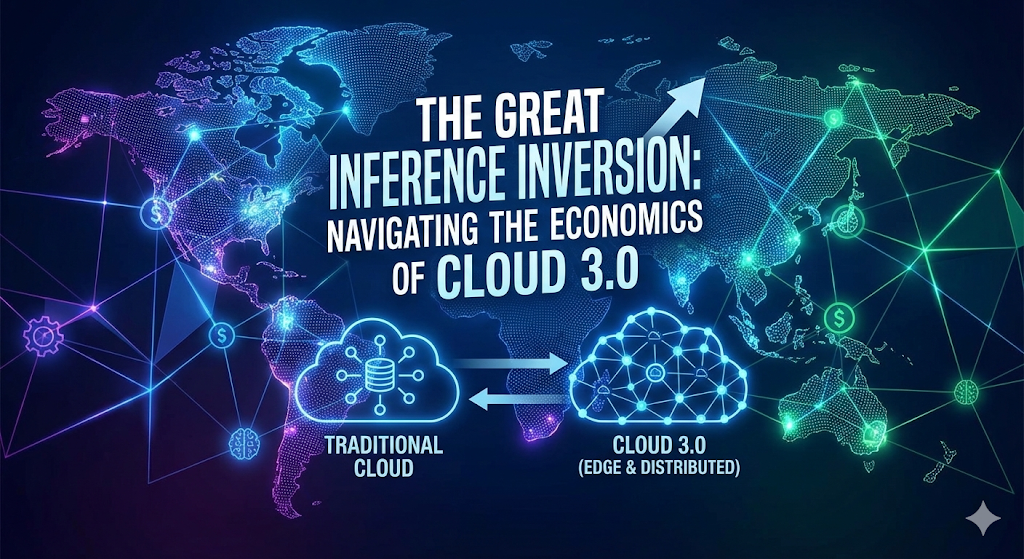
But as we enter 2026, the spotlight has shifted. The "Great Inference Inversion" is here—a historic tipping point where the volume of tokens generated for users has officially surpassed the tokens used for model training.
AI has moved out of the laboratory and into the assembly line. The question is no longer "Can it think?" but "Can we afford to let it think at scale?"
The Rise of Inference Economics
For years, the primary barrier to entry in AI was the capital expenditure (CapEx) required to train a model. Today, training is increasingly viewed as a one-time "sunk cost," while inference has become the dominant operating expense (OpEx) that determines whether an AI business is a unicorn or a money pit.
Inference economics is the study of how to deliver a single prediction, summary, or generated image for the lowest possible price. It is the math that keeps SaaS founders up at night.
Consider the shift in compute allocation. In 2023, most organizations spent roughly 70% of their AI budget on training. By early 2026, that ratio has flipped, with inference workloads accounting for nearly 80% of total AI compute demand.
This shift has forced a fundamental redesign of hardware. Generic GPUs, once the gold standard, are being challenged by "inference-first" ASICs like Microsoft’s Maia 200 and Groq’s LPU (Language Processing Unit). These chips aren't designed to learn; they are designed to execute—optimizing for "tokens per dollar" rather than raw "FLOPS."
Cloud 3.0: The Intelligence-Native Era
If Cloud 1.0 was about virtualization (moving servers to the web) and Cloud 2.0 was about the "as-a-service" revolution (SaaS and containers), then Cloud 3.0 is defined by native intelligence.
In the Cloud 3.0 paradigm, AI is no longer a "bolt-on" feature or an API call away. It is embedded into the very fabric of the infrastructure. We are moving away from passive storage and compute toward infrastructure that understands, orchestrates, and evolves on its own.
Key characteristics of this new era include:
Hyper-specialized Silicon: Instead of a hardware monoculture dominated by a single vendor, Cloud 3.0 uses heterogeneous arrays where different chips handle specific parts of the reasoning chain.
Deterministic Latency: For applications like voice-AI or autonomous systems, "average" speed isn't enough. Groq’s deterministic architecture, for example, removes the "jitter" of traditional GPUs, ensuring that the robotic arm or voice assistant responds with zero perceptible lag.
Agentic Orchestration: The cloud control plane is no longer just a dashboard for humans; it’s a workspace for AI agents that manage their own resource scaling and self-healing protocols.
McKinsey predicts that this AI-driven cloud automation could reduce operational costs by up to 40% while simultaneously increasing business agility.
Decentralization and the DePIN Solution
As demand for inference explodes, the centralized hyperscalers (AWS, Azure, Google) are facing a "power wall." Building a single massive data center now requires the energy output of a small city, leading to a desperate scramble for nuclear power and sustainable grids.
This bottleneck has birthed the DePIN (Decentralized Physical Infrastructure Networks) movement. By harnessing idle global GPU resources—from dormant gaming rigs to underutilized enterprise servers—networks like io.net and Aethir are creating a "global compute fabric."
The economics are startling. Case studies show that decentralized GPU clusters can offer up to 86% cost savings compared to traditional centralized clouds.
This isn't just about price; it’s about sovereignty. For startups and sovereign nations alike, DePIN offers a way to scale AI without being beholden to the pricing whims or "gatekeeper" policies of the Silicon Valley giants.
The New Metric: Intelligence per Joule
In the old cloud, we measured performance in "uptime" and "latency." In Cloud 3.0, the metric that matters is Power Compute Effectiveness (PCE), or more colloquially, "intelligence per joule."
Sustainability is no longer a PR exercise; it is a core constraint of inference economics. As models become more complex—moving from simple text to high-fidelity video generation—the energy cost per query is skyrocketing. Generating a 5-second video clip can consume nearly 1 kilowatt-hour, over 800 times more energy than a high-quality image.
The winners of the next decade won't be the companies with the biggest models, but the ones who can run those models with the highest efficiency. This means mastering techniques like quantization (shrinking models to fit on smaller chips) and speculative decoding (using small models to "guess" tokens for larger models).
Conclusion: The Industrialization of Reason
We are witnessing the industrialization of intelligence. Just as the steam engine turned physical power into a commodity, inference economics is turning cognitive power into a utility that is metered by the token.
The transition to Cloud 3.0 represents a shift from "AI as a feature" to "AI as the OS." Organizations that cling to the old paradigms of Cloud 2.0—over-provisioning generic hardware and treating AI as an external service—will find their margins eroded by those who embrace inference-first architectures.
The future belongs to the efficient. In the world of Cloud 3.0, the most powerful model is the one you can actually afford to use.