
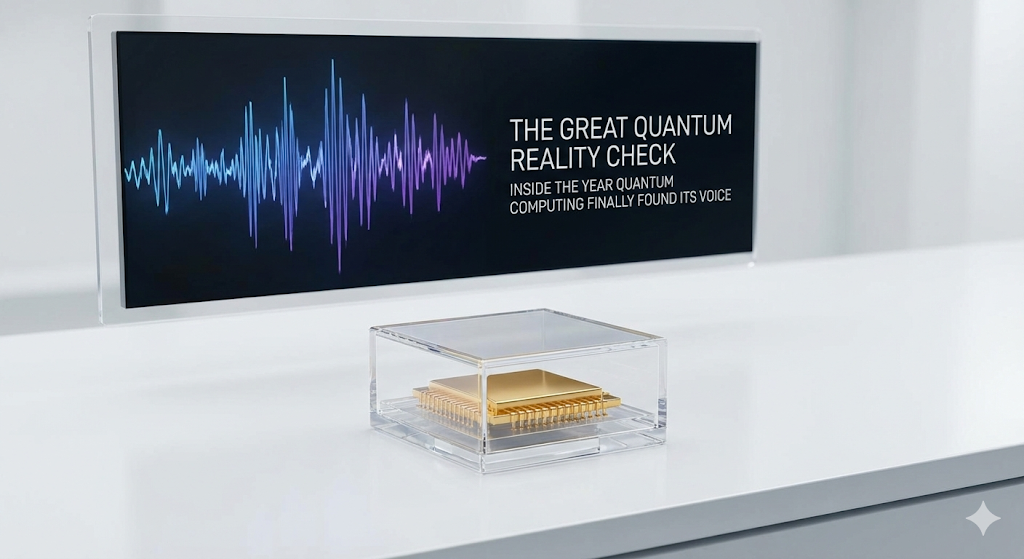
Imagine a machine that solves in five minutes a problem that would take the universe's most powerful supercomputer ten septillion years to finish. For decades, this was the stuff of science fiction and theoretical whiteboards.
In 2025, it became the benchmark for a new era. This was the year the industry stopped asking "if" and started demanding "when."
For the better part of a decade, quantum computing lived in a state of permanent potential. We were trapped in the era of Noisy Intermediate-Scale Quantum (NISQ) devices—machines that were powerful enough to be interesting, but too "loud" and error-prone to be useful.
But as the calendar turned to 2025, a global shift occurred. The United Nations declared it the International Year of Quantum Science and Technology, and for the first time, the hardware actually kept the promises made by the marketing departments.
The Resilient Logic Revolution
The primary technical narrative of 2025 wasn't about counting physical qubits; it was about the stabilization of "logical" qubits. To understand why this matters, you have to think of physical qubits as fragile glass ornaments sitting on a vibrating table.
Any tiny disturbance—heat, light, or even a stray atom—causes them to shatter, losing their data. Quantum Error Correction (QEC) is the process of grouping these fragile physical qubits together to create a single, robust "logical" qubit that can withstand the noise.
Google's Willow: Cracking the Physics Risk
In January 2026, the tech industry was still vibrating from the seismic shifts caused by Google’s Willow quantum processor. Willow didn't just perform a fast calculation; it demonstrated "below-threshold" error correction.
This means that for the first time, researchers proved that adding more physical qubits to a system could actually decrease the overall error rate. It effectively retired the "physics risk" that has plagued the sector for thirty years.
Google's five-minute computation, which would outlast the universe if run on a classical machine, proved that quantum utility is no longer a distant mirage. It is a functional reality that is currently being integrated into the company's broader research infrastructure.
The Rise of the Dark Horse: AWS Ocelot
While Google and IBM were fighting for superconducting supremacy, Amazon Web Services (AWS) made a strategic pivot that caught many by surprise. In February 2025, they unveiled Ocelot, their first in-house quantum chip.
Ocelot doesn't chase high qubit counts. Instead, it focuses on "bosonic encoding" and what researchers call "cat qubits."
Think of a cat qubit like a spinning coin that is magically prevented from falling over. By suppressing bit-flips at the physical level, AWS claims they can reduce the overhead of error correction by up to 90%.
The Industrialization of the Qubit
As the hardware matured, the conversation shifted from the laboratory to the boardroom. Enterprise leaders, tired of hearing about "quantum supremacy," began demanding a measurable return on investment (ROI).
Case Study: Sustainable Mobility with BMW and Airbus
One of the most actionable insights of the year came from a collaboration between BMW Group, Airbus, and Quantinuum. The trio developed a hybrid quantum-classical workflow to simulate the chemical reactions of catalysts in fuel cells.
Current classical computers struggle to model the oxygen reduction reaction on the surface of platinum-based catalysts. Because quantum computers naturally speak the language of atoms, they can model these reactions with a precision that was previously impossible.
For companies like BMW, this isn't a science experiment. It is a high-stakes search for more efficient, sustainable fuel cell technology that could redefine the future of transportation.
Quantinuum’s Unrivaled Benchmarks
Quantinuum spent 2025 solidifying its position as the performance leader in the ion-trap modality. They achieved a Quantum Volume of over 8 million, fulfilling a five-year promise to increase computational power by 10x annually.
Their H-Series systems have become the gold standard for full connectivity. This allows every qubit to talk to every other qubit, a feature that is critical for solving the messy, complex optimization problems found in global supply chains and financial portfolios.
The Economic Reckoning and the "Quantum Chill"
However, 2025 was also a year of intense reality checks. As the "hype phase" of early 2025 gave way to the "delivery phase" of 2026, the market experienced what analysts called the "Quantum Chill."
Pure-play quantum stocks like IonQ, Rigetti, and D-Wave saw their valuations slip as institutional investors rotated toward companies that could show immediate commercial traction. The market is no longer rewarding potential; it is rewarding execution.
The High Cost of Entry
One objection often raised by skeptics is the sheer cost of quantum infrastructure. Building a fault-tolerant machine still requires 1,457 physical qubits for every single stable logical qubit.
This "overhead" is the primary bottleneck to widespread adoption. While Google and Microsoft have roadmaps to reach millions of qubits by the 2030s, the current reality for most enterprises is a "hybrid" approach.
The Hybrid Future
The most successful companies in 2025 weren't trying to replace their data centers with quantum computers. Instead, they used tools like NVIDIA’s CUDA-Q and Xanadu’s PennyLane to run hybrid workflows.
In this model, classical GPUs handle the bulk of the heavy lifting, while the quantum processor acts as a specialized accelerator for specific, high-value sub-routines. This is the "GPU moment" for quantum computing—the realization that it is a specialized tool in a broader computational toolkit.
The Security Mandate: Staying Safe in a Post-Quantum World
As the power of quantum hardware grows, so does the threat to our global digital infrastructure. A "Cryptographically Relevant Quantum Computer" (CRQC) could theoretically break the RSA encryption that protects everything from bank transfers to state secrets.
The SEC’s Post-Quantum Framework
In September 2025, the U.S. Securities and Exchange Commission (SEC) received a proposal for the Post-Quantum Financial Infrastructure Framework (PQFIF). This document outlines a roadmap for the global financial system to transition to quantum-resistant algorithms.
The threat isn't just in the future; it's happening now through "Harvest Now, Decrypt Later" attacks. Bad actors are stealing encrypted data today, waiting for the day they have a quantum computer powerful enough to unlock it.
Businesses are being told that preparation isn't optional. It involves a 5-step roadmap: inventorying data, identifying vulnerable crypto-assets, testing post-quantum cryptography (PQC) standards, and ultimately migrating to a quantum-safe architecture.
A New Definition of Advantage
The "Show Me" year has redefined what success looks like in the quantum sector. We have moved past the era of vanity metrics and into an era of strategic resilience.
Success is no longer measured by how many qubits you have, but by how many "errors" you can correct. It is measured by the depth of your partnerships with industry giants like Airbus and BMW. It is measured by your ability to integrate into the existing AI and HPC stacks that power the modern economy.
We are entering a period where the line between traditional high-performance computing and quantum computing will continue to blur. The ultimate winners won't be the ones with the flashiest physics; they will be the ones who can navigate the intersection of quantum processing and generative AI to solve the world's most intractable problems.
The physics risk is retired. The engineering challenge remains. But for the first time in history, the machine is actually turned on, and it’s finally starting to give us the answers we've been waiting for.