
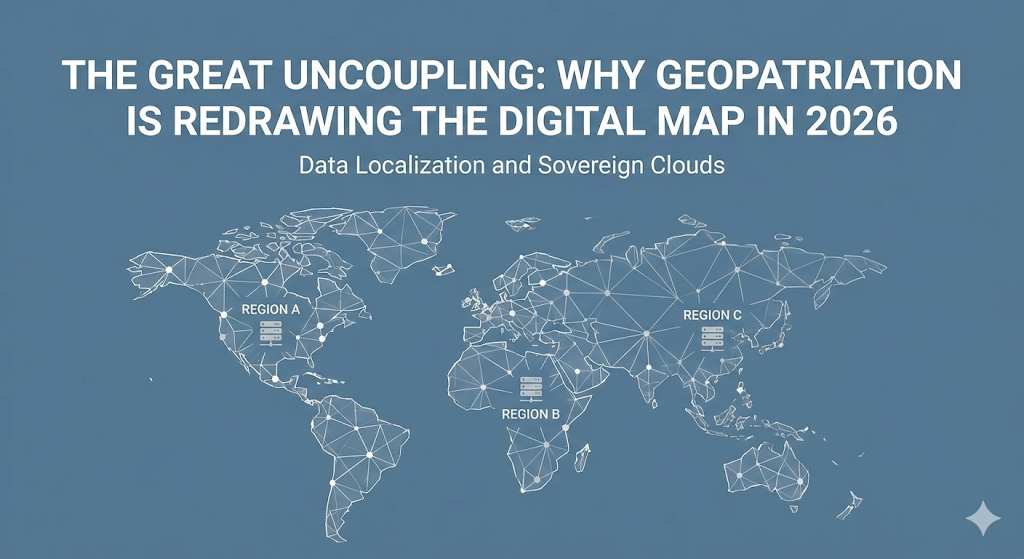
For nearly two decades, the tech world operated under a comfortable delusion. We were told that data was ethereal, that the "Cloud" was a borderless utopia, and that geography no longer mattered in a hyper-connected world.
By the start of 2026, that illusion has completely shattered. We have entered the era of the zip-coded byte, where the physical location of a server is just as important as the code running on it.
The Death of the Borderless Internet
The global digital landscape has transitioned from a commercial utility into a contested strategic asset. Digital sovereignty—the capacity for a nation or organization to maintain absolute control over its digital infrastructure—has moved from the fringe of policy whitepapers to the center of the boardroom.
The catalyst for this shift isn't just a single event, but a convergence of "cloud-flation," aggressive AI expansion, and a fragmenting geopolitical order. When the "lights of Caracas" can be turned off by remote cyber expertise, as suggested in recent reports, the concept of "hosting" takes on a whole new level of risk.
Today, the cloud is no longer an abstract concept. It is a physical territory with a sovereign owner, a local tax code, and, most importantly, a "kill switch" that foreign powers can potentially pull.
Geopatriation: Bringing the Data Home
A new term has entered the executive lexicon to describe this exodus: geopatriation. It is the strategic movement of data and applications out of global public clouds and back into local, sovereign, or hybrid environments.
This isn't just about moving data from Point A to Point B. It is a fundamental "re-patriation" of digital assets to home turf to mitigate the risk of being caught in the crossfire of trade wars or legislative overreach.
Gartner recently predicted that by 2030, over 75% of European and Middle Eastern enterprises will geopatriate their virtual workloads. This is a staggering jump from the less than 5% we saw at the start of 2025.
"Digital sovereignty is no longer a luxury for the paranoid; it is the baseline for economic resilience in a multi-polar world."
The Economics of the Exit
While geopolitics provided the push, economics provided the pull. The "Cloud-flation" of 2024 and 2025 forced companies to look at their monthly hyperscaler bills with fresh eyes.
Take the case of 37signals, the makers of Basecamp and HEY. They famously exited the public cloud entirely, saving millions of dollars in the process by owning their own hardware again.
Dropbox followed a similar path, shifting 90% of its customer data to its own infrastructure. These weren't retreats into the past; they were strategic upgrades to control.
By repatriating predictable workloads, organizations are reporting cost reductions of 30% to 60%. In 2026, the public cloud has become a place for "bursting" and experimentation, while the "crown jewels" of data are kept under lock and key at home.
The Rise of Sovereign AI
The most intense battleground for digital sovereignty is currently the GPU. As AI moves from "chatting" to "acting," the models themselves have become the ultimate sovereign assets.
India has taken an audacious lead here. The IndiaAI Mission, backed by a ₹10,372 crore outlay, is building a "Sovereign AI" stack that relies on home-grown models and a government-shared compute pool of over 38,000 GPUs.
The goal is simple: ensure that the intelligence driving Indian industry isn't dependent on a black-box API hosted in Northern Virginia. When a nation's GDP is tied to its AI efficiency, relying on a foreign provider is seen as a modern form of vassalage.
The EuroStack and Europe’s Dilemma
In Europe, the push for "EuroStack" represents a similar desire for independence. With 80% of Europe’s digital infrastructure currently relying on non-European providers, the continent faces a strategic dependence that German Chancellor Friedrich Merz has called a "central threat to competitiveness."
However, Europe faces what we call the "Sovereignty Paradox." By building walls to protect its data, it risks fragmenting the very innovation ecosystem it needs to compete.
The challenge for 2026 is building autonomy without descending into digital isolationism. The goal isn't to build a "European Internet," but a "European Stack" that can interact with the world on its own terms.
Navigating the Sovereignty Paradox
For business leaders, the path forward isn't a simple binary choice between "Global Cloud" and "On-Premises." It is about architectural agility.
Smart organizations are moving toward federated models. These are decentralized yet interconnected systems where multiple independent providers operate under shared standards, but the organization retains the "master key" to its data.
Key Strategies for 2026
Some key factors for navigating this transition include embracing hybrid-multi-cloud architectures, investing in localized AI models, and prioritizing open-source foundations.
Open source has become the "secret weapon" of digital sovereignty. By using open standards, companies can avoid vendor lock-in and ensure that their applications can be geopatriated in weeks, rather than years, if a geopolitical crisis occurs.
We are also seeing a shift toward "regulatory-ready" architectures. Instead of treating compliance as a checkbox, leaders are building systems that can automatically move data across jurisdictions to meet shifting laws like the UK Data (Use and Access) Act 2025.
The New Map of the Digital World
The digital map of 2026 looks nothing like the flat, borderless world we were promised at the turn of the century. It is a map of deep trenches, high walls, and guarded gateways.
This fragmentation is often criticized as the "Splinternet." But for the nations and companies successfully navigating it, it feels more like a long-overdue maturity.
We are finally treating digital infrastructure with the same gravity we afford to energy grids and water supplies. We are acknowledging that in a world of "Never Normal," resilience is more valuable than convenience.
Conclusion: The Freedom to Control
Digital sovereignty isn't about isolation; it's about the freedom to choose. It is the ability to say "no" to a provider, "no" to a foreign subpoena, and "yes" to long-term stability.
The companies that thrive in the late 2020s will be those that understand that data is not a weightless commodity. It has gravity, it has a history, and it has a home.
As we move further into 2026, the question for every CEO and CTO is no longer "Why should we move back?" but "How fast can we bring our future home?"
The era of the borderless cloud is over. The era of the sovereign stack has begun.