
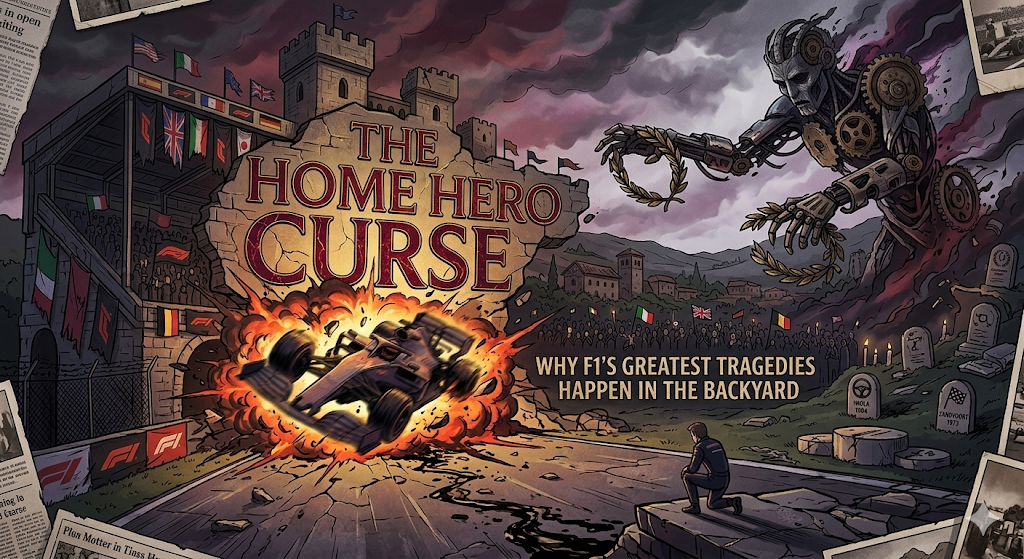
There is a specific, haunting frequency to the roar of a Formula 1 crowd when their local driver takes the lead. It is a sound that supposedly carries a "tenth of a second" in pure adrenaline—a psychological boost that turns elite athletes into national icons.
But for many, that tenth of a second is bought with a heavy interest rate. In the high-stakes theater of global motorsport, the "Home Hero" narrative often follows a Shakespearean arc: a weekend of flawless execution that collapses into a viral, soul-crushing tragedy in the final act.
As we look back at the moments that defined the sport’s emotional landscape, 2026 stands as a year of reflection on these "curses," reminding us that the greatest pressure isn't the G-force in the corners, but the weight of an entire nation watching from the grandstands.
The Ultimate Contrast: Felipe Massa (Brazil 2008)
The gold standard for sporting heartbreak will forever be Interlagos, 2008. Felipe Massa did everything a hero was supposed to do; he took pole position and won the race in a dominant display of Brazilian flair, believing for a few brief moments that he was the World Champion.
For exactly 38 seconds, the Ferrari garage erupted in a celebration that would later become one of the most painful viral moments in F1 history. While Massa crossed the line, Lewis Hamilton was still battling through a rain-slicked final lap, eventually overtaking a slow-moving Timo Glock in the final corners.
The shift in energy was instantaneous. The cameras caught Massa’s family transitioning from ecstasy to devastation in real-time, a sequence that many Brazilian fans still describe as more painful than the country’s biggest soccer defeats. It wasn't just a loss; it was a mathematical theft of destiny.
The Decade of DNF: Rubens Barrichello’s Interlagos Nightmare
If Massa’s heartbreak was a sudden strike, Rubens Barrichello’s was a slow, agonizing ritual. Between 1995 and 2003, Barrichello failed to finish his home race nine times in a row, a statistic that defies the laws of probability for a driver in top-tier machinery.
The most poignant of these failures came in 2003, when Rubens was leading the race for Ferrari and looked certain to finally break the streak. A simple fuel pressure failure ended his afternoon, leaving him to sit on a plastic chair by the side of the track while the rain poured down—a visual metaphor for the "Barrichello Luck" that haunted his career.
Fans often debate whether these failures were mechanical coincidences or a manifestation of the psychological stressors unique to a home race. When every mechanic, sponsor, and childhood friend is in the paddock, the "invisible backbone" of focus can sometimes snap under the tension.
The "Le Curse" of Monaco: Charles Leclerc
Until May 2024, Charles Leclerc was the modern face of the home-race jinx. Growing up in an apartment overlooking the Sainte-Dévote corner, Leclerc spent years being sabotaged by his own streets, suffering through brake failures, strategy blunders, and a heartbreaking DNS (Did Not Start) from pole position in 2021.
The "Monaco Curse" became a self-fulfilling prophecy in the media, with every small error being analyzed through the lens of local misfortune. It took a flawless lights-to-flag victory in 2024 to finally "squash the curse," a moment that saw the driver, the fans, and even Prince Albert II in tears.
This redemption arc proves that the only way to beat the "Home Hero" pressure is through a "Proof of Impact" on the track that transcends the noise. Leclerc didn't just win a race; he reclaimed his city from the ghosts of his previous failures.
The Celebrations That Weren’t: Daniel Ricciardo (Australia 2014)
Sometimes the heartbreak doesn't happen on the track, but in the steward's room. In 2014, Daniel Ricciardo sent the Melbourne crowd into a frenzy by finishing second in his first race for Red Bull, becoming the first Australian to stand on a home podium in the F1 era.
The image of Ricciardo’s beaming "Honey Badger" smile on the podium remains iconic, but it was followed by a shock disqualification hours later due to a fuel flow sensor violation. The fans went home thinking they had witnessed history, only to wake up to a technicality that erased the achievement.
This moment highlighted the brutal reality of modern F1: technical debt and regulatory compliance can strip away a hero's glory just as effectively as a engine blowout. For Ricciardo, that "lost" podium remains a "what if" that still stings a decade later.
Conclusion: The Survival of the Stoic
The "Year of Truth" in Formula 1 isn't about the fastest car; it’s about the driver who can compartmentalize the roar of 100,000 people. The home race remains the ultimate crucible, a place where technical failures feel like personal betrayals and strategic errors feel like national tragedies.
For every Charles Leclerc who finally fulfills his destiny, there is a Felipe Massa or a Rubens Barrichello whose career is defined by the one that got away. In 2026, as we analyze these viral moments, we realize that the heartbreak is what makes the victory so essential.
F1 isn't just a race of machines; it is an orchestration of human emotion. And as long as there are home races, there will be the "curse" to ensure that when a hero finally wins, the roar is loud enough to be heard for generations.