
For years, artificial intelligence felt like a ghost in the machine—a powerful but ethereal tool trapped behind the glass of our monitors. Whether it was drafting emails or generating art, the "intelligence" remained firmly in the digital realm.
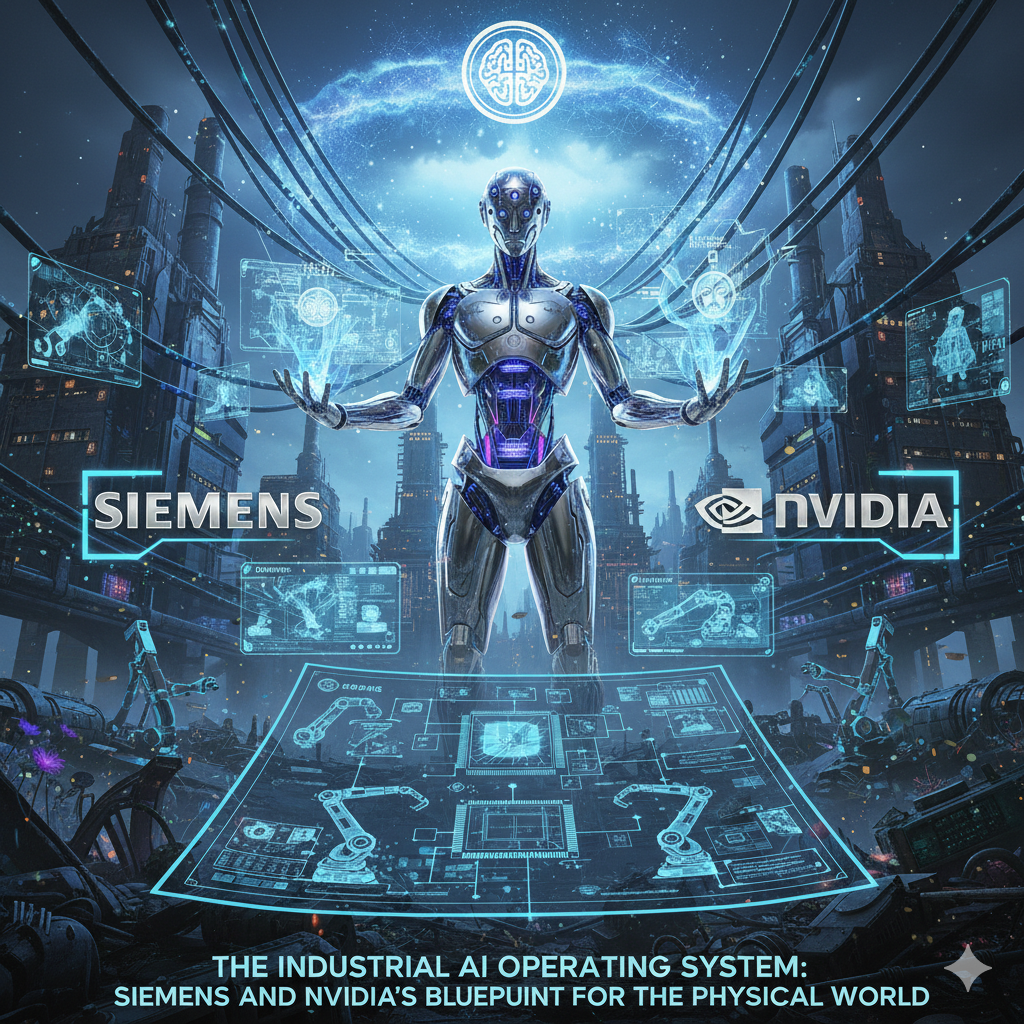
At CES 2026, Siemens and NVIDIA shattered that glass. By announcing a massive expansion of their partnership to build what they call the Industrial AI Operating System, these two giants are moving AI into the heavy machinery, power grids, and supply chains that keep the modern world running.
This isn't just another software update; it is a fundamental restructuring of how we design, build, and operate everything from electric vehicles to sustainable energy plants.
Moving Beyond the Mirror: The Rise of Active Digital Twins
To understand why this partnership matters, we have to look at the evolution of the digital twin. For the last decade, a digital twin was essentially a passive mirror—a high-fidelity 3D model that showed you what was happening in a physical factory in real-time.
While useful for monitoring, these models were often reactive. If a robot arm failed on the floor, the twin showed you the failure, but it didn't necessarily prevent it.
The expanded Siemens and NVIDIA collaboration changes the math by infusing these twins with generative AI and physics-based simulation. Instead of just mirroring reality, these new twins act as generative agents that can run thousands of "what-if" scenarios in a virtual environment before a single piece of steel is moved in the real world.
Fusing Infrastructure with Domain Expertise
The logic behind the "Operating System" moniker is simple but profound. NVIDIA provides the "brain"—the accelerated computing stack, AI infrastructure, and the Omniverse platform—while Siemens provides the "body" and the "experience."
Siemens holds a massive industrial software portfolio and centuries of domain expertise in how factories actually work. When you combine NVIDIA’s raw processing power with Siemens’ deep understanding of industrial physics, you get a system that doesn't just guess; it knows.
Think of it as the difference between a generic AI trying to describe a jet engine and a system that understands the specific thermal dynamics and material fatigue of a Siemens turbine. The latter is what makes industrial-grade reliability possible.
Real-World Impact: From PepsiCo to Nuclear Fusion
The theoretical benefits of this partnership are already being tested in high-stakes environments. PepsiCo, for instance, is using the new Siemens Digital Twin Composer to simulate upgrades to its manufacturing and warehouse facilities in the United States.
By creating a "computational sandbox," PepsiCo has identified up to 90 percent of potential issues before physical construction even began. This level of foresight drastically reduces capital expenditure and prevents the costly downtime that usually haunts factory retrofits.
Even more ambitious is the work being done with Commonwealth Fusion Systems. They are leveraging AI-powered digital twins to accelerate the development of the SPARC fusion machine, a technology that could provide limitless carbon-free energy. In this context, the partnership isn't just about efficiency; it's about solving the world's most complex engineering challenges.
Software-Defined Manufacturing: The New Standard
We are seeing a transition toward "software-defined" everything. Much like a Tesla receives over-the-air updates to improve its braking or battery range, the Siemens-NVIDIA stack allows for software-defined vehicles and factories.
Siemens’ new PAVE360 platform, for example, allows automakers to begin full-system validation of vehicle software from day one of a project. By simulating the hardware in the cloud using NVIDIA’s chips, engineers can cut environment setup times from months to mere days.
This agility is crucial in a market where the industrial AI software sector is projected to reach over $50 billion by 2031. Companies that cannot iterate at the speed of software will find themselves physically incapable of competing with those that can.
Navigating the Friction of the Physical World
Despite the optimism radiating from the CES stage, the path to a fully AI-driven industrial world isn't without its hurdles. The primary challenge remains the "brownfield" problem—the reality that most of the world's manufacturing happens in factories filled with legacy equipment.
Integrating a cutting-edge AI operating system with a 30-year-old hydraulic press requires more than just a software patch. It requires a massive investment in edge computing and sensor retrofitting.
Furthermore, the energy demands of running massive, high-fidelity simulations are significant. As industries strive for sustainability goals, they must balance the carbon footprint of the data centers powering these AI twins against the efficiency gains they provide on the factory floor.
A Deterministic Shift in Global Infrastructure
We are no longer asking if AI will transform industry; we are now mapping out the "operating system" that will manage that transformation. The Siemens-NVIDIA partnership is a signal to executives and engineers alike that the era of trial-and-error in the physical world is coming to an end.
The future belongs to the "industrial metaverse"—a place where we can fail safely, innovate rapidly, and solve problems at a scale that was previously unimaginable.
By closing the gap between ideas and reality, these two companies are doing more than just selling software. They are providing the foundational architecture for the next industrial revolution, ensuring that when we finally do "touch steel," we do so with the absolute certainty that it will work.