
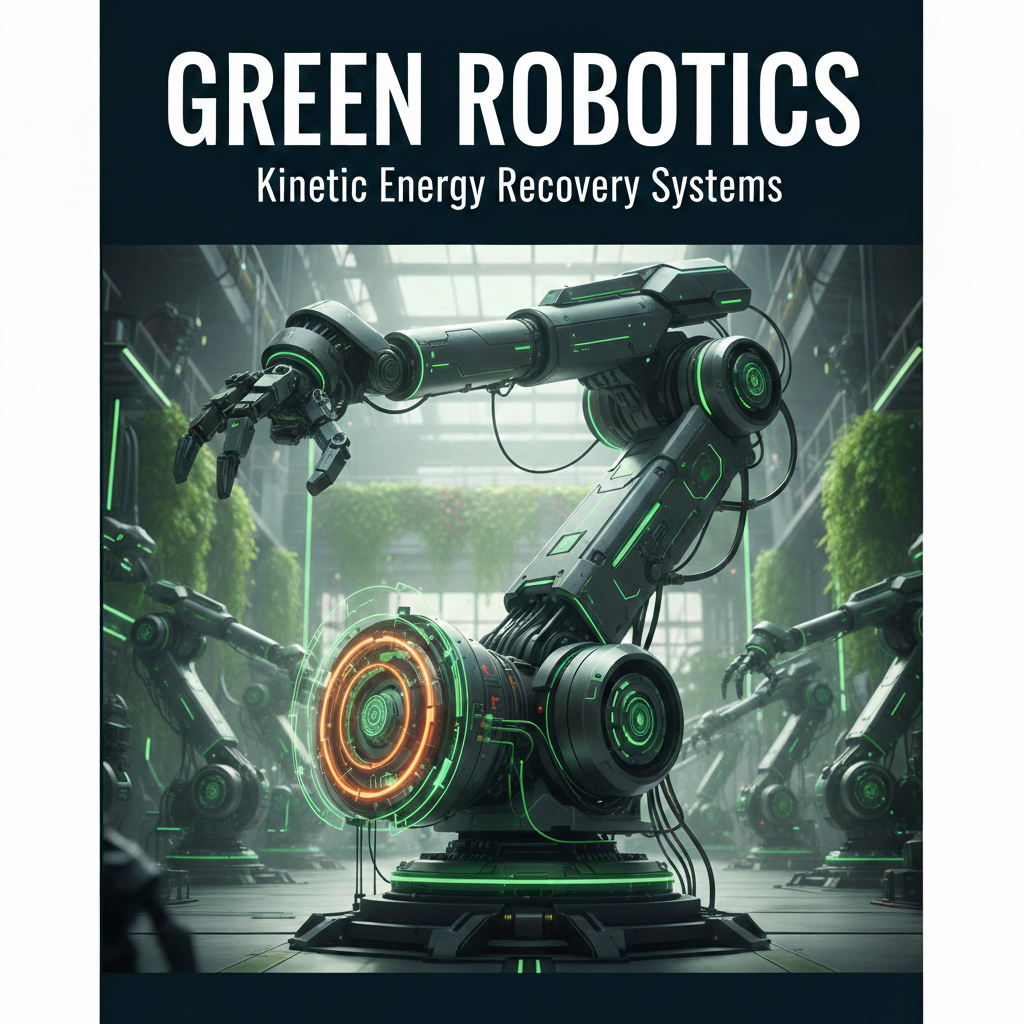
For decades, the hum of the factory floor has been the sound of wasted potential. Every time a high-speed robotic arm stops to place a part, the energy used to move it simply vanishes into the atmosphere as heat.
We are finally learning how to catch that ghost in the machine. By integrating Kinetic Energy Recovery Systems (KERS) into the joints and drivetrains of automation, manufacturers are turning every deceleration into a power-up.
This isn't just a marginal gain for a few eco-conscious firms; it is a fundamental shift in how we build the future. As we move toward a world of autonomous factories, the "invisible fuel" of recovered energy is becoming the competitive edge of the decade.
The Industrial Imperative: Why Green Robotics Matters Now
The transition toward sustainable manufacturing has elevated green robotics from a specialized sub-sector to a dominant industrial requirement. According to the Green Manufacturing Robotics Market Report 2030, the global market is projected to expand at a compound annual growth rate (CAGR) of 12.47%, rising from USD 3.293 billion in 2025 to USD 5.927 billion by 2030.
This growth is fueled by a harsh reality: industrial robots alone account for approximately 8% of global electricity consumption in manufacturing. As energy prices fluctuate and carbon taxes become a standard line item on balance sheets, inefficiency is no longer just a technical flaw—it's a financial liability.
The architectural focus of industrial automation has shifted toward energy efficiency and carbon neutrality. Industry 6.0, as detailed in recent research on environmentally centric robotics, represents a paradigm where robots aren't just tools for production, but active participants in a circular energy economy.
From the Racetrack to the Warehouse: How KERS Works
If you've watched a Formula 1 race in the last fifteen years, you’ve seen KERS in action. In motorsports, the system captures the immense kinetic energy generated during braking and stores it to give the driver a temporary horsepower boost for overtaking.
In the world of robotics, the application is more subtle but far more constant. Instead of a single "boost" button, the system operates in a perpetual loop of capture, store, and reuse across thousands of cycles per day.
The Motor/Generator Unit (MGU)
The heart of the system is the MGU, which acts as a bridge between motion and electricity. When a robot arm accelerates, the MGU acts as a motor; when it slows down, the MGU reverses its role, acting as a generator that creates resistance to stop the arm while producing an electrical current.
The Power Control Unit (PCU)
The captured current cannot simply be dumped back into the main power grid without careful management. The PCU acts as the brain, determining whether the energy should be stored in a local reservoir or immediately diverted to another joint on the same robot that is currently in an acceleration phase.
The Storage Reservoir
The final piece of the puzzle is where that energy lives between cycles. While traditional batteries were the first choice, the rapid-fire nature of robotic movement—often requiring dozens of stops and starts per minute—has pushed engineers toward more specialized solutions like supercapacitors and flywheels.
The Storage Paradox: Supercapacitors vs. Batteries
Choosing the right storage medium is perhaps the most critical decision in KERS design. While lithium-ion batteries are great for long-term endurance, they struggle with the high-frequency "burst" charging required by industrial robots.
Standard batteries often suffer from thermal stress when forced to absorb massive amounts of energy in a fraction of a second. This leads to shorter lifespans and increased maintenance costs, which can quickly erase the ROI of the recovery system.
Supercapacitors, however, are built for this exact scenario. As companies like Skeleton Technologies have demonstrated, supercapacitors can absorb energy almost instantly and release it with the same speed.
They can endure millions of charge-discharge cycles without significant degradation, making them the ideal "short-term memory" for a robot's energy system. Some modern setups even use a hybrid approach, where a supercapacitor handles the violent bursts of braking energy while a battery provides the steady baseline power for the robot's logic and sensors.
The Humanoid Factor and the Solid-State Future
As we look toward 2026 and beyond, the rise of humanoid robots is set to supercharge the demand for advanced energy recovery. Unlike fixed industrial arms, humanoids must carry their own power source, making every joule of recovered energy vital for operational runtime.
TrendForce research suggests that humanoid robots will drive a massive surge in solid-state battery demand, with projections reaching 74 GWh by 2035. These batteries offer the high energy density needed for mobility while being safer and more stable under the dynamic loads of a bipedal robot.
However, even with better batteries, the "Hexagonal Warrior" dilemma—balancing weight, power, speed, and endurance—remains. KERS is the bridge that allows a robot like Tesla’s Optimus or Boston Dynamics’ Atlas to extend an 8-hour shift into a 10-hour one without adding a single gram of extra battery weight.
Hardware Giants and the Push for Standardization
The leaders of the "Big 4" in robotics are already integrating these features into their core controllers. FANUC, for instance, has developed the R-30iB Plus Controller, which includes an optional "Power Regeneration Module" to minimize energy costs.
Similarly, ABB has taken a leadership role in trying to standardize the measurement of robot energy consumption. Without a global standard, it is difficult for plant managers to compare the actual efficiency of different systems.
By creating a transparent metric for "energy-per-cycle," ABB and others are forcing the industry to compete on efficiency rather than just raw speed. This transparency is critical for manufacturers who are trying to qualify for green subsidies or meet strict ESG (Environmental, Social, and Governance) targets.
The AI Layer: Optimizing the Recovery Loop
The most exciting development in KERS isn't mechanical; it's algorithmic. Advanced control strategies like Deep Reinforcement Learning (DRL) and Neural Network Model Predictive Control (NN-MPC) are being used to plan robot paths that maximize energy recovery.
Traditional path planning focuses on the shortest distance or the fastest time. Modern AI-driven planning, however, looks for "energy-optimal" trajectories.
Consider a robot arm moving from point A to point B. A standard path might involve hard acceleration and a hard stop. An AI-optimized path might use a slightly more fluid, "human-like" curve that allows the MGU to capture energy over a longer deceleration window, resulting in a 10-15% increase in recovered power.
These systems can even adapt in real-time. If the AI detects that the storage supercapacitor is nearly full, it can adjust the next three movements to use more power, ensuring that no potential energy is wasted as heat because there was nowhere to put it.
Realistic Challenges: The ROI Hurdle
Despite the clear benefits, integrating KERS isn't a "plug-and-play" solution for every factory. The upfront costs of high-quality MGUs and supercapacitors can be significant, often adding 15-20% to the initial price of a robotic cell.
Integration complexity is another barrier. Reprogramming existing lines to take advantage of energy sharing between robots can take months of engineering time. As noted in recent analysis of robotics adoption challenges, manufacturers often face "flexibility gaps" where the effort to optimize a line exceeds the immediate energy savings.
However, the calculation changes when you look at the total cost of ownership over five to ten years. When you factor in reduced thermal wear on components—since braking energy is being captured rather than turning into damaging heat—the maintenance savings often rival the energy savings.
The Path Toward Zero-Waste Automation
Kinetic energy recovery is more than a technical trick; it is the realization that in a truly efficient system, there is no such thing as "spent" energy. There is only energy that has been redirected.
As we stand on the threshold of a new era in industrial history, the winners will be those who stop fighting physics and start partnering with it. By turning every stop into a start, KERS is proving that the most sustainable power source is the one we already have.
The factory of the future won't just be automated; it will be regenerative. It will be a place where the hum of the machinery isn't the sound of waste, but the sound of a system that finally knows how to keep its own fire burning.