
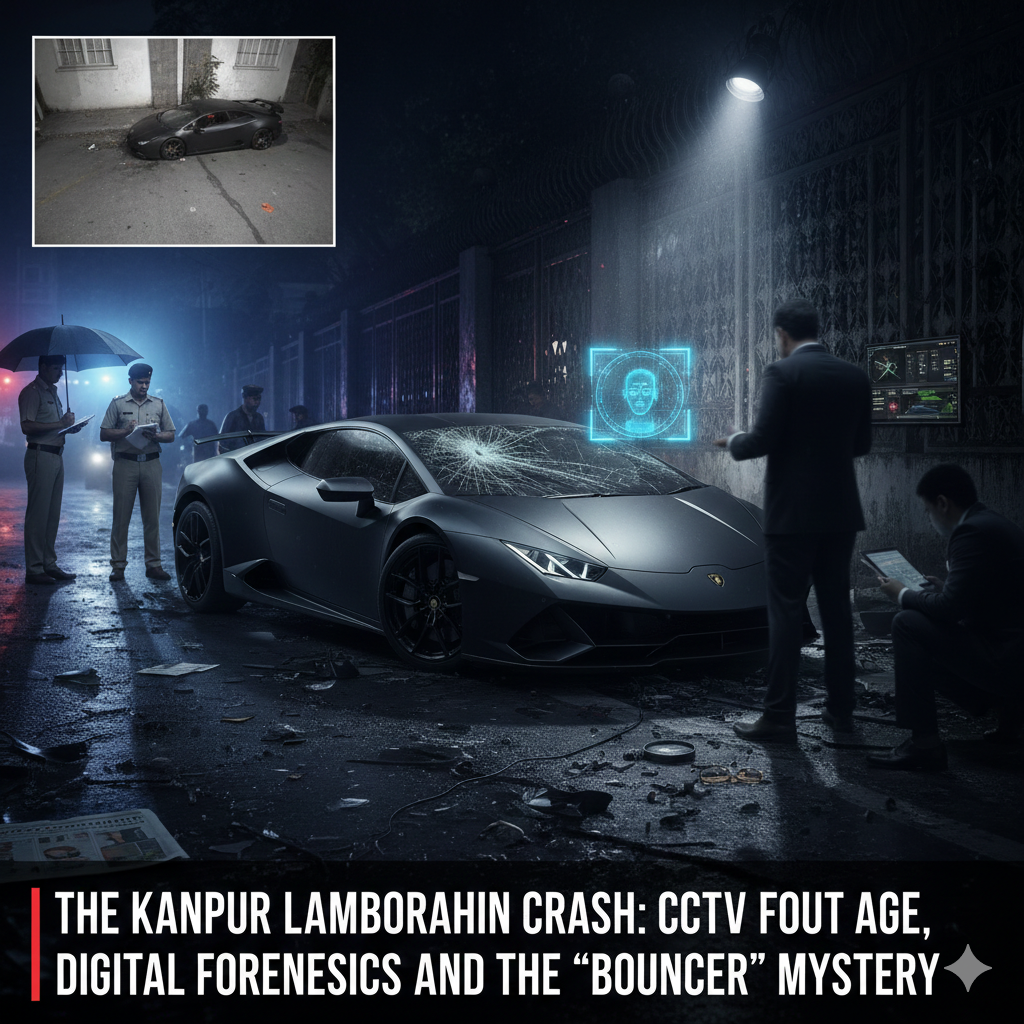
In the early afternoon of February 8, 2026, the quiet status quo of Kanpur’s upscale VIP Road was shattered by the roar of a 1,000-horsepower hybrid. Seconds later, a Lamborghini Revuelto—one of the world's most exclusive supercars—lay crumpled against an electric pole, surrounded by injured pedestrians and a mounting public outcry.
What followed wasn't just a standard traffic investigation; it was a masterclass in narrative control. From the rapid extraction of the driver by private bouncers to the sudden appearance of a “surrogate driver,” the incident has become a national focal point for the conversation surrounding “elite impunity.”
The Physics of a Multi-Stage Collision
The crash wasn't a single impact, but a terrifying sequence of high-velocity failures. Witnesses describe the Revuelto swerving at extreme speeds near the Rev-3 Mall before initiating its destructive arc.
The vehicle first clipped a moving autorickshaw, an impact that reportedly triggered a sudden surge in the supercar’s speed. This phenomenon, often termed “pedal misapplication,” is common when inexperienced drivers panic in high-torque vehicles. The secondary acceleration propelled the car into a stationary Royal Enfield Bullet motorcycle, crushing it beneath the chassis.
The energy transfer was so massive that the motorcycle rider was reportedly flung nearly 10 feet into the air. The car only stopped after mounting a pavement and striking an electric pole, likely the only thing that prevented further casualties in the crowded commercial zone.
The Bouncer Mystery: Extraction as Legal Strategy
Perhaps the most controversial element of the afternoon was the "bouncer mystery." Before the dust had even settled, a private security detail following the Lamborghini in a separate escort vehicle sprang into action.
Instead of providing first aid to the bleeding bystanders, these bouncers focused entirely on the driver, identified by police and CCTV as Shivam Mishra, son of tobacco tycoon K.K. Mishra. When the car’s automatic locks jammed the doors, the bouncers used force to break the windows and pull him out.
"They took him away in another vehicle before any medical tests could be done," noted one eyewitness.
This maneuver, often called a "private extraction protocol," serves a clear legal purpose. By removing the principal from the scene immediately, a defense team can effectively bypass on-site breathalyzer tests and prevent public identification, creating a critical gap in the initial evidentiary chain.
Conflicting Narratives: The “Mohan” Variable
In the days following the crash, the Mishra family’s legal team deployed a multi-pronged defense. The centerpiece? A driver named Mohan.
Despite viral videos appearing to show Mishra being pulled from the driver's side, his lawyers filed a surrender application in court for Mohan, a family chauffeur. They argue that Mishra was merely a passenger in his own car and that Mohan was at the wheel.
When faced with the CCTV evidence, the defense pivoted to a medical mitigation strategy. They claimed that Mishra suffered an epileptic seizure or a minor heart attack behind the wheel, which caused the loss of control.
Institutional Trust and the Selfie Scandal
The local police response only added fuel to the fire. Initially, the First Information Report (FIR) listed the accused as an "unknown person," despite officers having helped transport Mishra to the hospital from the scene.
Public trust eroded further when images surfaced of police personnel at the Gwaltoli station taking selfies with the seized ₹10-crore vehicle. The "wealth-awe" exhibited by the local force led to the swift removal of the Station House Officer (SHO), Santosh Kumar Gaur, for procedural negligence.
Kanpur Police Commissioner Raghubir Lal has since taken a firm stance, stating that CCTV footage and eyewitness accounts clearly place Mishra in the driver’s seat. The investigation has now moved into a forensic phase, with authorities looking to extract data from the vehicle’s Event Data Recorder (EDR).
The Legacy of the 2024 Raids
The intense scrutiny of Shivam Mishra is inseparable from his family’s history. In 2024, the Income Tax department raided the properties of Banshidhar Exports, the family’s tobacco firm.
Investigators seized a fleet of luxury cars valued at ₹70 crore, including a Rolls-Royce Phantom and multiple Ferraris. To many, the Lamborghini crash is not just an accident; it is the physical manifestation of a lifestyle that perceives itself as above the law.
Conclusion: A Test for the Justice System
The Kanpur Lamborghini crash represents a definitive moment in the struggle for road safety and administrative transparency in India. It highlights a growing trend: the professionalization of liability mitigation.
When the ultra-wealthy can deploy bouncers as "legal rapid response teams" to contaminate a crime scene, the burden of proof shifts heavily toward digital evidence and public vigilance. As the case moves toward the courtroom, the central question remains: will the legal system prioritize the forensic data of a dashboard or the influence of a dynasty?
For the victims like Taufiq Ahmed, the answer to that question will determine whether Indian roads are truly shared spaces or merely playgrounds for those who can afford the insurance of an escort vehicle.