
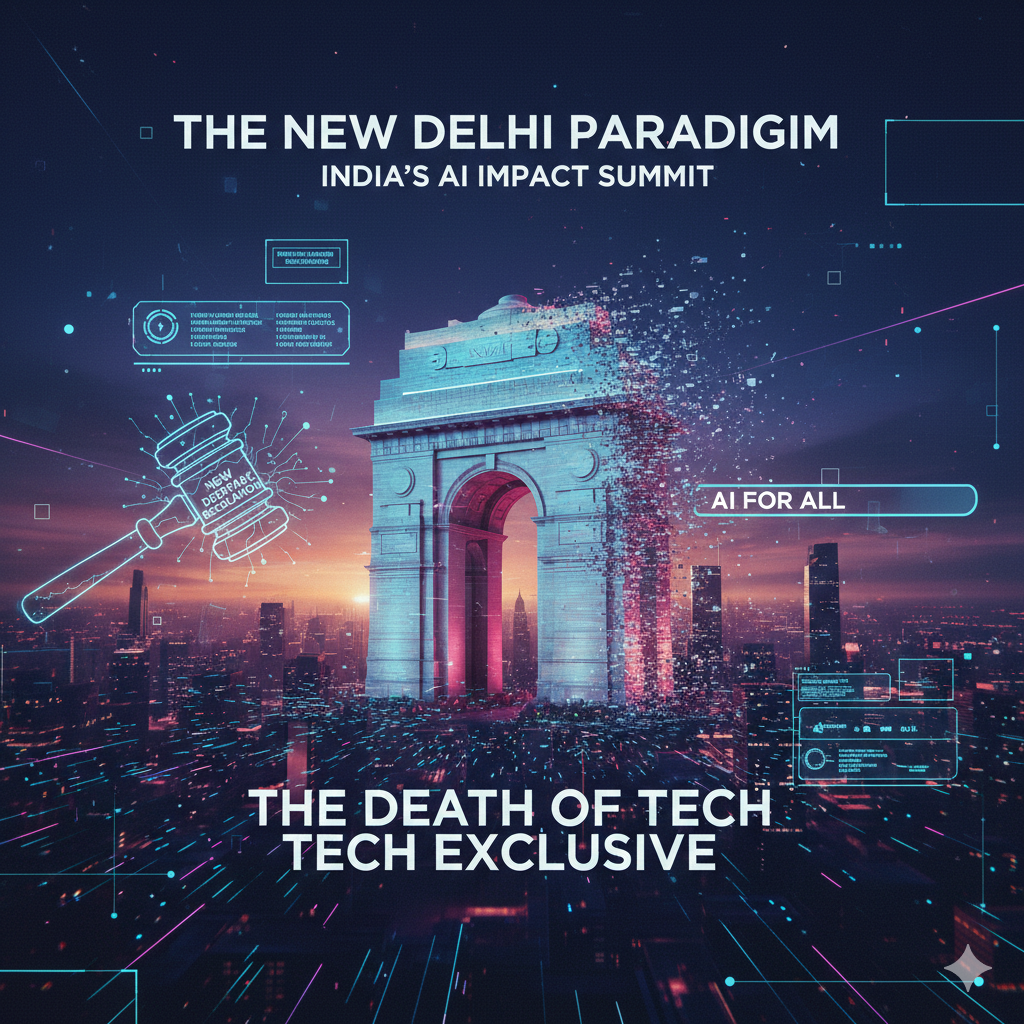
The era of "AI Safety" as a gatekeeping mechanism for the global elite is officially over. For years, the conversation around artificial intelligence was dominated by the Bletchley Park and Seoul Summits, focused largely on the existential risks of frontier models. But this week at Bharat Mandapam, New Delhi has flipped the script, hosting the India-AI Impact Summit 2026—the first global AI gathering of this scale to be held in a developing economy.
We aren't just talking about chatbots or Silicon Valley boardroom drama anymore. This is about the democratization of foundational resources—compute power, datasets, and talent—ensuring that the benefits of intelligence are not concentrated in the hands of a corporate few.
From Risk Management to Real-World Impact
While previous summits obsessed over "the alignment problem," India is focused on the "implementation problem." The New Delhi Paradigm marks a structural shift in the global dialogue, moving away from abstract technical parameters and toward measurable societal outcomes.
The summit is anchored in three foundational "Sutras": People, Planet, and Progress. It’s a deliberate pivot toward using AI as a strategic national tool rather than just a commercial commodity. By framing AI as a public good, India is positioning itself as the leader of the Global South, offering a blueprint for nations that don't want to choose between Western tech monopolies and Chinese digital surveillance.
Sovereign Compute: The New Strategic Reserve
One of the most provocative themes emerging from the summit is the concept of "Sovereign AI." For a country to be truly independent in 2026, it must own its compute. The Indian government has backed this vision with the IndiaAI Mission, a ₹10,300 crore initiative designed to build indigenous GPU capacity and datasets.
The bottleneck for most developing nations has always been hardware. India is addressing this by aiming to roll out 18,000 high-end GPU servers through public-private partnerships. The goal is to provide affordable AI access at roughly ₹65 per hour, ensuring that a startup in Pune has the same fighting chance as one in Palo Alto.
The Bharat-VISTAAR Initiative
Nowhere is this democratization more visible than in the launch of Bharat-VISTAAR. Proposed in the Union Budget 2026, this multilingual AI advisory platform is designed to transform the lives of millions of farmers. It isn't just a fancy weather app; it’s an integrated digital backbone that connects farmers with verified agricultural knowledge in their own tongue.
Empowering the Informal Backbone
Perhaps the most radical proposal at the summit is NITI Aayog’s Mission Digital ShramSetu. While the West worries about AI replacing white-collar workers, India is looking at how it can empower its 490 million informal workers.
This segment of the workforce contributes nearly half of India's GDP but has historically been excluded from formal systems. The mission aims to use AI, blockchain, and immersive learning to dismantle systemic barriers to credit, healthcare, and skilling. It’s a powerful reminder that technology doesn't automatically create equity—it requires deliberate, human-centric policy to ensure the "intelligence dividend" reaches the street level.
The Challenges of Autonomy
It would be naive to suggest the path to tech democratization is without hurdles. India faces a steep climb in securing GPU supply chains amidst global shortages and rising costs. Furthermore, while the Budget 2026 offered a bold tax holiday for global cloud players until 2047, there is a delicate balance to strike.
The risk is that India could become a "data colony" where global giants use Indian land and energy to serve the world while the local population sees only marginal benefit. To counter this, the government is pushing for sovereign AI models that are ring-fenced for local languages and public services.
A New Global Consensus
The India-AI Impact Summit isn't just an Indian event; it’s a global recalibration. With over 100 countries engaging through the "Seven Chakras" or working groups, we are seeing the emergence of a new responsible AI framework that prioritizes inclusion over exclusivity.
The presence of the largest-ever U.S. industry delegation, led by the US-India Strategic Partnership Forum (USISPF), suggests that even the established tech powers recognize the shift. The center of gravity is moving.
AI is no longer a luxury reserved for those with the most capital; it is becoming the essential utility for the next billion users. As the delegates leave New Delhi, the message is clear: the future of AI will be written in many languages, on many continents, and for all people—not just the ones who built the first models.