
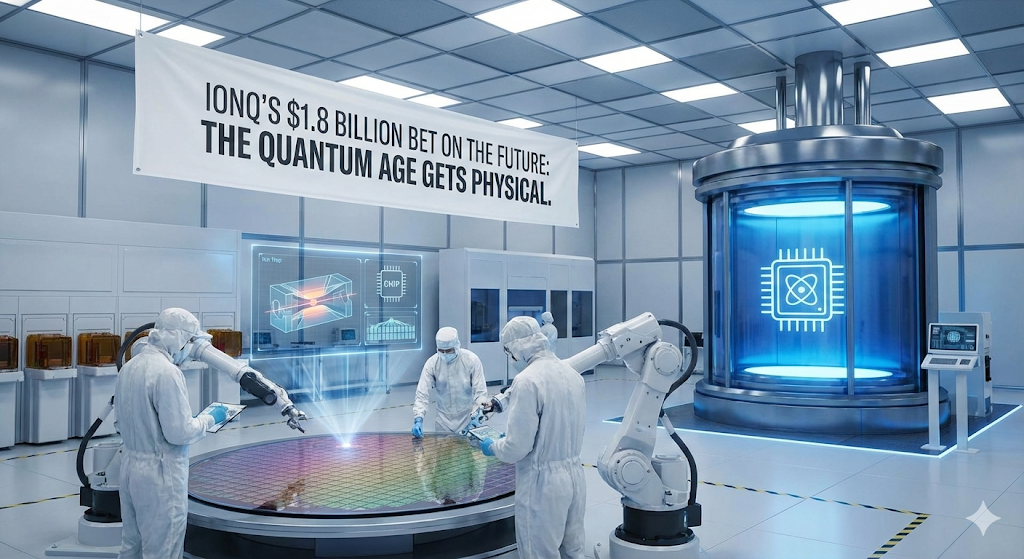
For the last decade, quantum computing has felt like a physics experiment that accidentally wandered into a boardroom. We’ve watched companies chase coherence times and qubit counts, celebrating every millisecond of stability like a moon landing. But on January 26, 2026, the narrative shifted violently from discovery to manufacturing.
IonQ, the leader in trapped-ion quantum computing, announced it is acquiring SkyWater Technology for $1.8 billion. This isn’t just a merger; it’s a signal that the industry is graduating from the "lab bench" phase to the factory floor. By buying the only U.S.-owned, pure-play semiconductor foundry, IonQ is making a massive bet that the bottleneck for quantum dominance isn't software or physics anymore—it's the ability to actually build the chips.
Let’s unpack why a quantum software and hardware company would buy a traditional chip factory, and what this vertical integration means for the future of hard tech.
The End of the "Fabless" Fantasy
In the classical semiconductor world, being "fabless" is the gold standard. Companies like NVIDIA and Apple design chips and let TSMC do the heavy, messy lifting of manufacturing them. It’s capital-efficient and smart. So, why is IonQ doing the exact opposite?
The answer lies in the unique weirdness of quantum hardware. Unlike standard silicon transistors, which are commoditized and standardized, quantum chips are finicky beasts. IonQ’s trapped-ion processors require exotic materials, specific electrode layouts, and optical integration that standard CMOS foundries simply aren't designed to handle at scale.
When you are pushing the boundaries of physics, you can’t just email a CAD file to a standard fab and expect a working quantum processor back. You need to control every atom of the process.
This acquisition, valued at $35.00 per share, gives IonQ that control. They aren't just buying capacity; they are buying the ability to iterate. Instead of waiting months for a third-party foundry to squeeze their weird quantum run in between massive orders for car chips, IonQ can now prioritize their own roadmap. They are effectively saying that to build the computer of the future, they first had to buy the factory of today.
Buying Sovereignty: The National Security Play
We cannot ignore the geopolitical map underlaying this deal. SkyWater Technology isn’t just any foundry; it is a DMEA-accredited "Trusted Supplier." In plain English, this means they are certified by the U.S. Department of Defense to manufacture chips for sensitive military and government applications.
By bringing SkyWater in-house, IonQ has effectively cemented itself as the primary quantum partner for the U.S. government. We are living in a time where "supply chain sovereignty" is a board-level imperative. The U.S. government is desperate to ensure that the next generation of computing power is not dependent on supply chains that run through geopolitical rivals.
This move creates a vertically integrated, domestic fortress for quantum computing. For the defense sector, this is the dream scenario: a U.S. company that designs the quantum architecture and owns the secure facility where it’s built. It transforms IonQ from a vendor of experimental hardware into a strategic national asset.
The Economics of "Full Stack"
Financial analysts often get nervous when software-heavy tech companies buy hardware-heavy factories. Foundries are notoriously capital-intensive—they eat cash for breakfast. However, a look at IonQ’s recent financials suggests they are playing from a position of strength, not desperation.
According to their Q3 2025 report, IonQ sat on a pro-forma cash pile of roughly $3.5 billion. They have the war chest to absorb SkyWater’s operations without immediately jeopardizing their runway. Furthermore, SkyWater is a revenue-generating entity with its own book of business. This isn't a pre-revenue startup buying another pre-revenue startup; it's a well-capitalized leader buying a functional industrial engine.
The risk, of course, is focus. Managing a foundry with existing commercial customers while trying to pivot its capabilities toward exotic quantum manufacturing is a balancing act. If IonQ gets bogged down in the low-margin struggles of contract manufacturing, it could distract from their core mission. But if they pull it off, the economic moat they create will be nearly impossible for competitors to cross.
What This Means for the Industry
The IonQ-SkyWater deal is likely the first domino in a wave of "hard tech" consolidation. We are moving away from the era where having a brilliant PhD and a prototype was enough. The new barrier to entry is industrialization.
For investors, this signals a maturation of the market. The winners of the quantum race won't just be the ones with the smartest algorithms; they will be the ones who can manufacture high-fidelity qubits by the thousands, reliably and repeatedly.
We are seeing the separation of the "science projects" from the "industrial titans." IonQ has decided that to win the race, they can't just design the engine—they have to own the assembly line. It’s a bold, expensive, high-stakes move. But in the world of quantum computing, playing it safe has never been a winning strategy.
This article is based on analysis of the January 2026 acquisition announcement and financial filings from IonQ and SkyWater Technology.