
For decades, the life of a small business owner has been a balancing act of extreme cognitive load. You weren't just the CEO; you were the head of marketing, the lead accountant, the customer service representative, and the IT troubleshooter, all while trying to remember which of your fifteen separate apps held the data you actually needed.
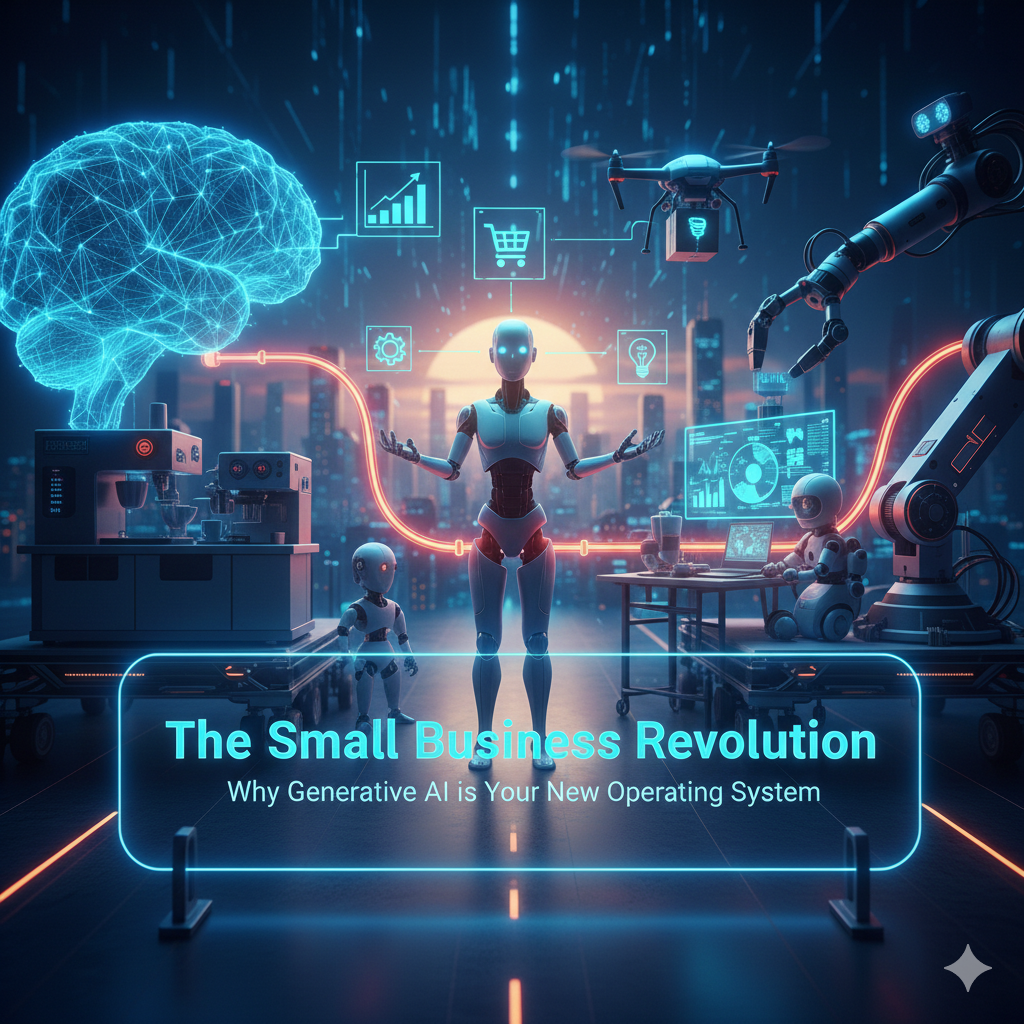
The emergence of Generative AI (GenAI) has finally broken this cycle, acting not as just another tool in the shed, but as a central reasoning layer that orchestrates the entire enterprise. We are witnessing a fundamental shift where intelligence is no longer a luxury of the Fortune 500, but a democratized operating system available to any entrepreneur with a laptop and a vision.
The End of the "App for Everything" Era
We’ve lived through the era of "SaaS sprawl," where the solution to every problem was to buy a new subscription. While these tools democratized specific tasks, they created a secondary crisis of data fragmentation and mental fatigue.
Small businesses have historically run on a manual operating system where the owner served as the primary processor, manually moving data from an email to a spreadsheet and then into an invoice. This "manual OS" is inherently unscalable because it relies on the finite hours and energy of a human being.
Generative AI changes the architecture of the business by providing a unified reasoning tier. It doesn't just store data; it understands the context across your entire workflow, allowing a single individual to achieve what once required entire departments.
The Reasoning Engine: Glue for a Fragmented World
To understand GenAI as an OS, think of it as the "glue" that connects your disparate functions. It is the first technology that can read a customer’s frustrated email, check your inventory in a separate database, look up your refund policy in a PDF, and draft a personalized response—all in seconds.
This is the transition from a collection of static tools to a dynamic intelligence engine. According to a 2023 McKinsey report, GenAI could add between $2.6 trillion and $4.4 trillion annually to the global economy, with much of that value accruing to those who can move faster through automation.
For a small enterprise, this means the "operating system" now handles the low-level processing, freeing the human owner to focus on high-level strategy and relationship building. It’s no longer about how many tools you use, but how well your central intelligence layer coordinates them.
Democratizing the "One-Person Unicorn"
The most provocative promise of this new OS is the rise of the "one-person unicorn." In the past, scaling a business meant hiring more people to manage the increasing complexity of operations, which often led to a "complexity tax" that killed margins.
Today, a founder can leverage AI-powered project management tools like Motion or Zapier Central to handle scheduling and workflow automation. They can use platforms like Nextiva to orchestrate customer journeys that feel personal but are entirely automated.
This allows a small team to maintain the "soul" of a boutique brand while operating with the efficiency of a massive corporation. You are no longer limited by your headcount, but by the quality of the prompts and the data you feed into your system.
From Tactical Execution to Strategic Advisory
Perhaps the most significant shift is occurring in specialized fields like accounting and law. For a small business, the "accounting OS" used to be about data entry; now, it’s about real-time financial coaching.
Modern platforms are shrinking the month-end close from twelve days down to just three. When your "operating system" automatically reconciles bank statements and flags tax-saving opportunities, the role of your accountant shifts from being a historian of your past to an architect of your future.
This transition allows business owners to spend less time "keeping the lights on" and more time analyzing the data that the AI has already cleaned and categorized. It turns every small business into a data-driven enterprise by default.
The Reality of the "Survival Imperative"
While the potential for growth is high, the adoption of this new OS is increasingly becoming a matter of survival rather than a choice. We are seeing a global trend where small businesses that fail to integrate AI are quickly losing ground to "AI-native" competitors.
Interestingly, Southeast Asian SMEs are currently adopting AI faster than their Western counterparts due to "survival pressure." They are bypassing traditional strategic planning and moving straight into implementation because they recognize that efficiency is the only way to compete on a global stage.
In the United States, recent data from Goldman Sachs shows that 74% of small business owners plan to grow in the next year, with a significant portion of that confidence stemming from AI-driven productivity gains. The message is clear: the floor for "standard operations" has been raised, and the new baseline is AI-augmented.
Navigating the Friction of a New OS
Adopting a new operating system is never without its bugs and installation errors. Small businesses face real challenges regarding data privacy, the "hallucination" risks of early models, and the initial cost of implementation.
Building a sophisticated AI stack often involves assembling 20 to 30 different components, including security protocols and data enrichment tools. It requires a mindset shift from "hiring for tasks" to "hiring for systems thinking."
There is also the risk of losing the "human touch" that defines many small brands. The key is to use AI for the "robotic" parts of the job—reconciliation, drafting, scheduling—while preserving the human intuition required for storytelling and complex negotiation.
Conclusion: The New Foundation of Enterprise
Generative AI is not a passing trend or a specialized tool; it is the fundamental infrastructure upon which the next generation of small businesses will be built. By acting as a unified reasoning layer, it collapses the distance between a great idea and a functioning enterprise.
The transition from a "manual OS" to an "AI OS" is the great equalizer of our time. It removes the administrative tax of being small and allows the focused, agile entrepreneur to outpace the bloated corporate giant.
The question is no longer whether your business will run on AI. The question is how quickly you will embrace this new operating system to reclaim your time, your focus, and your competitive edge in an increasingly automated world.