
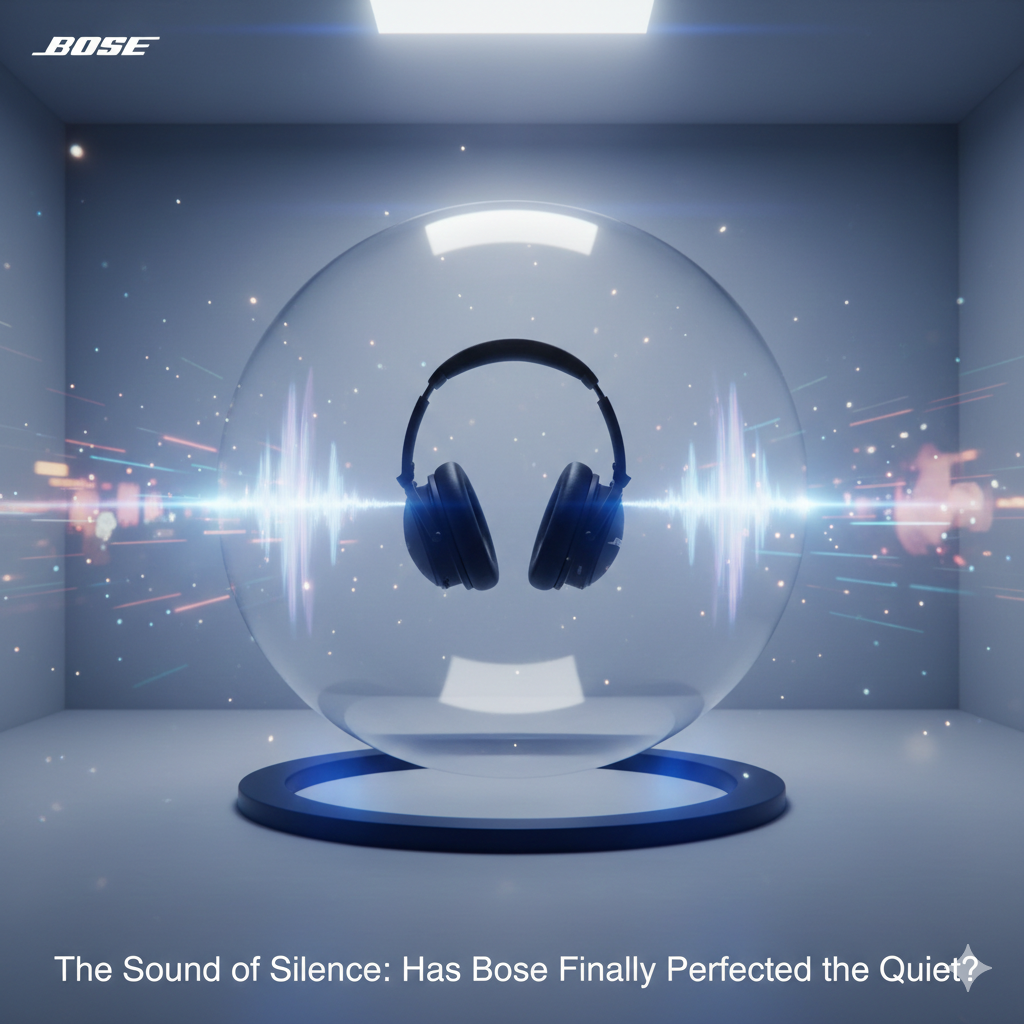
The roar of a jet engine or the clatter of a crowded café used to be the ultimate test for premium headphones. Today, the challenge has shifted to something far more elusive: the ability to create a seamless, high-fidelity sanctuary in an increasingly noisy digital world.
With the maturation of the Bose QuietComfort Ultra Gen 2, we aren't just looking at another iterative update in a long line of "QuietComfort" models. We are witnessing a pivot where silicon and software now dictate the limits of human hearing.
Beyond the Silhouette: The Silicon Revolution
At first glance, you might mistake the Gen 2 for its predecessor, as Bose has largely retained the refined 2023 design language. But underneath that familiar exterior lies a re-engineered signal processing chain designed for the demands of 2026 audio standards.
The internal digital-to-analog conversion (DAC) pathways have been overhauled to support a broader range of high-resolution inputs. This isn't just a win for audiophiles; it’s a necessary adaptation for an era where lossless streaming has become the baseline rather than the exception.
By prioritizing software-defined acoustic environments, Bose has moved away from the "one-size-fits-all" hardware approach. The Gen 2 utilizes an optimized version of Custom Tune technology, which maps the unique shape of your ear canal in less than a second to calibrate both sound and silence.
The Lossless Leap: USB-C and the Wired Revival
One of the most significant, yet understated, upgrades in the Gen 2 series is the official support for lossless audio over USB-C. In a world that went "fully wireless" years ago, this move feels both nostalgic and profoundly forward-thinking.
As wireless protocols like Bluetooth 5.4 continue to improve, they still face physical limitations in bandwidth. By including a high-fidelity digital pathway through the charging port, Bose has addressed a major pain point for users who want the flexibility of wireless but the uncompromising quality of a wired connection for focused listening.
This "hybrid" philosophy ensures the headphones remain future-proof. Whether you are tethered to a high-end DAC at your desk or navigating a terminal with Snapdragon Sound, the Gen 2 scales its performance to match the source material.
Active Noise Cancellation (ANC) in the Age of AI
Bose has long been the titan of "The Silence," but the Gen 2 pushes this further by integrating AI-powered adaptive algorithms. Unlike traditional ANC, which reacts to persistent frequencies, the new system is designed to predict and neutralize sudden spikes like a passing siren or a dog's bark.
The impact of this is most noticeable in the transition between modes. Moving from "Quiet" to "Aware" now feels less like flicking a switch and more like a natural opening of the room.
Critics often argue that "Aware Mode" in other brands sounds synthetic or "tinny." Bose has countered this by leveraging hearing-aid technology research to preserve vocal clarity while filtering out distracting environmental hums, making conversation feel surprisingly organic even with the cans on.
The Ecosystem Challenge: Longevity in a Cloud-First World
No piece of technology exists in a vacuum, and the Bose ecosystem has faced its share of scrutiny lately. The recent discontinuation of cloud support for the Sound Touch line serves as a stark reminder of the "digital half-life" of premium hardware.
While Bose has mitigated the fallout by delaying the shutdown to May 2026 and open-sourcing the tech, it raises a valid question for Gen 2 buyers: How long will these remain "smart"?
The answer seems to lie in the pivot toward local processing. By moving the heavy lifting of Cinema Mode and spatial audio processing directly onto the headphone’s internal chips, Bose is reducing the dependency on cloud-based servers, potentially extending the functional life of the Gen 2 well beyond the typical five-year cycle.
Weighing the Investment: Is Silence Worth the Premium?
At a launch price of approximately $449, the QuietComfort Ultra Gen 2 sits at the upper echelon of the market, competing directly with the Sony WH-1000XM6 and the aging but iconic Air Pods Max.
For users who already own the first-generation Ultra, the upgrades—while meaningful—might feel incremental. The $20 price increase over the original model is justified by the USB-C audio and improved Bluetooth stability, but the core ANC performance remains largely comparable for the average listener.
However, for those still clinging to a QC35 or early XM4, the jump to Gen 2 is transformative. The combination of "Immersive Audio" and the sheer comfort of the protein-leather earcups makes it the definitive choice for long-haul travel and deep-work sessions.
Final Thoughts: The Mastery of the Invisible
True innovation in audio is often about what you don't hear. The Bose QuietComfort Ultra Gen 2 doesn't scream for attention with flashy neon lights or radical new shapes. Instead, it focuses on the invisible: the data packets, the sound waves, and the silence.
In 2026, the best headphones aren't just speakers you wear on your head; they are sophisticated computers that filter your reality. Bose has bet that the world is only getting louder—and they’ve built the perfect wall to keep it out.
Author's Note: This analysis reflects the state of the Bose ecosystem as of February 20, 2026. Performance may vary based on future firmware updates and hardware revisions.