
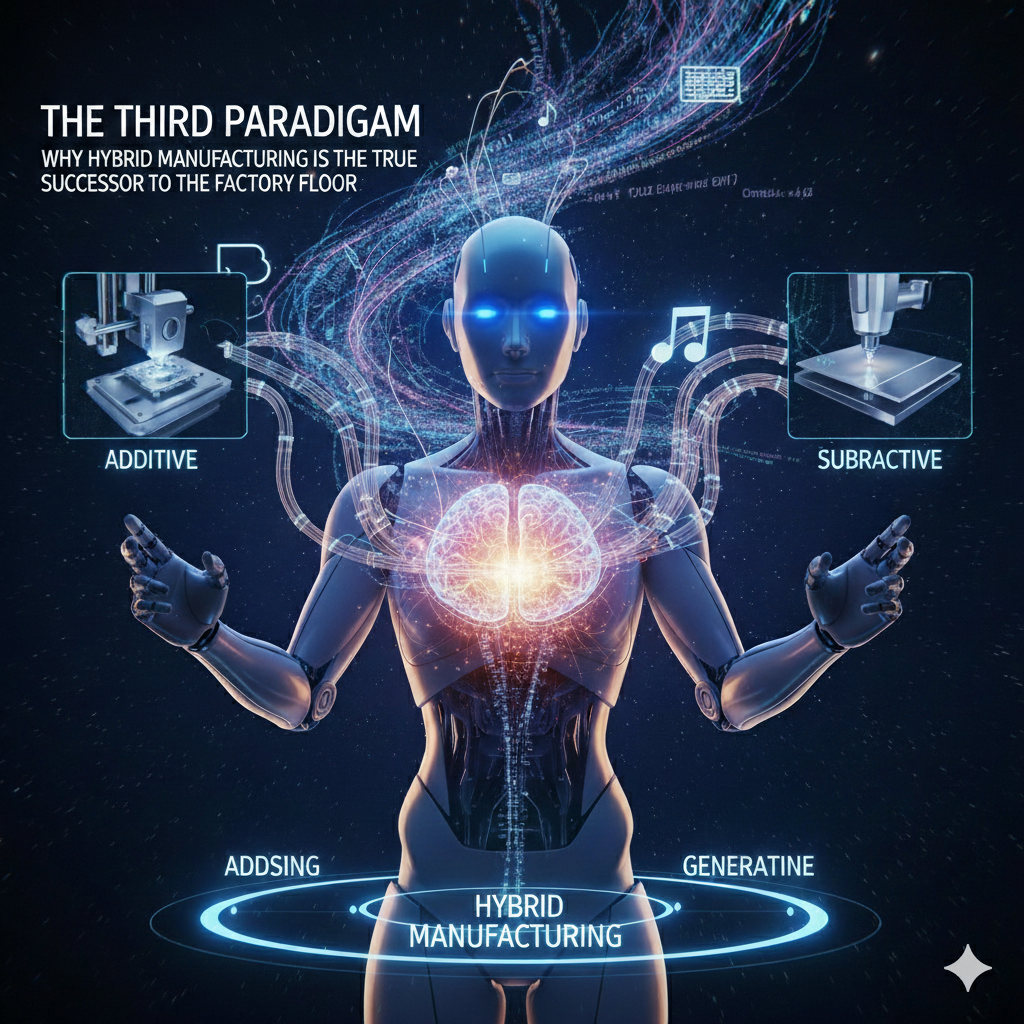
For decades, the manufacturing world was divided by a philosophical wall. On one side stood the traditionalists, wielding massive CNC machines to carve parts out of solid blocks; on the other stood the futurists, promising that 3D printers would soon build everything from the ground up, layer by microscopic layer.
We are now realizing that the future isn't a choice between adding and subtracting, but a sophisticated dance between the two. Hybrid manufacturing is the name for this middle ground, and it is quietly becoming the most significant industrial evolution since the introduction of the assembly line.
By merging the geometric freedom of 3D printing with the surgical precision of traditional milling, companies are finally solving the "dirty secrets" of additive manufacturing: poor surface finish, dimensional inaccuracy, and frustratingly slow production cycles.
The Marriage of Two Worlds
To understand why this matters, we have to look at the inherent tragedy of standalone processes. A standard 3D printer can create a complex internal cooling channel that would be impossible to drill, yet it often leaves the surface of the part looking like a stack of pancakes.
Conversely, a five-axis milling machine can achieve tolerances thinner than a human hair, but it is forced to waste up to 90% of its raw material as "chips" on the floor. Hybrid manufacturing removes this inefficiency by using Directed Energy Deposition (DED) to grow a "near-net shape" part and then instantly switching to a cutting tool to refine critical surfaces.
This isn't just a matter of convenience or moving a part from one machine to another. Modern hybrid platforms, like those pioneered by Meltio, DMG Mori, and Mazak, integrate these capabilities into a single workspace, allowing for a seamless digital workflow that treats the part as a living geometry.
From 10 Weeks to 72 Hours
The most compelling argument for hybrid systems isn't the technology itself, but the radical compression of time. In traditional aerospace and energy sectors, a custom forged or cast part often carries a lead time of 10 to 12 weeks before it even touches a finishing tool.
Recent industrial reports show that hybrid manufacturing can shorten these complex processing cycles by 50% or more. In some high-stakes scenarios, parts that once took months to procure are now being produced from raw wire or powder in as little as 72 hours.
This speed changes the fundamental math of a supply chain. Instead of keeping a warehouse full of "just-in-case" spare parts for a naval vessel or a power plant, a hybrid machine can "print" the replacement and "machine" it to specification on-site, effectively creating a digital inventory that exists only when needed.
The Problem of Surface Integrity
One of the primary hurdles for metal 3D printing has always been surface roughness. In the medical field, for instance, an implantable device needs a surface so smooth that it prevents bacterial adhesion, yet additive processes typically yield a roughness (Ra) of around 30 micrometers.
Hybrid manufacturing addresses this by performing in-process machining. By alternating between adding material and milling it, a machine can reach internal features that would be inaccessible once the part is finished, refining the surface finish from a "raw" state to medical-grade smoothness (Ra 0.4μm) without the part ever leaving the chuck.
This "done-in-one" philosophy significantly reduces the risk of alignment errors. When you move a part between different machines, you introduce "stack-up" errors in positioning; when the same spindle handles both the additive head and the milling tool, the precision is baked into the system.
Material Alchemy and Functional Gradients
Perhaps the most "sci-fi" aspect of hybrid manufacturing is the ability to create Functionally Graded Materials (FGMs). This involves changing the material composition of a part while it is being built, a feat that is virtually impossible with casting or traditional machining.
Imagine a rocket nozzle that needs to be incredibly heat-resistant on the inside but structurally flexible on the outside. A hybrid system can seamlessly transition from one metal alloy to another, such as bonding Inconel to stainless steel, in a single continuous build.
This isn't just a laboratory trick. It allows engineers to put expensive, high-performance materials only where they are absolutely required, while using cheaper alloys for the bulk of the component, dramatically lowering the "buy-to-fly" ratio that plagues the aerospace industry.
The Reality of the "Hybrid Tax"
Despite the optimism, hybrid manufacturing is not a magic bullet for every workshop. The most obvious barrier is the sheer cost of the equipment, with high-end hybrid platforms often fetching seven-figure price tags that require significant volume to justify the investment.
There is also a steep learning curve in the software stack. Traditional CAM (Computer-Aided Manufacturing) software is designed to remove material, while 3D printing slicers are designed to add it; coordinating these two opposite logics in a single toolpath is a massive computational challenge that requires highly skilled operators.
Some skeptics also point to material limitations, as not every metal that can be machined can be easily welded or deposited by a laser. Issues like residual stress and thermal warping remain persistent challenges, as the intense heat of the additive process can distort the very surfaces the subtractive tool is trying to finish.
Conclusion: A New Industrial Logic
We are moving toward an era where the definition of a "machine tool" is being rewritten. The factory of the future will likely not be a hall of single-purpose stations, but a network of hybrid cells that can pivot from repair work to new part production with the flick of a digital file.
Hybrid manufacturing proves that we don't have to choose between the ancient art of the forge and the modern miracle of the printer. By combining the two, we gain a level of control over matter that was previously the stuff of technical fantasy.
Ultimately, the true value of the hybrid paradigm is its ability to turn "impossible" designs into physical reality. As we refine the software and lower the barrier to entry, the question for engineers will no longer be "how do we make this?" but rather "now that we can make anything, what should we build?"