
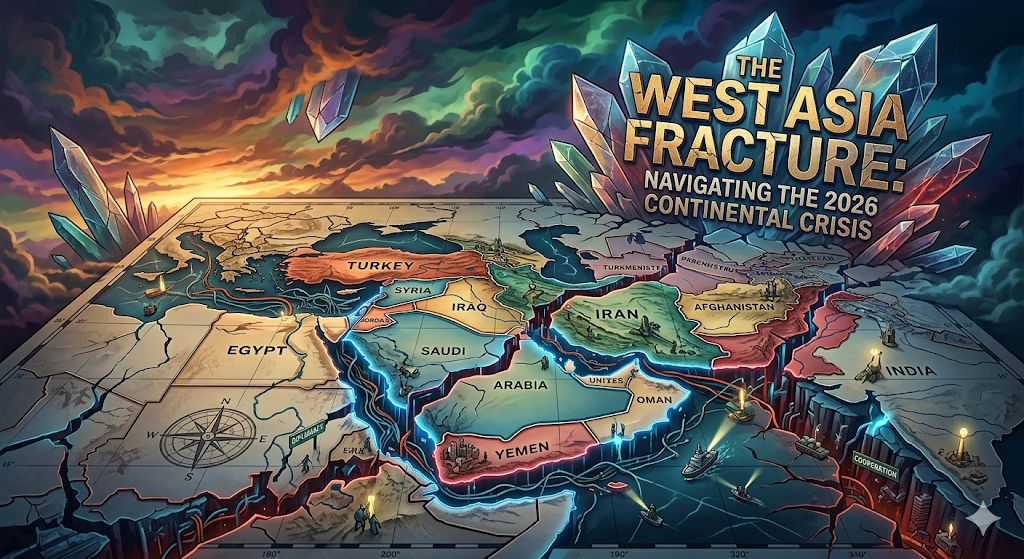
The geopolitical architecture of West Asia, once defined by a precarious balance of power, has finally shattered. On February 28, 2026, the long-predicted "shadow war" between Israel and the Islamic Republic of Iran transformed into a high-intensity frontal confrontation.
In a matter of days, the region moved from a decade-long policy of containment to one of direct regime degradation. This wasn't a slow burn; it was a structural collapse of diplomacy that has forced every global power—from Washington to Beijing—to pick a side in a fragmenting regional order.
As we navigate the fallout, the crisis is no longer just a localized conflict. It has become a global stress test for energy markets, maritime security, and the very concept of international mediation.
Operation Epic Fury: The End of Containment
The catalyst for the current firestorm was the total collapse of nuclear diplomacy in early 2026. Despite rigorous mediation by the Sultanate of Oman, which had suggested a breakthrough regarding Iran's enrichment levels, the skepticism of the Trump administration proved insurmountable.
On February 27, the International Atomic Energy Agency (IAEA) revealed that Iran had successfully concealed highly enriched uranium in an underground facility. Within twenty-four hours, the United States and Israel launched Operation Epic Fury, a systemic strike campaign targeting Iran's missile and nuclear infrastructure.
This shift represents a transition from "managing" the Iranian threat to actively dismantling its strategic assets. According to research from CSIS, the operation's reach has been unprecedented, effectively neutralizing major command centers and refineries in a bid to induce a fundamental change in the region’s power dynamics.
The Maritime Chokepoint: A Dual Crisis
The immediate consequence of this frontal war is the paralysis of global trade. We are currently witnessing an unprecedented dual chokepoint crisis, as both the Strait of Hormuz and the Bab el-Mandeb Strait have become virtually impassable for Western-linked shipping.
In retaliation for the strikes, Iran-aligned Houthi rebels in Yemen resumed missile and drone attacks on all vessels in the Red Sea corridor. This has effectively forced global shipping giants like Maersk and CMA CGM to revert to the longest possible routing around Africa, driving up transit times and insurance premiums.
The impact on the global economy is staggering. With oil prices surging above $85 and gas supplies from Qatar facing force majeure, the "West Asia Crisis" is rapidly becoming a threat to a global economy already rattled by trade wars and protectionist shifts.
The Fragmenting Gulf: Saudi-UAE Rivalry
While the world watches the US-Iran confrontation, a "war within a war" is unfolding between the region's traditional allies. The once-solid partnership between Saudi Arabia and the United Arab Emirates (UAE) has fractured over the future of Yemen.
The rift exploded into the open when Saudi officials accused the UAE of backing separatist groups in southern Yemen to secure maritime influence. This power struggle isn't just about territory; it's about two competing visions for the region’s strategic autonomy.
While Saudi Arabia seeks a centralized, stable neighbor to its south, the UAE has leaned into supporting the Southern Transitional Council (STC), aiming for a multi-polar, decentralized Yemen that favors its own logistical and port-based ambitions. This internal friction complicates any unified Arab response to the broader Iranian crisis.
Mediation at a Crossroads: The Russian and Chinese Play
As Western influence leans heavily into military force, the vacuum for diplomacy is being filled by non-Western actors. Russia, despite its own entanglements, has ramped up mediation efforts, positioning itself as the only power capable of talking to all sides.
However, the war has exposed the limits of Moscow’s leverage. A weaker Iran, cornered by "Epic Fury," is becoming less a strategic partner and more a liability for Russian regional interests. Meanwhile, China continues to play a "long game," focusing on the India-Middle East-Europe Economic Corridor (IMEC) as a rival to its own Belt and Road Initiative.
For these powers, the West Asia crisis is an opportunity to redefine the global trade "corridors." If the U.S.-led IMEC project collapses under the weight of the war, the alternative "Development Road" projects backed by regional actors may become the new default for 2026 and beyond.
Conclusion: The Survival of the Strategic
The "Year of Truth" for AI in 2026 is mirrored by this Year of Truth for West Asia. We have moved past the era of proxies and deniability into an age where the physical and political costs of conflict are laid bare.
The survival of regional stability now depends on three critical factors: the ability to de-escalate the maritime blockade, the resolution of the Saudi-UAE internal rift, and a move toward a new regional security architecture that doesn't rely solely on the total collapse of one side.
The honeymoon of regional normalization is over. For those who can navigate this fracture, the rewards are a new era of trade connectivity; for those who cannot, the quagmire of 2026 has only just begun.