

Q1: You and your friend are playing a game with a fair coin. The two of you will continue to toss the coin until the sequence HH or TH shows up. If HH shows up first, you win, and if TH shows up first your friend wins. What is the probability of you winning the game?
Answer:
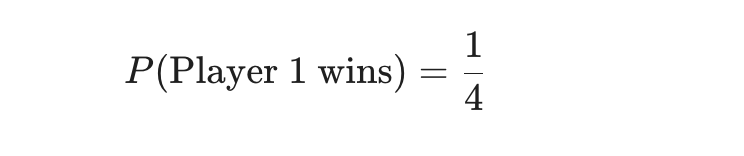
The probability of you winning is 1/4.
Explanation:
If the first flip is Heads (H):
If the second flip is Heads (H), the sequence is HH, and you win immediately.
If the second flip is Tails (T), the sequence is HT. At this point, HH can never occur before TH (because a T has appeared, any subsequent H will form TH first). Thus, your friend wins.
If the first flip is Tails (T):
The sequence HH can never occur before TH because the first H that appears will complete the TH sequence. Your friend wins.
Scenarios:
HH: Player 1 wins (Probability: 1/4)
HT: Player 2 wins (Probability: 1/4)
TH: Player 2 wins (Probability: 1/4)
TT: Sequence continues, but eventually TH will occur before HH. Player 2 wins.
Thus, Player 1 wins only in the HH scenario.
Q2: If you roll a die three times, what is the probability of getting two consecutive threes?
Answer:
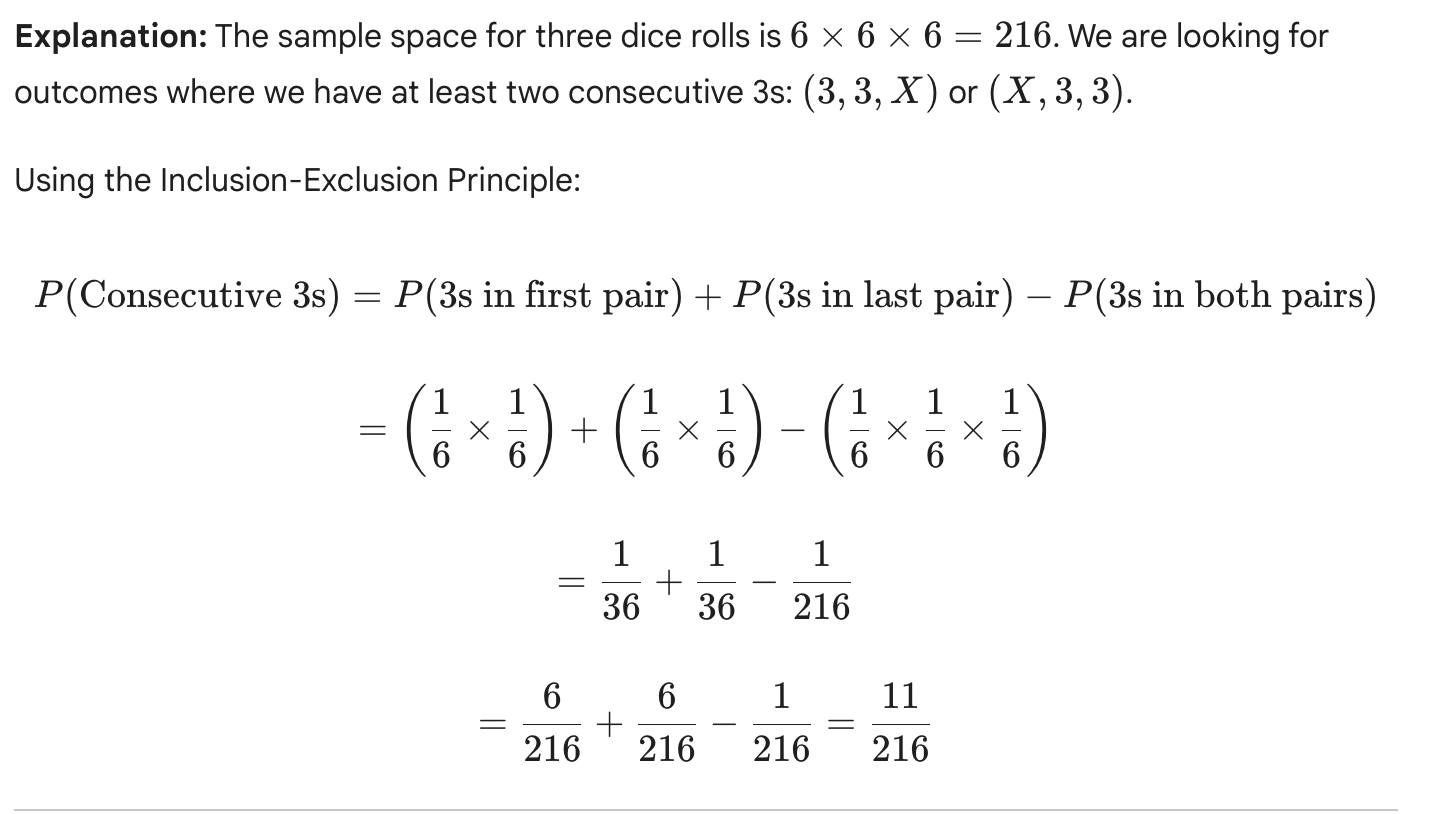
The probability is 11/216.
Q3: Suppose you have ten fair dice. If you randomly throw them simultaneously, what is the probability that the sum of all the top faces is divisible by six?
Answer:
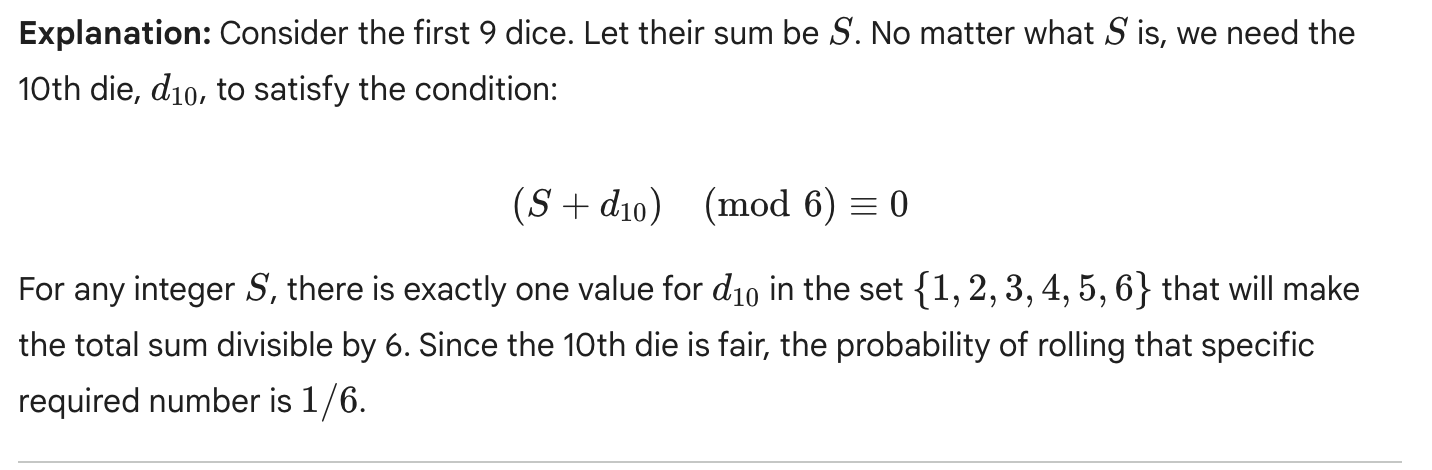
The probability is 1/6.
Explanation:
Q4: If you have three draws from a uniformly distributed random variable between 0 and 2, what is the probability that the median of the three numbers is greater than 1.5?
Answer:
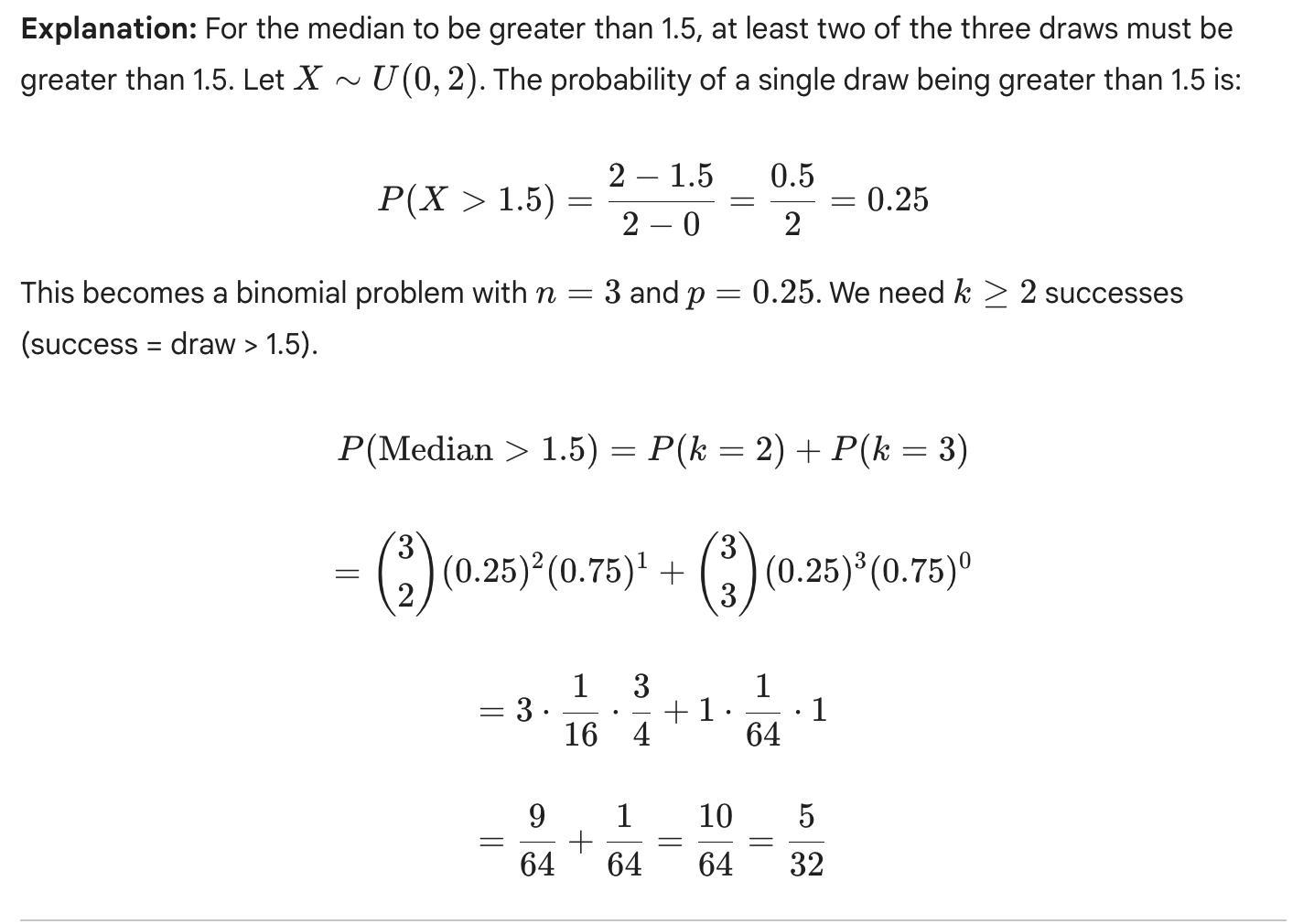
The probability is 5/32 (approx 15.6%).
Explanation:
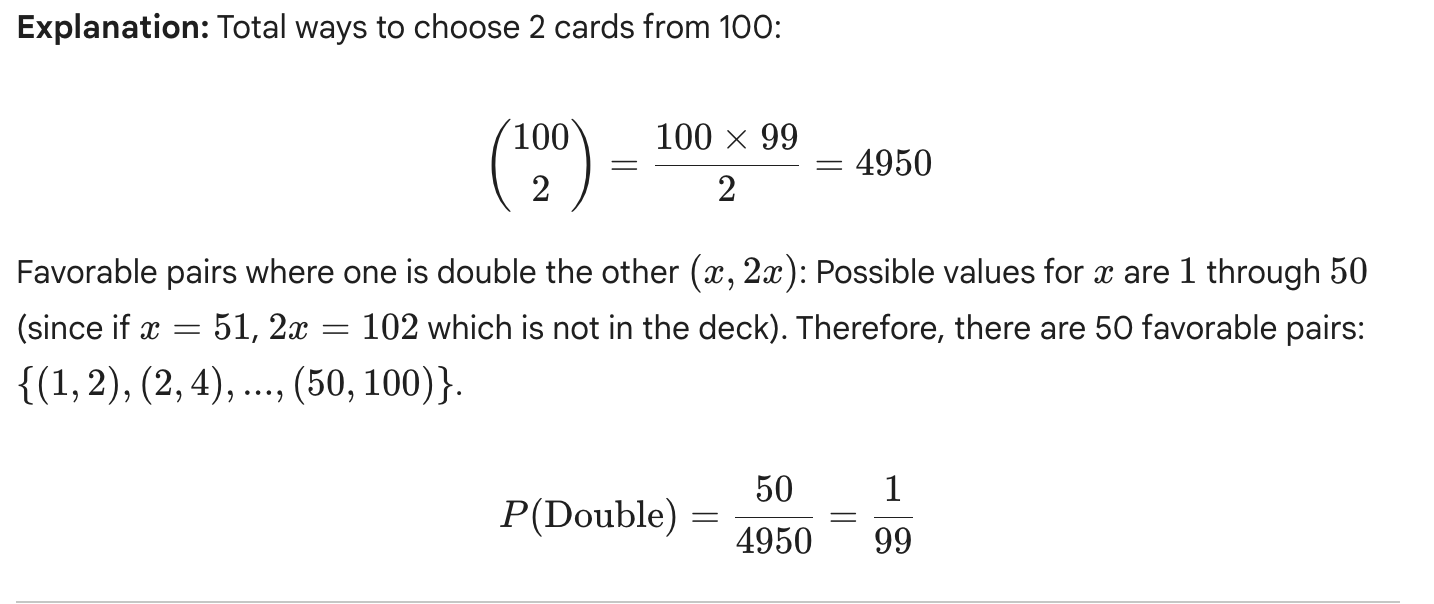
Q5: Assume you have a deck of 100 cards with values ranging from 1 to 100. If you draw two cards randomly without replacement, what is the probability that the number of one of them is double the other?
Answer:
The probability is 1/99.
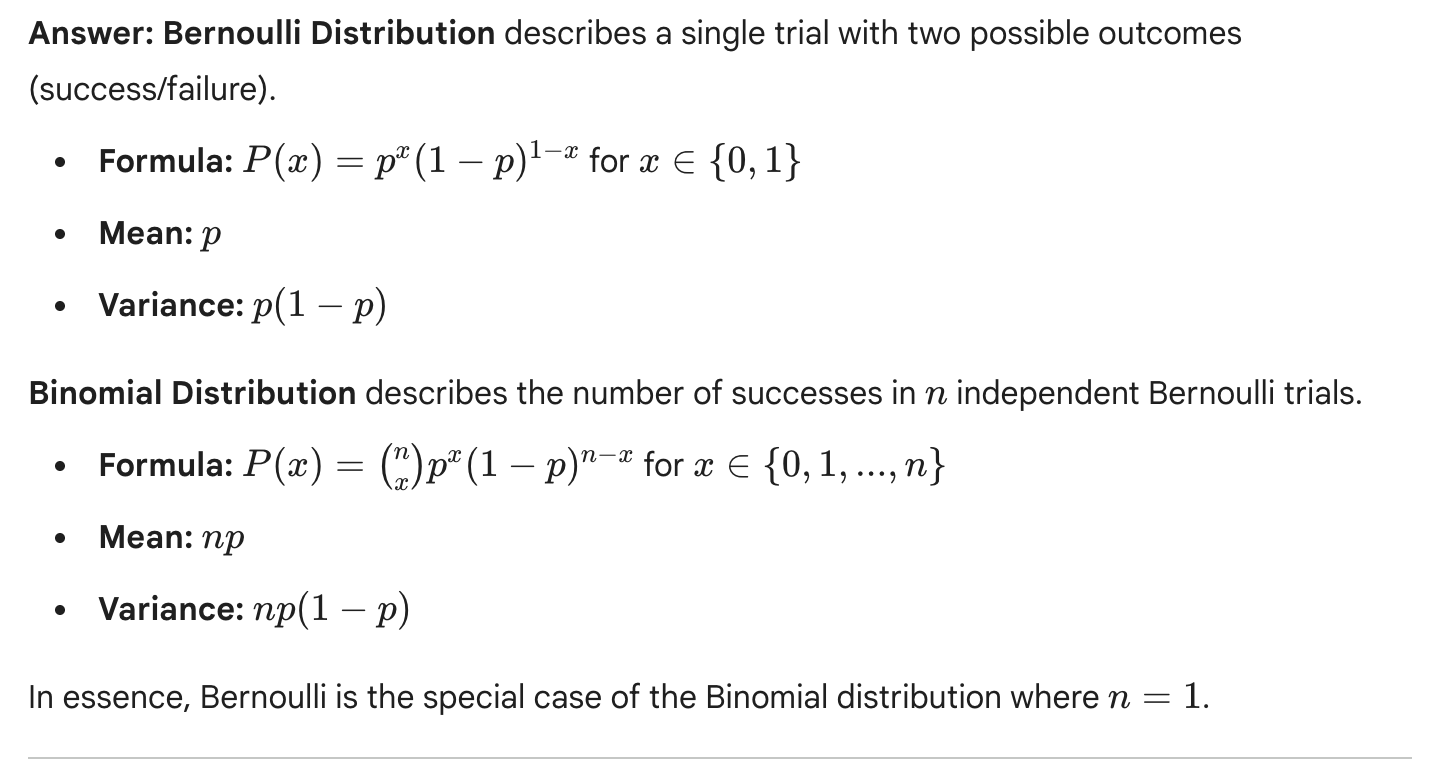
Q6: What is the difference between the Bernoulli and Binomial distribution?
Answer:
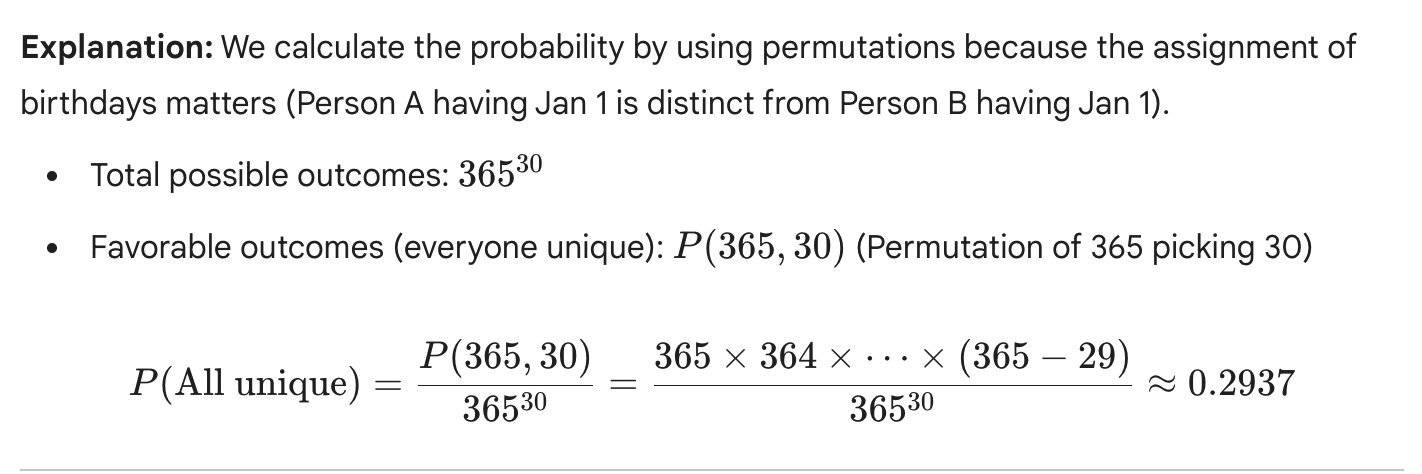
Q7: If there are 30 people in a room, what is the probability that everyone has different birthdays?
Answer:
The probability is approximately 29.37%.
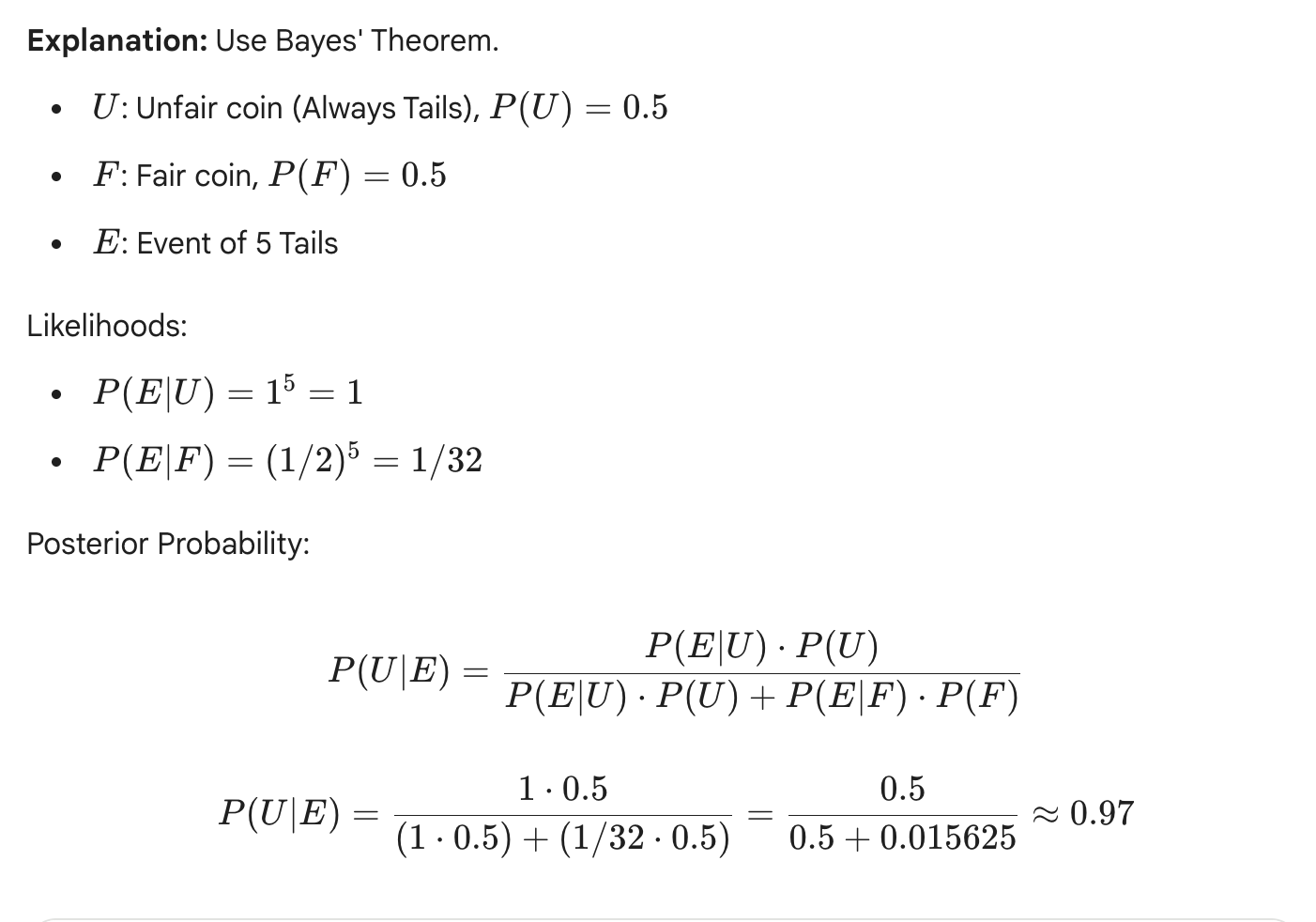
Q8: Assume two coins, one fair and the other unfair (always tails). You pick one at random, flip it five times, and observe tails all five times. What is the probability that you are flipping the unfair coin?
Answer:
The probability is approximately 97%.
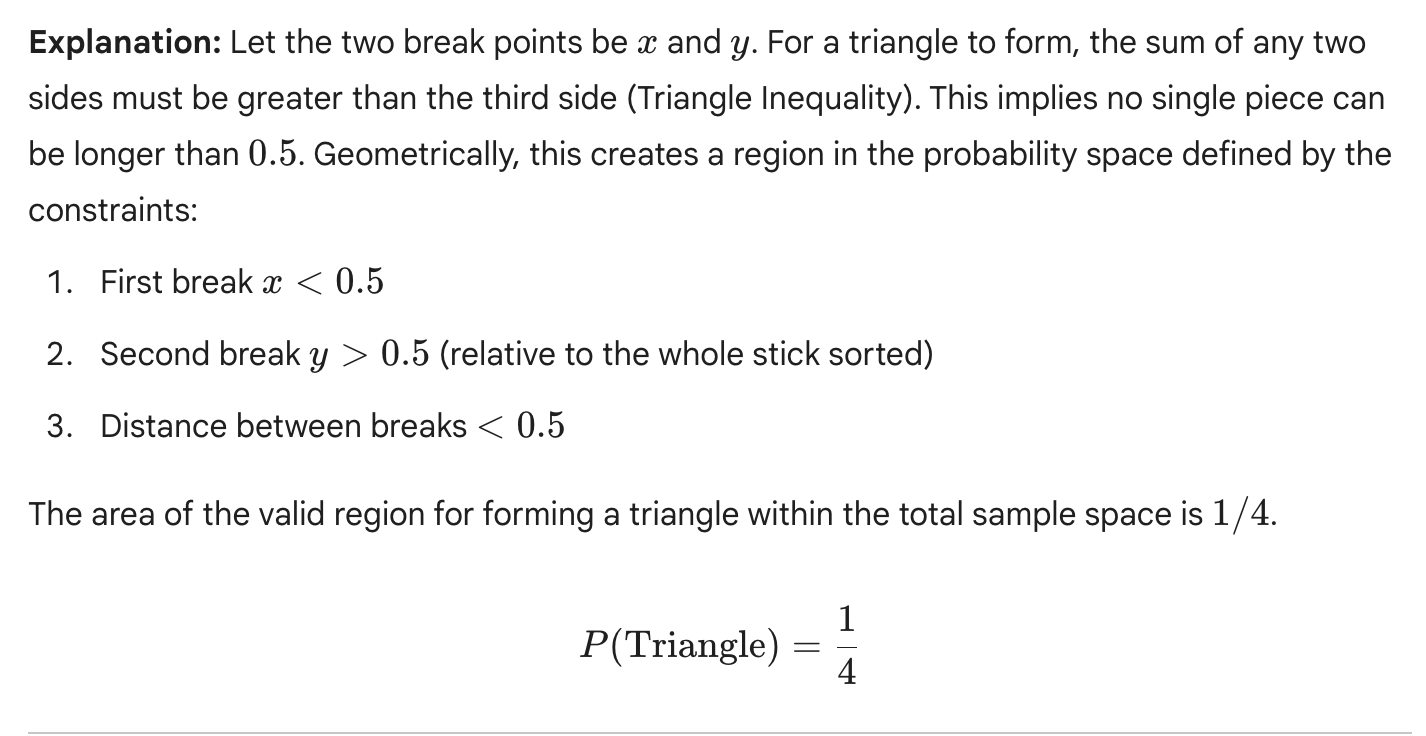
Q9: Assume you take a stick of length 1 and break it uniformly at random into three parts. What is the probability that the three pieces can form a triangle?
Answer:
The probability is 0.25.
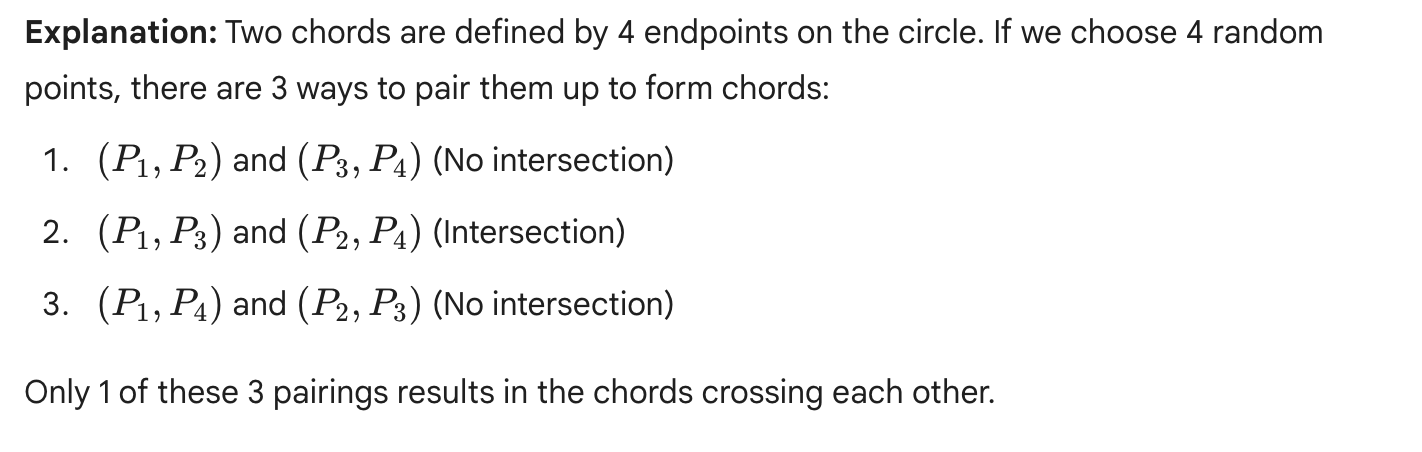
Q10: Say you draw a circle and choose two chords at random. What is the probability that those chords will intersect?
Answer:
The probability is 1/3.
Explanation:
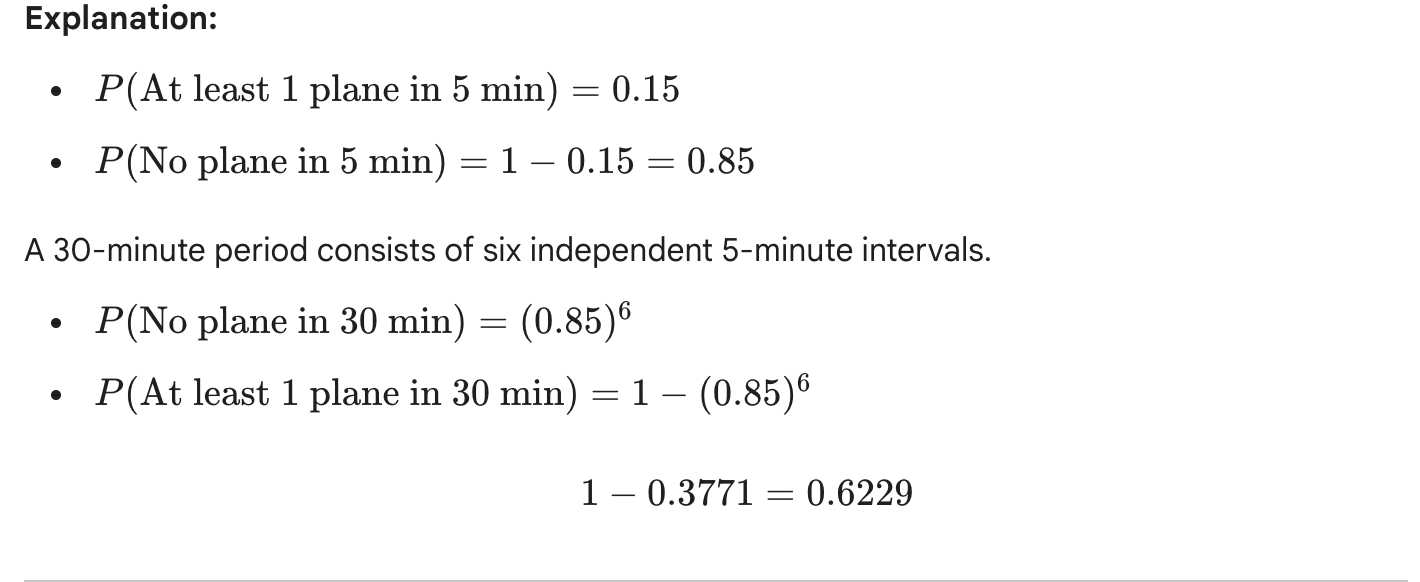
Q11: If there’s a 15% probability that you see at least one airplane in a 5-minute interval, what is the probability that you see at least one airplane in a period of 30 minutes?
Answer:
The probability is approximately 62.28%.
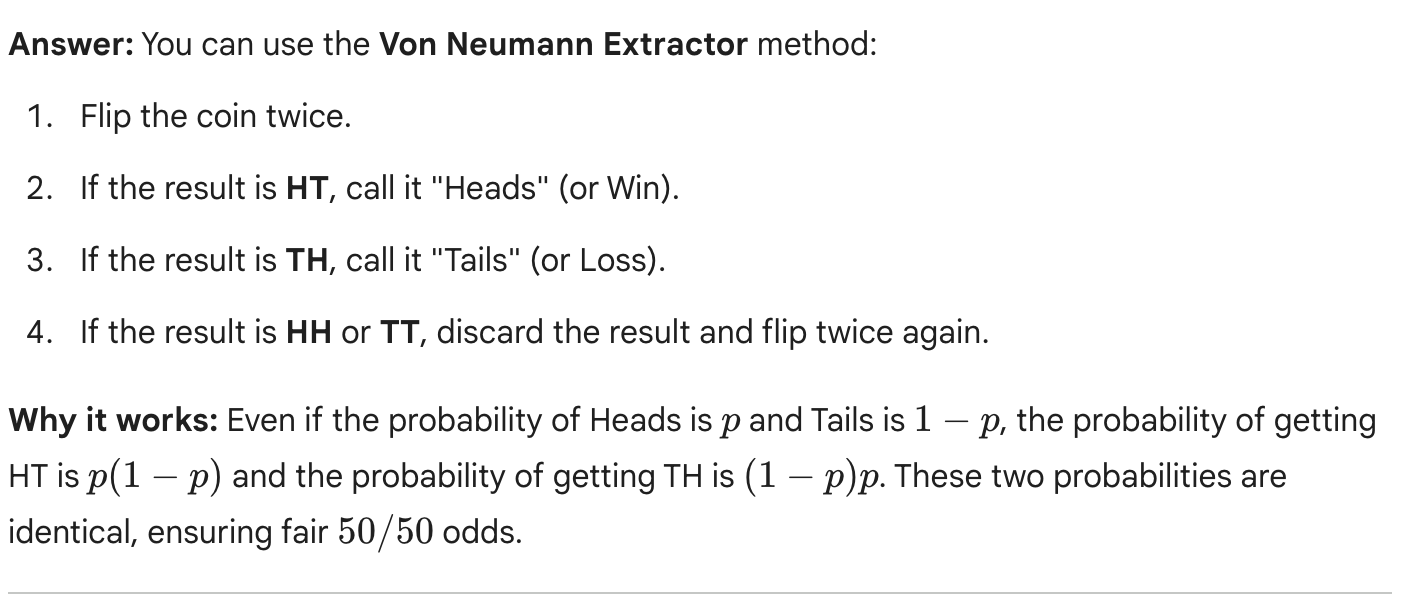
Q12: Say you are given an unfair coin with an unknown bias. How can you generate fair odds using this coin?
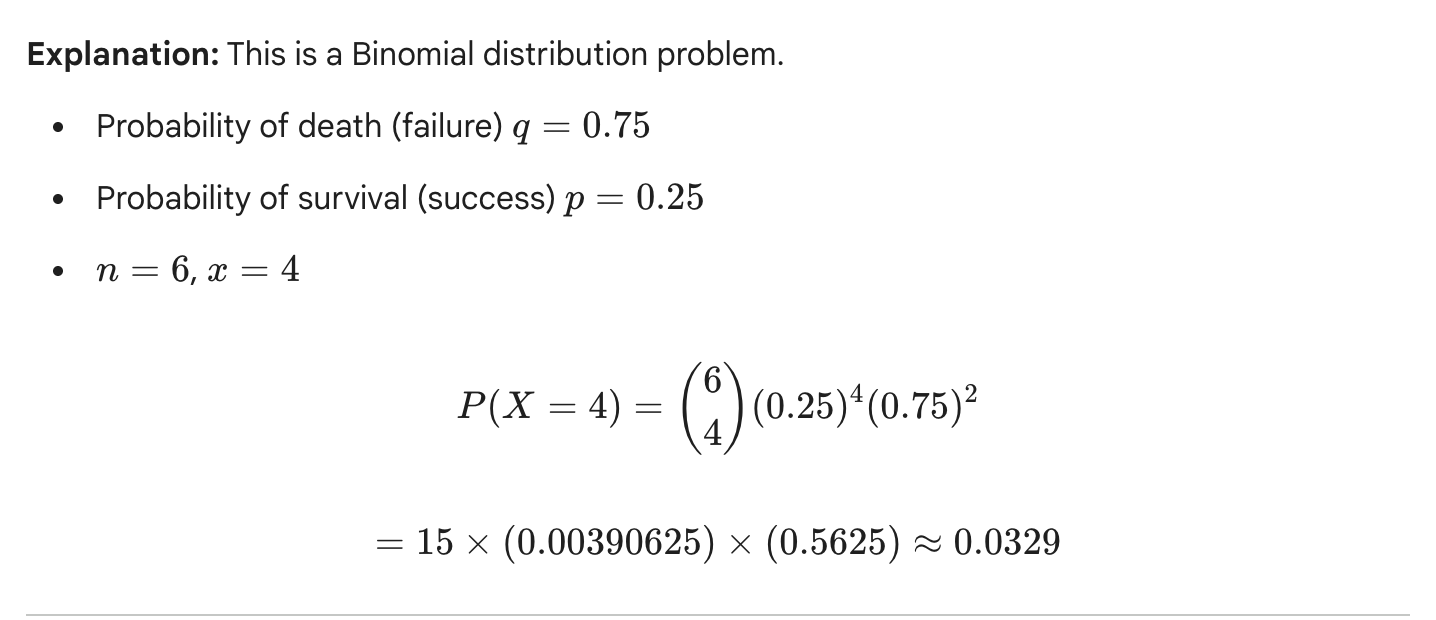
Q13: According to hospital records, 75% of patients suffering from a disease die from it. Find the probability that 4 out of 6 randomly selected patients survive.
Answer:
The probability is roughly 3.3%.
Q14: Discuss some methods you will use to estimate the parameters of a Probability Distribution.
Answer:
Common methods for parameter estimation include:
Maximum Likelihood Estimation (MLE): Maximizing a likelihood function so that, under the assumed statistical model, the observed data is most probable.
Method of Moments: Equating sample moments (mean, variance) with theoretical moments.
Bayesian Estimation: Updating a prior distribution with data to get a posterior distribution.
Least Squares Estimation: Minimizing the sum of the squares of the offsets (residuals).
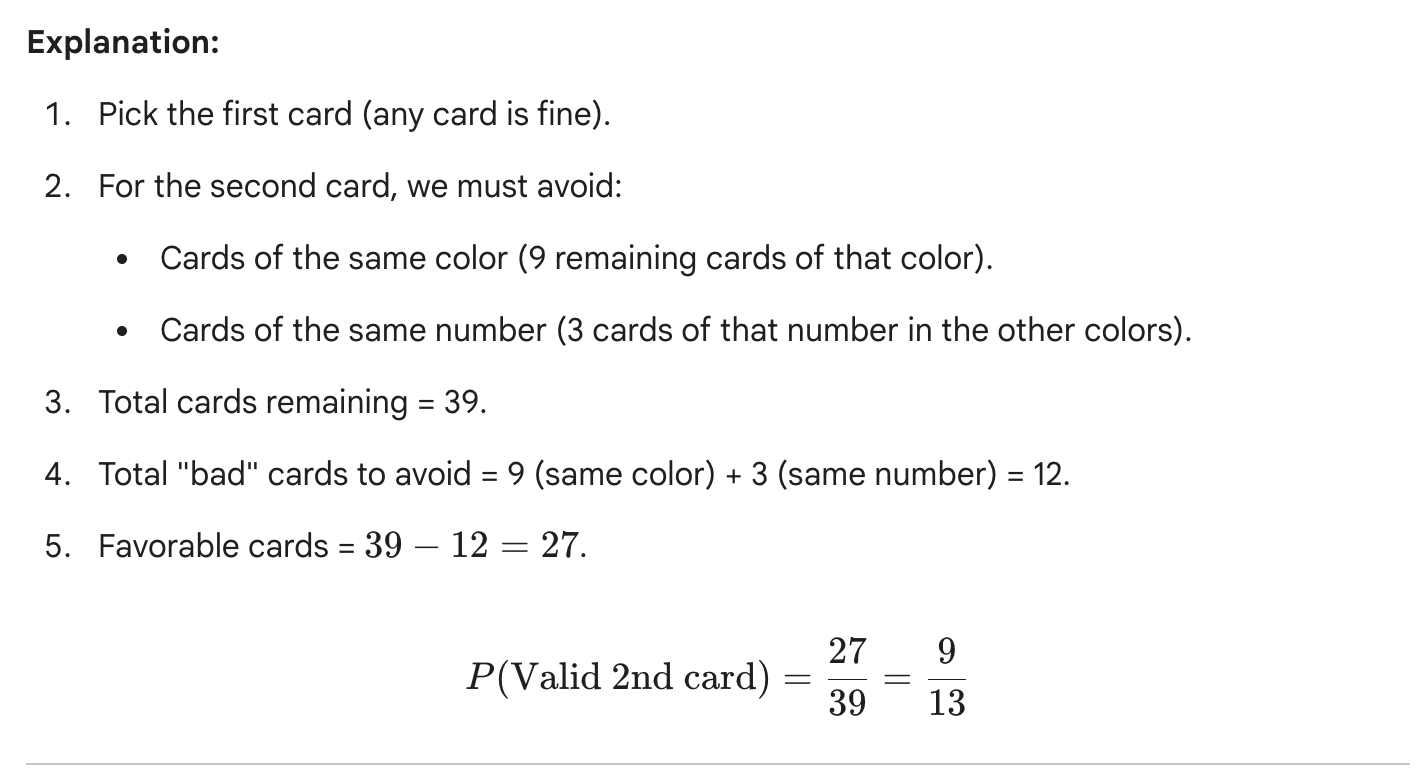
Q15: You have 40 cards in four colors (10 Red, 10 Green, 10 Blue, 10 Yellow), numbered 1 to 10. If you pick two cards without replacement, what is the probability that the two cards are not the same color and not the same number?
Answer:
The probability is 9/13.
Q16: Can you explain the difference between frequentist and Bayesian probability approaches?
Answer:
Frequentist Approach: Defines probability as the limit of an event's relative frequency in a large number of trials. Parameters are considered fixed but unknown constants. Data is random.
Bayesian Approach: Defines probability as a degree of belief. Parameters are treated as random variables with their own distributions (priors). We update our beliefs about these parameters as we acquire data (posterior).
Q17: Explain the Difference Between Probability and Likelihood.
Answer:
Probability: Measures the chance of observing data given a specific model/parameter (Data| Model). The area under the curve sums to 1.
Likelihood: Measures the plausibility of a model/parameter given specific observed data (Model|Data). It is a function of the parameters, and the area under the curve does not necessarily sum to 1.