Mercury 3
Mercury 3 is Inception's frontier diffusion large language model (dLLM) co-founded by Stanford Professor Stefano Ermon, delivering an unprecedented 1,068 tokens per second inference speed via parallel denoising across a native 1-million-token context window.
1,000k
~750k words input
$0.1 / $0.35
Prompt / Completion per 1M
1068 tokens/s
Output Speed
Cloud Managed
Zero local VRAM
Holistic Capability Distribution
Normalized 0-100 rating vectors balanced across intelligence, throughput, and economics.
Verified LLM Benchmarks
Empirical evaluations across academic reasoning, software engineering, agentic execution, and human preference.
Mercury 3 Empirical Results & Generational Scaling
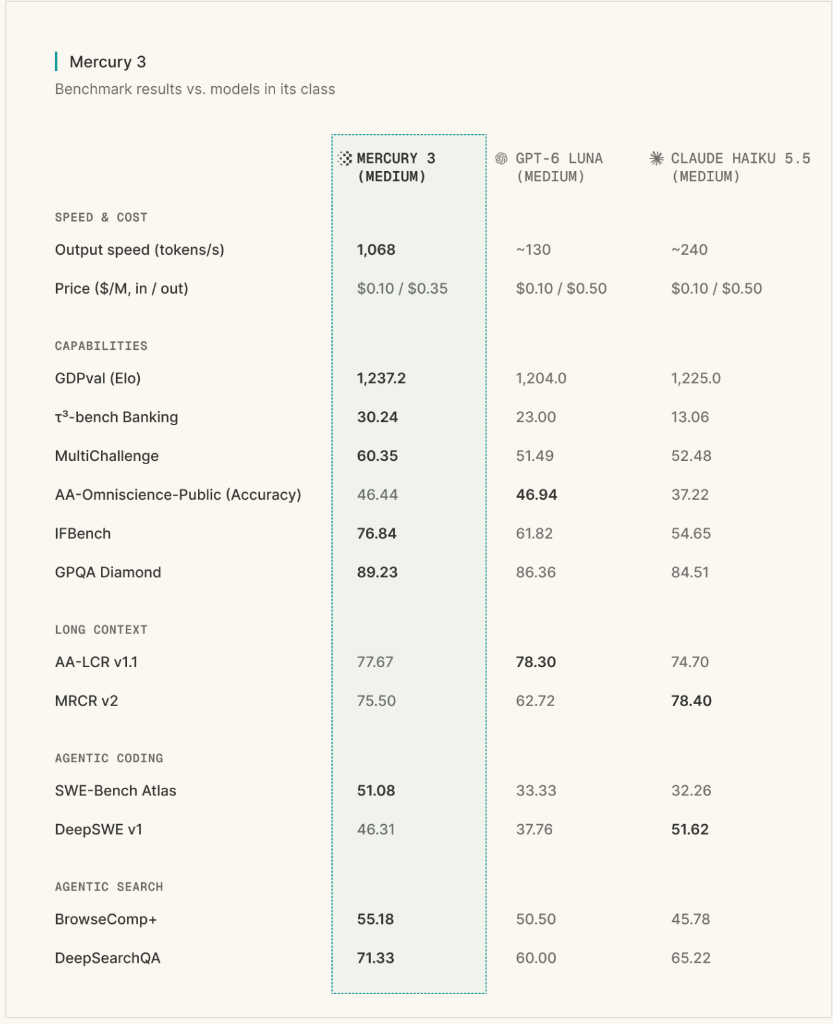
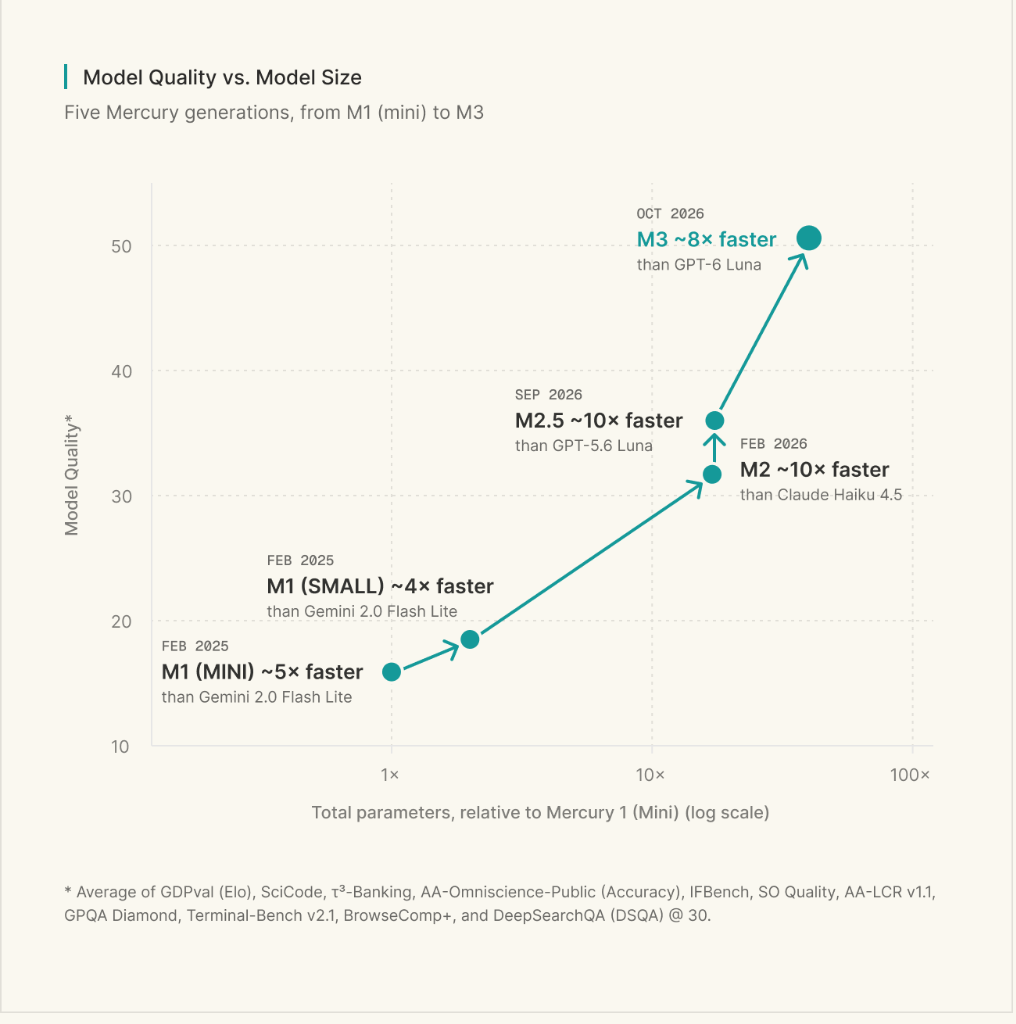
Verified release visuals published by Inception Labs comparing Mercury 3 against GPT-6 Luna and Claude Haiku 5.5.
Inference Latency & Generation Throughput
Empirical telemetry benchmarking generation throughput (Tokens/Second) and Time to First Token (TTFT).
Measured under concurrent production load
p95 latency: 210 ms
Across 5,000 monitored requests
Architectural Strengths vs. Operational Considerations
An objective technical balance sheet analyzing deployment advantages and production constraints.
Key Architectural Strengths
- Unrivaled 1,068 tokens/second throughput via non-autoregressive parallel diffusion, 4x–8x faster than GPT-6 Luna (~130 tps) and Claude Haiku 5.5 (~240 tps).
- Disruptive commercial pricing ($0.10 input, $0.35 output per 1M tokens) with $0.02 cache read.
- Native 1,000,000-token context window with sub-100ms time-to-first-token (TTFT).
- Frontier benchmarks: 89.23% on GPQA Diamond, 1237.2 Elo on GDPval-AA v2, 76.84% on IFBench, and 51.08% on SWE-Bench Atlas.
- Parallel iterative refinement eliminates autoregressive exposure bias and repetitive token looping.
- Co-founded by Stanford Associate Professor Stefano Ermon, pioneering diffusion generative models.
Operational Considerations
- Non-autoregressive diffusion text generation behaves differently than standard causal next-token logit samplers.
- Long-horizon multi-step formal mathematical theorem proving is still best served by dense hybrid-reasoning models like Claude Opus 5.5.
Hardware & Execution Parameters
Genealogical Provenance
Third-generation frontier diffusion language model (dLLM) by Inception Labs, scaling parallel denoising across 5 Mercury generations to 1M context with 1,068 tokens/sec throughput.
inception mercury 2 5
Mercury 3
Architecture Engineering & Capability Deep-Dive
Topology & Attention Mechanics
Mercury 3 marks a paradigm shift in language modeling by replacing sequential left-to-right autoregressive next-token prediction with a continuous-state discrete diffusion process. Rather than generating text one token at a time, it initializes with a parallel draft and refines all token positions concurrently across a handful of iterative denoising passes.
Evaluation Profile & Reasoning Capabilities
Because the diffusion process updates all token positions concurrently, the model has access to global bidirectional context throughout generation. This eliminates classic autoregressive errors where an early wrong token derails the entire subsequent reasoning chain, yielding 89.23% on GPQA Diamond and 1237.2 Elo on GDPval-AA v2.
Inference Economics & Cost Optimization
Extremely aggressive $0.10 input and $0.35 output per million tokens ($0.02 cache read) makes high-frequency autonomous agent loops, real-time voice bots, and deep search queries economically viable at scale.
Primary Production Workloads & Suitability
Cloud Deployment Architecture & Hardware Sizing
Cloud Deployment Architecture
Distributed enterprise serving infrastructure, autoscaling semantics, and runtime execution profile.
Proprietary commercial model hosted on managed multi-region clusters with automatic autoscaling, high availability, and prompt prefix caching.
Multi-Tenant Cloud API
Continuous autoscaling with regional failover
0 GB Local VRAM
Inference executed on hyperscaler accelerator clusters
1,000k tokens
Supported with automated KV cache prefix compression
SDK Installation
Official Repositories & Papers
Compare Showdowns
Mercury 3 vs Claude Haiku 4.5
Compare Mercury 3 against Claude Haiku 4.5's verified benchmarks, context window, and pricing.
Mercury 3 vs Claude Haiku 5.5
Compare Mercury 3 against Claude Haiku 5.5's verified benchmarks, context window, and pricing.
Mercury 3 vs GPT-4o
Compare Mercury 3 against GPT-4o's verified benchmarks, context window, and pricing.
Mercury 3 vs Gemini 2.0 Flash
Compare Mercury 3 against Gemini 2.0 Flash's verified benchmarks, context window, and pricing.
Commercial Token Rates & Cost Estimator
$0.10 / 1M
Standard prompt context ingestion
$0.35 / 1M
Generated completion & thinking tokens
$0.01 / 1M
Re-used prompt prefix context
Monthly Production Cost Simulator
$20.10
Includes prompt caching
-$5.40
Saved via prefix context caching
Comparable Foundation Architectures
Alternative foundation models with comparable intelligence benchmarks, context windows, and deployment profiles.
Claude Haiku 4.5
Claude Haiku 4.5 delivers lightning-fast inference and remarkable intelligence density, operating at sub-200ms latency for real-time customer workflows, classification, and content moderation.
Claude Haiku 5.5
Sub-100ms ultra-fast foundation model delivering Claude 4 Sonnet-level capability at edge prices ($0.50/$2.50) with 500k context.
GPT-4o
OpenAI's flagship omni model natively processing text, audio, and vision with low-latency multimodal reasoning and a 128,000 token context window.
Gemini 2.0 Flash
Google's next-generation multimodal model built for the agentic era with sub-second latency, native tool use, and a 1,000,000 token context window.
SDK Installation & API Integration
import OpenAI from 'openai';

// Inception Labs provides an OpenAI-compatible API
const client = new OpenAI({
  baseURL: 'https://api.inceptionlabs.ai/v1',
  apiKey: process.env.INCEPTION_API_KEY,
});

const response = await client.chat.completions.create({
  model: 'mercury-3',
  messages: [
    { role: 'user', content: 'Explain how diffusion models generate text in parallel at 1000+ tokens per second.' }
  ],
  reasoning_effort: 'medium',
  max_tokens: 2048,
});

console.log(response.choices[0].message.content);Frequently Asked Questions about Mercury 3
Engineering specifications, VRAM sizing, commercial licensing terms, token economics, and empirical benchmark evaluations.
Mercury 3 uses a diffusion language model (dLLM) architecture. Rather than generating text one token at a time sequentially, it drafts entire blocks of text in parallel and refines them across a small number of denoising iterations, yielding 4x–8x higher throughput on modern NVIDIA GPUs compared to traditional autoregressive models like GPT-6 Luna (~130 tps) and Claude Haiku 5.5 (~240 tps).
Mercury 3 features a native 1-million-token context window with sub-100ms time-to-first-token. Official pricing is $0.10 per 1M input tokens and $0.35 per 1M output tokens, with prompt prefix cache reads at just $0.02 per 1M tokens.