Jev AI
Jev is TypeSafe AI's breakthrough non-autoregressive System One decision model. Rather than generating conversational prose, Jev evaluates state payloads (JSON or text) against explicit typed questions—including binary condition probabilities (noul), categorical choices, and multi-tier rubric scores—in parallel, returning calibrated probabilistic judgments at $0.042 per million input tokens with zero output token fees.
65.536k
~49k words input
$0.042 / $0
Prompt / Completion per 1M
42 ms
Decision Latency
Cloud Managed
Zero local VRAM
Holistic Capability Distribution
Normalized 0-100 rating vectors balanced across intelligence, throughput, and economics.
Verified LLM Benchmarks
Empirical evaluations across academic reasoning, software engineering, agentic execution, and human preference.
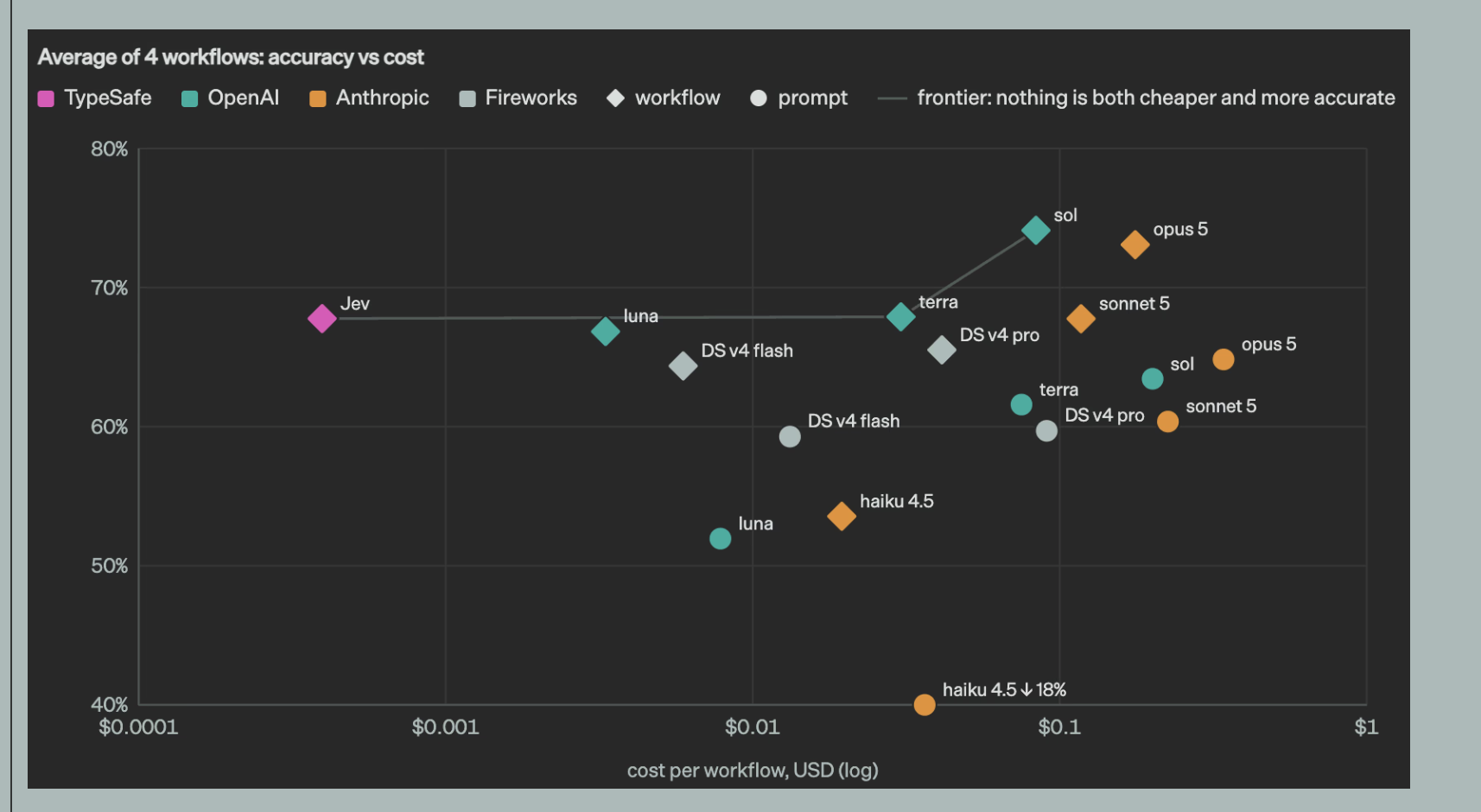
Jev AI Empirical Results & Generational Scaling
Verified release visuals published by Inception Labs comparing Mercury 3 against GPT-6 Luna and Claude Haiku 5.5.
Inference Latency & Generation Throughput
Empirical telemetry benchmarking generation throughput (Tokens/Second) and Time to First Token (TTFT).
Measured under concurrent production load
p95 latency: 85 ms
Across 25,000 monitored requests
Architectural Strengths vs. Operational Considerations
An objective technical balance sheet analyzing deployment advantages and production constraints.
Key Architectural Strengths
- Ultra-fast sub-50ms execution via parallel question evaluation, completely avoiding autoregressive token-by-token latency.
- Disruptive economics: $0.042 per million input tokens ($42/billion) with zero output token fees, enabling millions of daily agent control checks.
- Rigorously calibrated probability distributions across discrete choice sets (up to 255 options) and binary conditions (noul).
- Deterministic typed JSON outputs eliminate downstream regex and JSON repair parsing failures.
- Dual-tier context architecture handling states up to 64k tokens (and up to 262k in long-context mode).
Operational Considerations
- Purely discriminative: cannot produce free-form natural language generation, summaries, or chat dialogue.
- Questions must be defined with explicit types (choice, score, or noul).
Hardware & Execution Parameters
Genealogical Provenance
TypeSafe AI's flagship System One model, named after 19th-century economist William Stanley Jevons (Jevons Paradox).
typesafe jev 1 13
Jev AI
Architecture Engineering & Capability Deep-Dive
Topology & Attention Mechanics
Jev is engineered around a non-autoregressive discriminative architecture that processes a shared state buffer and evaluates multiple typed questions concurrently. Instead of sampling token by token from a vocabulary of 100k+ logits, Jev uses targeted classification heads that project directly onto defined schema bounds.
Evaluation Profile & Reasoning Capabilities
Optimized for fast cognitive System 1 reactions—answering 'Is this safe?', 'Which department should handle this?', or 'How severe is this bug?' with rigorous confidence calibration.
Inference Economics & Cost Optimization
At $0.042 per 1M inputs and $0 output costs, running 1,000,000 decisions costs less than a single nickel ($0.042).
Primary Production Workloads & Suitability
Cloud Deployment Architecture & Hardware Sizing
Cloud Deployment Architecture
Distributed enterprise serving infrastructure, autoscaling semantics, and runtime execution profile.
Proprietary commercial model hosted on managed multi-region clusters with automatic autoscaling, high availability, and prompt prefix caching.
Multi-Tenant Cloud API
Continuous autoscaling with regional failover
0 GB Local VRAM
Inference executed on hyperscaler accelerator clusters
65.536k tokens
Supported with automated KV cache prefix compression
SDK Installation
Official Repositories & Papers
Compare Showdowns
Jev AI vs OpenAI Decisions
Compare Jev AI against OpenAI Decisions's verified benchmarks, context window, and pricing.
Jev AI vs Mercury 3
Compare Jev AI against Mercury 3's verified benchmarks, context window, and pricing.
Jev AI vs GPT-6 Luna
Compare Jev AI against GPT-6 Luna's verified benchmarks, context window, and pricing.
Jev AI vs Claude Opus 4
Compare Jev AI against Claude Opus 4's verified benchmarks, context window, and pricing.
Commercial Token Rates & Cost Estimator
$0.04 / 1M
Standard prompt context ingestion
$0.00 / 1M
Generated completion & thinking tokens
$0.01 / 1M
Re-used prompt prefix context
Monthly Production Cost Simulator
$4.38
Includes prompt caching
-$1.92
Saved via prefix context caching
Comparable Foundation Architectures
Alternative foundation models with comparable intelligence benchmarks, context windows, and deployment profiles.
OpenAI Decisions
OpenAI Decisions is OpenAI's dedicated high-throughput decision-making API powered by GPT-6 Luna, accessed via the POST /v1/decisions endpoint. Designed for agent routing, automated content moderation, and classification, it processes typed questions (predicates, categorical choices, and rubric scores) roughly 10x faster than standard generation, billed at $0.10 per million input tokens with zero output-token fees.
Mercury 3
Mercury 3 is Inception's frontier diffusion large language model (dLLM) co-founded by Stanford Professor Stefano Ermon, delivering an unprecedented 1,068 tokens per second inference speed via parallel denoising across a native 1-million-token context window.
GPT-6 Luna
Ultra-fast low-latency frontier model in the GPT-6 generation, streaming at 130+ tps across a 1-million-token context window at $0.20/$0.80 economics.
Claude Opus 4
Claude Opus 4 is Anthropic's flagship frontier reasoning model for the Claude 4 generation, featuring an advanced hybrid test-time reasoning engine, 200k context window, and breakthrough scores on graduate-level STEM and multi-step deduction.
SDK Installation & API Integration
// TypeScript: Call Jev AI via TypeSafe System One API
const response = await fetch("https://api.typesafe.ai/v1/systemone", {
  method: "POST",
  headers: {
    "Authorization": `Bearer ${process.env.TYPESAFE_API_KEY}`,
    "Content-Type": "application/json",
  },
  body: JSON.stringify({
    model: "jev-latest",
    state: "Customer states: 'I was charged twice on invoice #9021 and need an immediate refund.'",
    questions: {
      is_urgent: {
        type: "noul",
        instructions: "The customer conveys high urgency or distress."
      },
      department: {
        type: "choice",
        choices: ["billing", "technical_support", "sales", "general_inquiry"]
      },
      severity: {
        type: "score",
        scale: [1, 5],
        instructions: "Financial dispute severity from 1 (minor) to 5 (critical)"
      }
    }
  }),
});

const decision = await response.json();
console.log(decision.answers);Frequently Asked Questions about Jev AI
Engineering specifications, VRAM sizing, commercial licensing terms, token economics, and empirical benchmark evaluations.
Jev is a 'System One' decision model developed by TypeSafe AI. Unlike generative models like GPT-4 or Claude that produce conversational prose word-by-word, Jev evaluates a state payload (text or JSON) against typed questions (choices, scores, and binary conditions) and returns structured probabilities. It does not generate text; it acts as an intelligent, high-speed programmatic conditional branch.
Jev supports three primary response shapes: 'choice' (picks from a defined set of up to 255 discrete options with probability distributions), 'score' (evaluates an input against ordered numeric thresholds or rubrics), and 'noul' (computes a calibrated yes/no probability for a specific condition).